Delhi-NCR's stricter no-PUC, no-fuel rollout began on 1 Oct 2026, but first-day reporting indicates that the experience at petrol pumps varied: automated number-plate checks were active at locations visited by reporters, while on-ground enforcement staff were not consistently visible. For motorists, the immediate takeaway is practical: a lapsed Pollution Under Control (PUC) certificate can delay or stop refuelling, so the certificate should be checked before setting out.
Key takeaways
- CAQM Direction No. 101, dated 15 May 2026, set 1 Oct 2026 as the effective date for restricting fuel to vehicles without a valid PUCC across the National Capital Region.
- Delhi's reported campaign covers about 500 fuel stations equipped with Automatic Number Plate Recognition (ANPR) systems.
- NDTV and The Times of India found scanners, database checks or announcements working at the pumps they visited, but no visible deployment of government enforcement staff at those locations.
- The New Indian Express reported long queues, certificate checks and a rush at PUC centres at several stations, showing that the rollout was not uniform across the city.
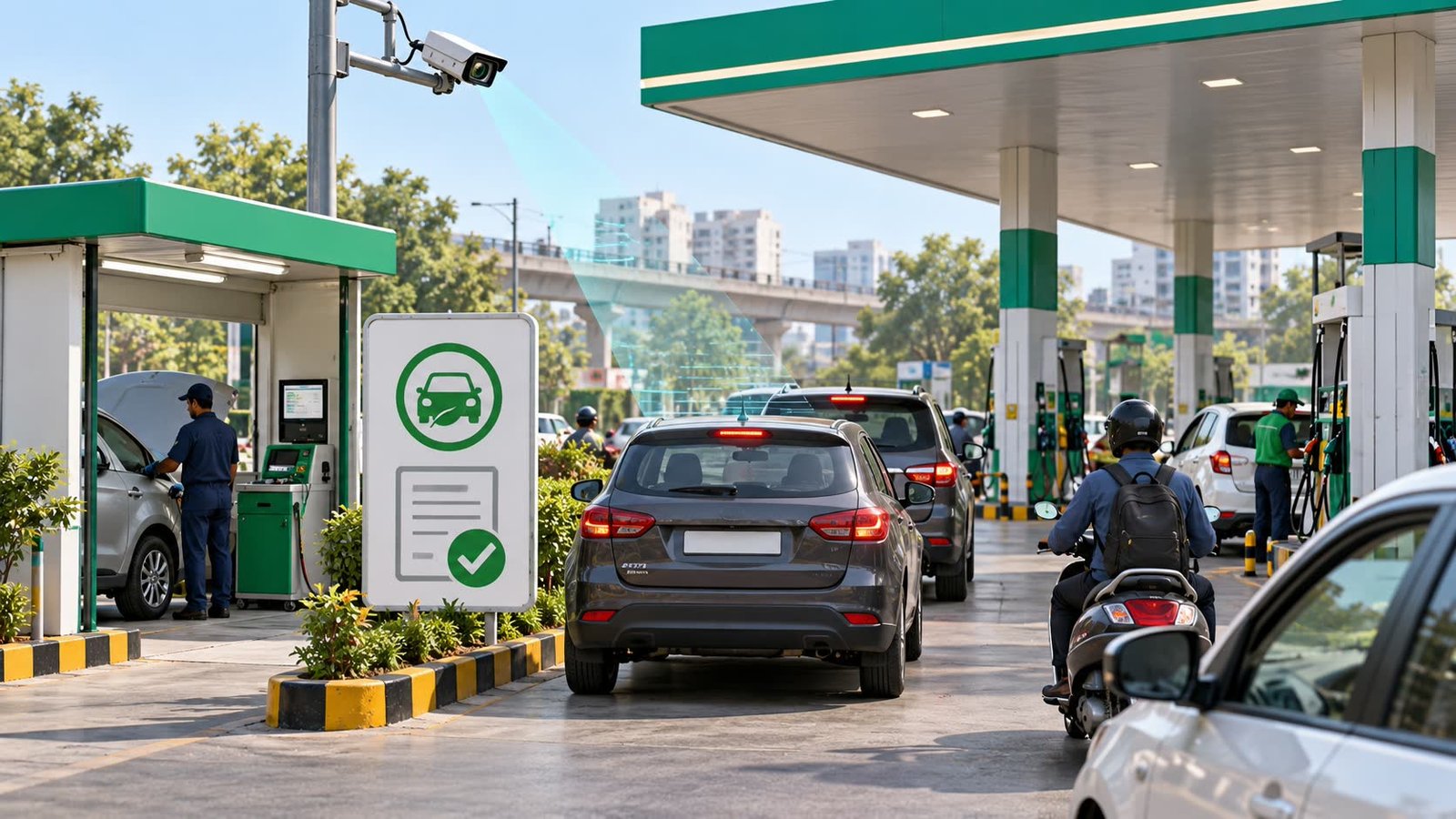
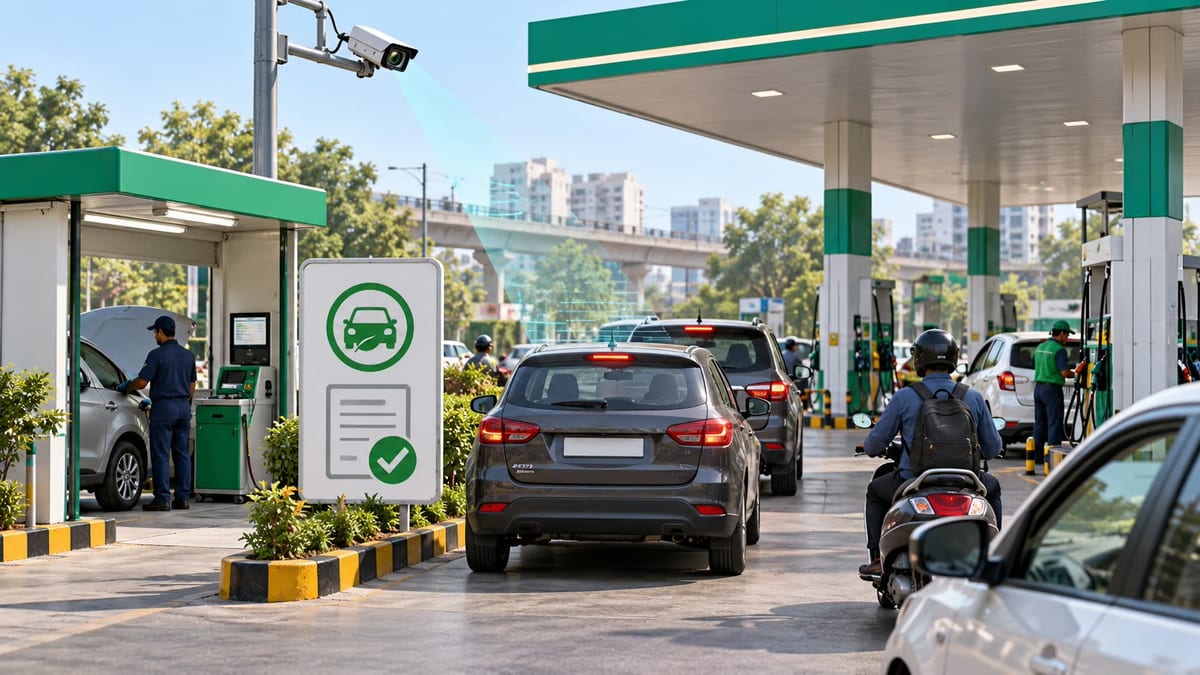 Illustrative image generated for FuelPrice; it is not a photograph of a specific petrol pump.
What changed on 1 Oct
The rule comes from the Commission for Air Quality Management's Direction No. 101, issued on 15 May 2026. It directs that fuel should not be dispensed in the NCR to a vehicle identified as not having a valid Pollution Under Control Certificate (PUCC) through ANPR, another technology-enabled system or a prescribed enforcement mechanism.
Delhi's implementation has been described as a mission-mode campaign at around 500 ANPR-equipped fuel stations. The system checks a vehicle's registration against government records when it arrives, so the issue is not a change in the listed petrol or diesel rate. It is a condition attached to access to fuel. Drivers who want to separate the compliance question from the price question can check live petrol, diesel and CNG prices before leaving.
This is a follow-up to FuelPrice's earlier explainer on the Delhi-NCR enforcement start. The new development is what motorists and pump operators saw when the rule moved from an announced date to on-ground checks.
What day-one checks found
NDTV's report from Janpath and Mayur Vihar Phase 1 said ANPR cameras were scanning number plates, automated warnings were playing and PUC centres were open. At the pumps it visited, however, no Transport Department enforcement team was present. Petrol dealers told the outlet that staff were being left to refuse fuel when the system flagged a vehicle, a situation that can create arguments at busy outlets.
NDTV also reported that some motorists saw long queues at PUC centres, trouble with plate reading and delays between an on-site test and the central record being updated. That matters because a driver can complete a test but still face a verification problem if the result has not yet appeared in the database.
The Times of India's ground check at pumps in central Delhi similarly found staff relying on existing scanners, CCTV and announcements rather than a visible special deployment of marshals. Staff told the newspaper that vehicles without valid certificates were being asked to renew them before refuelling, while the timing of a scanner alert could sometimes lag behind the moment fuel was dispensed.
The New Indian Express described a different experience at several stations: long queues formed, enforcement teams checked certificates and vehicle owners rushed to renew PUCs. Its report said two-wheeler riders were also being asked to show valid certificates before refuelling. These accounts are not necessarily contradictory; they reflect different pumps, times and levels of staff presence. Together, they point to a rollout that was active but uneven on its first day.
What motorists should check now
Check the certificate before the fuel stop
A driver planning a commute or a longer NCR trip should verify that the vehicle's PUC certificate is valid before arriving at a station. A recent renewal should also be allowed time to appear in the government-linked record, particularly if the certificate was obtained at a busy pump. Keeping the certificate details available can make it easier to resolve a mismatch without holding up the queue.
For a journey where a delayed fuel stop could disrupt the schedule, the FuelPrice fuel-cost calculator can help estimate the trip's fuel requirement separately from the compliance check. The calculator cannot replace a valid PUC, but it can make the expected fuel need clearer before departure.
Expect local variation while systems settle
The official direction is NCR-wide, but the day-one reports suggest that the visible process may differ from one station to another. Some motorists may hear an automated warning and be directed to a PUC centre; others may encounter staff checks or a queue. Drivers should not treat the absence of a marshal at one station as proof that the rule has been suspended elsewhere.
For pump operators, the reports raise a practical implementation question: who handles a disagreement when a system flags a vehicle but the driver says the certificate is valid? The Delhi Petrol Dealers Association told NDTV that government enforcement personnel would reduce confrontations between motorists and pump staff. Consistent instructions, timely database updates and clear escalation channels will determine whether the rule reduces pollution without creating avoidable delays at fuel stations.
What to watch next
The next useful signals will be whether Delhi publishes clearer station-level guidance, whether the NCR states report consistent enforcement, and how quickly renewed PUC records become visible to the fuel-station systems. The first-day reports also make it important to distinguish a functioning camera from a fully staffed enforcement process: they are related parts of the rollout, but they are not the same thing.
For now, the reader takeaway is simple. The no-PUC, no-fuel condition is in force across the NCR from 1 Oct 2026, while the first field reports show that implementation is still settling. Check the certificate before refuelling, allow extra time if a renewal is needed and treat the pump's automated warning or staff instruction as a compliance issue rather than a petrol-price change.
Sources
- Commission for Air Quality Management, “Direction No-101 dt 15.05.2026 – Imposing restriction on fueling of vehicles without valid PUCC in NCR”, 15 May 2026
- NDTV, “Delhi's 'No PUC, No Fuel' Day 1: Cameras On, But No Officials At Pumps”, 2 Oct 2026
- The New Indian Express, “‘No PUC, No Fuel’ rule causes chaos in Delhi”, 2 Oct 2026
- The Times of India, “No marshals this time, pumps rely on scanners for PUCC check”, 1 Oct 2026