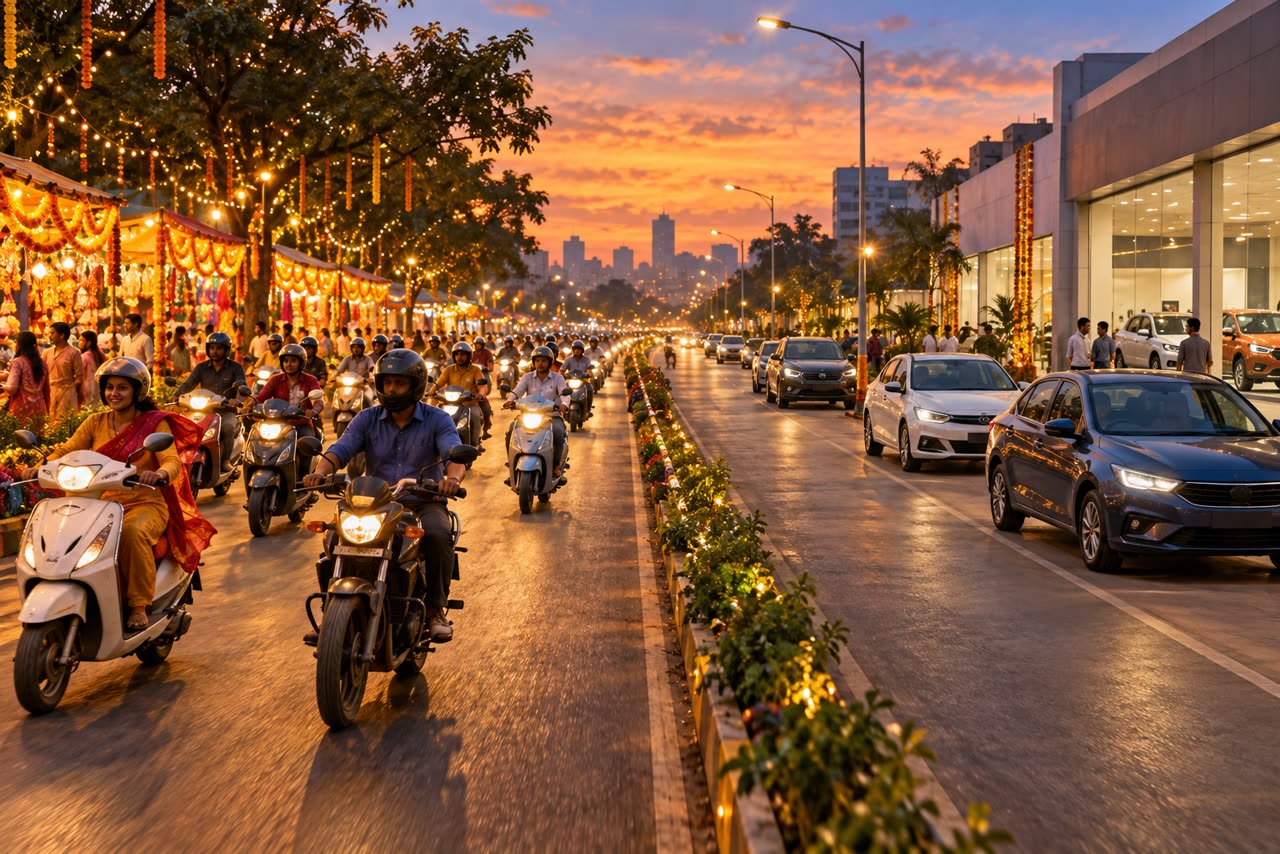
India's festive vehicle market is splitting by segment. A Jefferies report cited by The Economic Times and Business Today on 26 Oct 2026 said two-wheeler registrations rose 16% year on year in the first 14 days of the festive season, while passenger-vehicle registrations fell 6%; separate Nuvama coverage in Financial Express and LiveMint used an 11–23 Oct 2026 window and found a 13% rise in two-wheelers and a 9% fall in passenger vehicles. The different cut-offs matter, so the figures should not be combined into one official final number.
Key takeaways
- Jefferies' 26 Oct 2026 reading showed two-wheeler registrations up 16% and passenger vehicles down 6% over the first 14 festive days.
- Nuvama's analysis of registrations from 11–23 Oct 2026 showed two-wheelers up 13% and passenger vehicles down 9%.
- Both reports describe a divergence between stronger two-wheeler momentum and softer passenger-vehicle demand, but they use different periods and methods.
- The comparison is affected by last year's GST-led demand base, supply constraints, waiting periods and uneven regional demand.
What the two reports found
| Report and date | Period covered | Two-wheelers | Passenger vehicles | Other signal |
|---|---|---|---|---|
| Jefferies, reported by The Economic Times and Business Today on 26 Oct 2026 | First 14 days of the festive season | Registrations up 16% year on year | Registrations down 6% year on year | Truck registrations up 76%; tractors up 21% |
| Nuvama, reported by Financial Express and LiveMint on 26 Oct 2026 | 11–23 Oct 2026 | Registrations up 13% year on year | Registrations down 9% to 2,43,022 from 2,68,153 | Cargo commercial vehicles up 21%; three-wheelers up 8% |
The headline direction is similar, but the percentages are not interchangeable. Jefferies' report describes a first-14-day comparison, while the Nuvama figures published by Financial Express cover registrations from 11 to 23 Oct 2026. Registration data also captures retail activity at the vehicle-registration stage; it is not the same as factory wholesale dispatches.
Why the passenger-vehicle number needs context
The softer passenger-vehicle reading does not by itself prove that the car market has entered a broad or lasting contraction. The Jefferies report, as published on 26 Oct 2026, said passenger-vehicle registrations had still grown 7% year on year in the first seven festive days, while passenger-vehicle registrations and wholesales had grown 28–29% year on year in the first half of FY27, from April to September 2026.
Financial Express' Nuvama report also pointed to the comparison base created by last year's GST changes. It said dealer checks in Madhya Pradesh, Bihar and Jharkhand indicated slower growth, and identified patchy rural demand, long waiting periods and supply constraints as factors affecting the festive numbers. That makes the latest data a snapshot of timing, availability and demand together, rather than a clean test of buyers' willingness to purchase every type of car.
For buyers, this is the useful distinction: a registration slowdown for the overall passenger-vehicle category does not tell you whether a particular model is in stock, has a waiting period or is being offered with a scheme. Those details remain model- and city-specific. The data also does not establish that a buyer will receive a discount or that a dealer will reduce a quoted price.
What the two-wheeler strength means
Two-wheelers are showing a stronger festive registration trend in both brokerages' reports, although the pace varies from 13% to 16% depending on the window. Jefferies also said two-wheeler registrations grew 22% year on year and wholesales rose 17% in April–September 2026. That provides a stronger first-half backdrop than the latest passenger-vehicle comparison, but it still does not predict the result for every motorcycle or scooter brand.
For an individual buyer, the market signal is most useful when paired with practical ownership numbers. A motorcycle or scooter with a lower purchase price can still have different fuel, service, insurance and financing costs from another model. The monthly bike running-cost guide can help structure that comparison, while the fuel-cost calculator can estimate a planned trip or monthly usage from distance and mileage assumptions.
What it means for the auto industry
The divergence matters for manufacturers, dealers and component suppliers because it points to different inventory and production questions across segments. Passenger-vehicle makers have to read registrations alongside waiting periods and supply availability; two-wheeler makers need to see whether the stronger festive pace holds through the remaining buying window. The truck and tractor increases in the Jefferies report also point to a separate commercial and rural-demand cycle, but the report itself cautioned that the truck comparison benefited partly from a weak year-ago base and that tractor demand could face pressure later in FY27.
Earlier first-half data already showed strong two-wheeler volume, but the new festive reading is a materially different checkpoint. FuelPrice's earlier report on India's two-wheeler sales in the first half of FY27 covers that broader April–September period; it should not be treated as a substitute for the newer festive registration window.
What buyers should watch next
The next reports should clarify whether passenger-vehicle registrations recover as the festive season progresses and whether two-wheeler growth remains above the previous year's base. Readers should check the period covered, whether the figures are registrations or wholesales, and whether the comparison is year on year or against a two-year baseline before drawing a conclusion.
For a vehicle budget, the live fuel-price pages provide the current petrol, diesel and CNG reference points; they are separate from the registration data and should not be treated as a forecast of future fuel prices. The practical takeaway is to compare the actual model's availability, running cost and total ownership terms with the data window, rather than reading one brokerage percentage as a promise about the next purchase.
Sources
- The Economic Times — “India's festive auto sales show mixed trends; two-wheelers outperform passenger vehicles: Jefferies” — 26 Oct 2026.
- Business Today — “Festive auto sales 2026: two-wheeler registrations jump 16%, passenger vehicles decline 6%” — 26 Oct 2026.
- Financial Express — “Navratri vehicle sales seen falling 9% due to GST-driven pent-up demand last year” — 26 Oct 2026.
- LiveMint — “Best auto stocks to buy ahead of Diwali 2026: Nuvama bets big on Eicher Motors, Hyundai and Tata Motors PV” — 26 Oct 2026.