Ashok Leyland said during its 16 Nov 2026 Q2 FY27 earnings call that the freight cost to move trucks and buses from its factories to dealers had risen by more than 50% per vehicle over the previous year. For Indian transporters and truck buyers, the disclosure points to a distribution-cost squeeze linked to diesel movements and carrier demand, but it does not announce a 50% increase in any vehicle’s retail price.
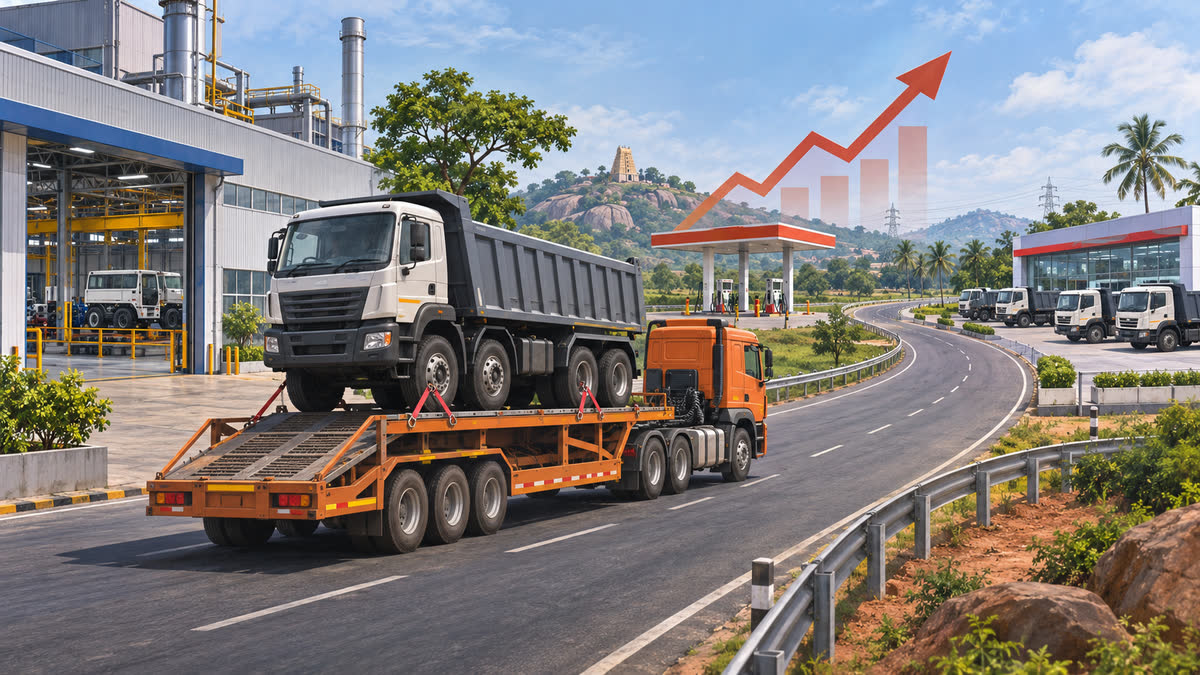
Illustrative image: an editorial artwork showing a generic commercial vehicle moving from a factory to a dealership; it is not an official Ashok Leyland product photograph.
Key takeaways
- The disclosed increase applies to Ashok Leyland’s factory-to-dealer freight cost per commercial vehicle, not automatically to the retail price of a truck or bus.
- The company’s CFO linked freight-rate revisions to diesel price movements and demand from transport operators; this is not a published nationwide freight tariff.
- Ashok Leyland’s official 14 Nov 2026 Q2 release reported 64,677 commercial-vehicle sales, up 32% year on year, and revenue of ₹13,364 crore, up 39%.
- For fleet operators, the immediate checks are diesel, route tolls, freight-rate terms and vehicle-delivery charges rather than treating the disclosure as a direct purchase-price change.
What Ashok Leyland disclosed
During the earnings call on 16 Nov 2026, managing director and chief executive Shenu Agarwal said the percentage cost of transporting trucks and buses from factories to dealers had increased by more than 50% per vehicle over roughly one year. The disclosure was about the company’s outbound distribution leg: it covers finished vehicles moving to the dealer network, not the cost of carrying goods for a customer.
The company’s chief financial officer, K.M. Balaji, said the business had accepted freight-rate revisions from transport contractors. He attributed the pressure to diesel price movements and demand from transport operators. Autocar Professional’s report on the call said carrier-capacity demand was also part of the cost pressure, while an Investing.com transcript carried the same management disclosure.
That distinction matters for readers. A higher factory-to-dealer freight bill can affect an automaker’s expenses and the timing of price recovery, but it is not evidence that every truck or bus in India has become 50% more expensive. Any effect on a buyer’s quotation would depend on the model, dispatch distance, delivery arrangement and how the manufacturer or dealer accounts for logistics.
The Q2 context: strong volumes, higher cost pressure
Ashok Leyland’s official results release dated 14 Nov 2026 showed commercial-vehicle volumes of 64,677 units in the July–September 2026 quarter, compared with 49,116 units in the same quarter a year earlier. The company said revenue rose to ₹13,364 crore from ₹9,588 crore, while EBITDA was ₹1,350 crore and EBITDA margin was 10.1%, against 12.1% a year earlier.
The numbers show why the freight disclosure is relevant even though sales were strong. More vehicles moving through the distribution network can lift revenue and improve factory utilisation, but the cost of moving those finished vehicles can rise at the same time. In the call, management described the demand environment as robust while acknowledging that commodity, fuel and logistics costs were weighing on the profit-and-loss account.
What it means for transporters
For fleet operators, the management comment is a signal to keep the freight-rate component visible when reviewing route economics. Ashok Leyland said higher freight rates in the market can support the commercial-vehicle industry because they improve the earning environment for transport operators. That is the company’s assessment of market conditions, not a guarantee that every route, contract or operator will see the same improvement.
Diesel is one of the cost inputs specifically named on the call. A transporter estimating a route can use the fuel cost calculator to test a typical distance, mileage and vehicle load assumption. Because diesel prices vary by location and can change over time, the result should be checked against the latest fuel-price reference for the relevant city or state.
Freight economics also include tolls, waiting time, maintenance, tyres, finance and driver costs. The toll-charge calculator can be used separately for a planned corridor so the road-cost component is not hidden inside a broad per-trip estimate. The Ashok Leyland disclosure itself does not quantify a diesel surcharge, toll increase or route-wise freight rate.
What it means for truck and bus buyers
A buyer reading a quotation should separate the ex-showroom price from registration, insurance, taxes and any delivery or handling line. The more-than-50% figure should not be multiplied by the price of a new vehicle: it refers to the manufacturer’s own freight cost per vehicle over the past year. A dealer may structure delivery charges differently, and the disclosure does not establish a standard charge for all dealers.
The practical question is whether manufacturers can recover higher distribution and input costs through vehicle pricing without weakening demand. Ashok Leyland management said there is a timing gap between inflation and passing price increases through to the market. That suggests buyers and fleet operators should watch actual model-level price lists and quotations, rather than infer a retail change from the freight percentage alone.
What to watch next
- Q3 cost recovery: the company’s next results and management commentary should show whether freight and commodity pressure is being absorbed, recovered through prices or offset by operating leverage.
- Freight-rate movement: sustained carrier demand could support transport rates, but contract terms and route competition will determine how much reaches individual operators.
- Distribution choices: manufacturers may continue reviewing dispatch routes, carrier capacity and the mix between road and other modes where practical, but no new Ashok Leyland route policy was announced in this disclosure.
- Vehicle quotations: any retail effect should appear in dated, model-specific price lists or dealer quotations, not in a blanket interpretation of the 50% logistics figure.
Reader takeaway
Ashok Leyland’s disclosure is an early warning about the cost of moving commercial vehicles through India’s distribution chain. It also reflects a wider tension: strong freight demand can support transport operators while diesel-linked carrier rates make it more expensive for manufacturers to deliver new trucks and buses. For readers, the useful next step is to model fuel and toll costs separately, then check the actual vehicle and delivery charges relevant to the route and model being considered.
Sources
- Ashok Leyland, “Ashok Leyland Delivers Robust Q2 Performance with Record Volumes, Revenue and Profit”, 14 Nov 2026
- Autocar Professional, “Outbound Freight Inflation Bites: Ashok Leyland’s Factory-to-Dealer Logistics Surges Over 50%”, 16 Nov 2026
- Investing.com, “Earnings call transcript: Ashok Leyland posts Q2 2026 revenue beat as margin pressure lingers”, 16 Nov 2026
- Stock Analysis, “Ashok Leyland (NSE:ASHOKLEY) Q2 2027 Earnings Call Transcript & Audio”, 16 Nov 2026