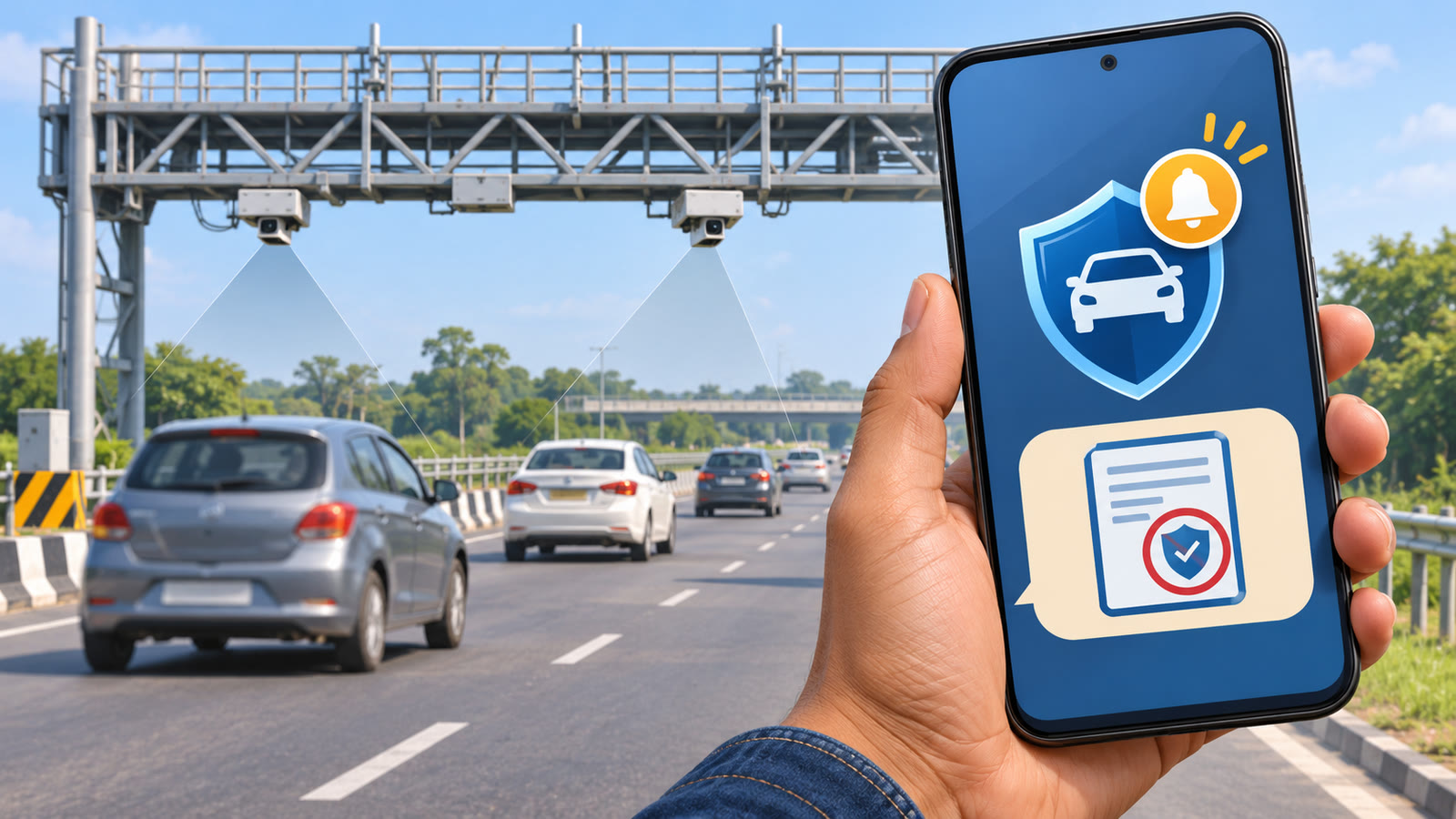
NHAI has reportedly begun a pilot at Delhi's Mundka toll plaza that checks a vehicle's insurance status through the VAHAN database and sends an SMS when mandatory third-party cover has expired or is missing. The immediate value for an owner is a prompt to verify the policy before another trip, while the reported trial is still not a nationwide rollout or a new insurance product.
ETAuto, citing an official, reported on 17 Nov 2026 that the pilot is running at Mundka on Urban Extension Road-II (UER-II) in Delhi. The report says the system can alert an owner within minutes of a National Highway toll-plaza crossing and is expected to be extended to more locations after stabilisation.
Key takeaways
- The reported trial is at Mundka toll plaza on UER-II in Delhi, not yet every NHAI plaza.
- The check uses a toll-plaza vehicle record and the VAHAN database to verify insurance validity.
- The reported SMS can include the registration number, crossing time and policy expiry date.
- Third-party motor insurance remains the legally required base cover; own-damage and other covers are separate policy choices.
- Owners can check the expiry date, the policy details and the mobile number linked to the vehicle before relying on an alert.
What the new pilot does
According to the ET report, a vehicle passing the plaza is matched against the VAHAN database hosted by the National Informatics Centre. If the policy is recorded as expired or the vehicle has no valid third-party insurance, the system sends an SMS advising the owner to address the lapse. The message is described as an alert rather than a toll demand, and the report does not say that every vehicle will be stopped at the plaza.
The details matter because an owner may know that a policy was purchased at some point without noticing that the term has ended. A short message after a highway crossing could expose that gap sooner than a claim, a police check or an accident would. It may also help an owner identify a mismatch between an insurer's current records and the vehicle information held in VAHAN.
The word pilot is important. The reported trial is intended to stabilise the process, and the report says it will be expanded across the country soon, but it does not give a plaza-by-plaza rollout list or a national start date. Owners should therefore treat the message as a compliance prompt, not assume that the absence of an SMS means a vehicle is covered.
How this fits into India's digital enforcement push
There are two related but separate digital systems. In an 18 Mar 2026 release, NHAI described an electronic notice framework for unpaid toll: electronic toll records can be linked with VAHAN, and notices can be delivered through SMS, email or an app. That release concerns toll payment compliance, not the new insurance-status alert reported from Mundka.
The insurance check follows a wider policy direction. In its 4 Aug 2026 judgment in National Insurance Company Limited vs Smt. Thungala Dhana Laxmi, the Supreme Court recorded that the Ministry of Road Transport and Highways had started e-detection of uninsured vehicles in seven states: Odisha, West Bengal, Rajasthan, Gujarat, Himachal Pradesh, Chhattisgarh and Uttarakhand. The judgment also directed integration of automatic number-plate recognition cameras with Insurance Information Bureau and VAHAN data for automatic action against uninsured vehicles.
The same judgment said nearly 56% of vehicles plying on Indian roads remained uninsured, citing a government report. Its recorded figure was 16.54 crore uninsured vehicles out of 30.48 crore vehicles, based on the government answer cited by the Court. Those figures are dated context from the judgment, not a live count of today's uninsured vehicles.
Section 146 of the Motor Vehicles Act requires a policy covering third-party risks before a vehicle is used in a public place. The Supreme Court's judgment describes third-party-only cover as the mandatory base policy, while comprehensive cover, personal-accident cover and own-damage cover address different risks. The new pilot is therefore aimed at checking the minimum statutory cover, not at deciding which optional cover a customer should buy.
What vehicle owners should check now
1. Check the actual policy expiry date
Open the latest policy document or insurer confirmation and note the end date of the third-party section. A comprehensive policy may contain several cover components with different terms, so an owner should match the vehicle registration number and the relevant third-party validity rather than rely on an old payment receipt. FuelPrice's car insurance policy date and renewal checklist is useful for organising those details.
2. Check the vehicle record and mobile number
The reported workflow depends on a vehicle record being matched to VAHAN. If ownership, registration or contact details have changed, an owner can verify the information through official Parivahan and insurer channels. A wrong or inactive mobile number can mean that a valid warning never reaches the person using the vehicle.
3. Treat a message as a prompt to verify
Do not share an OTP, card information or payment details through an unexpected link. Compare the vehicle number and expiry date in the message with the policy and the official vehicle record. If they conflict, contact the insurer and use the official transport portal rather than assuming that the SMS alone is conclusive.
4. Check documents before a long trip
For a family trip or a commercial run, insurance is only one part of the paperwork. The road-trip document checklist covers the other records drivers commonly need to confirm, including registration, PUC and FASTag-related details. Earlier VAHAN alerts about lapsed insurance and PUC are also covered in FuelPrice's previous explainer.
What changes for drivers and fleet operators
For a private driver, the immediate change is visibility: an insurance lapse may be surfaced shortly after a toll crossing instead of only when the policy is needed. The reported alert does not announce a change to toll rates, FASTag balances or insurance premiums. It also does not establish that a message will be issued at every plaza from 17 Nov 2026.
For a fleet operator, the larger issue is process control. A business with many cars, taxis or goods vehicles may need a reliable renewal calendar and a way to reconcile insurer records with vehicle records. That is especially relevant when vehicles change hands, move between states or have policies renewed through different intermediaries. A toll-plaza alert can be an additional check, but it should not replace a fleet's own document review.
Confirmed, reported and still to watch
- Reported on 17 Nov 2026: NHAI's pilot at Delhi's Mundka toll plaza checks insurance through VAHAN and can send an alert after a crossing.
- Confirmed in law: third-party motor insurance is the mandatory base cover under Section 146 of the Motor Vehicles Act.
- Already directed by the Supreme Court: technology-led insurance-status verification and pilot projects involving automatic detection at toll points.
- Still unspecified: the national rollout date, the full list of participating plazas and the precise enforcement action, if any, that may follow an alert.
The practical takeaway is simple: do not wait for a toll-plaza SMS to discover an expired policy. Keep the policy dates and vehicle details aligned, verify any warning through official channels, and treat the reported NHAI pilot as an additional compliance signal while its wider rollout is clarified.
This article is for general information only and is not financial, insurance or legal advice.
Sources
- ETAuto / Times of India — NHAI to send SMS alerts to vehicle owners with expired insurance at toll plazas — 17 Nov 2026
- Supreme Court of India — National Insurance Company Limited vs Smt. Thungala Dhana Laxmi, 2026 INSC 793 — 4 Aug 2026
- NHAI — National Highways Fee Rules, 2026 Amended to Strengthen Toll Compliance and Digital Enforcement — 18 Mar 2026
- India Code — The Motor Vehicles Act, 1988, Sections 146 and 196 — accessed 17 Nov 2026