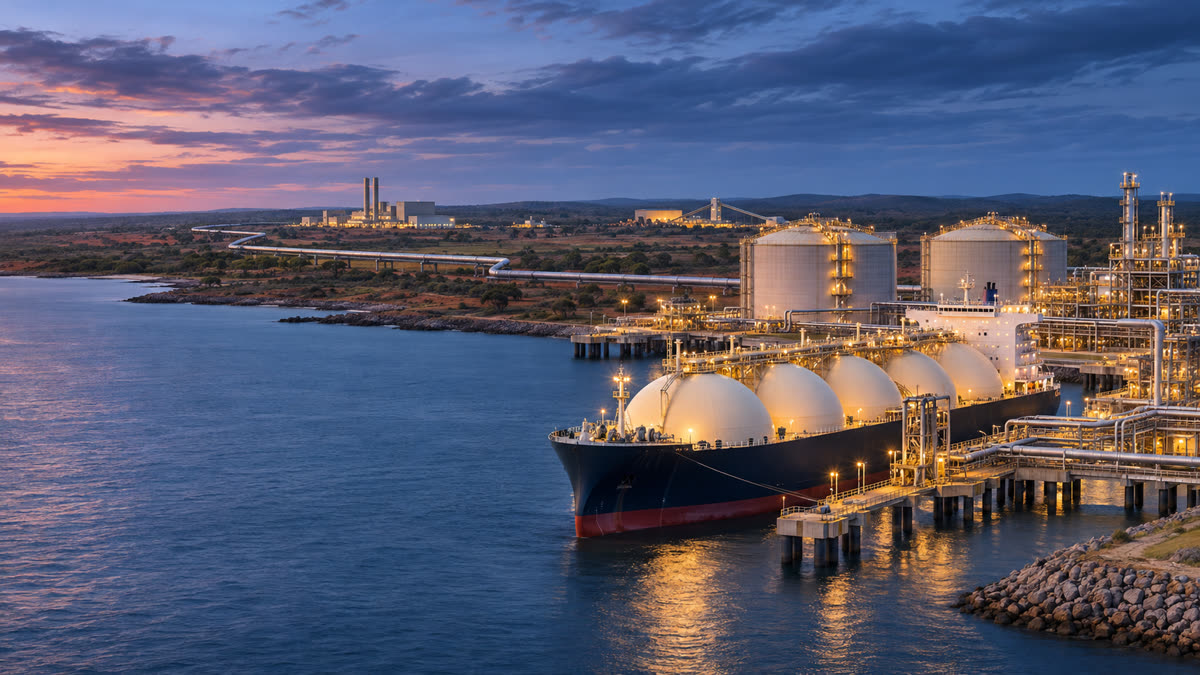
Australia’s Parliament has passed a domestic-gas reservation scheme that can require liquefied natural gas (LNG) exporters to supply up to 20% of their annual export volumes to the Australian market. The law matters beyond Australia because the country’s LNG export system is a major source of supply for Asia-Pacific buyers, while the domestic obligation changes how some gas is allocated before it reaches an export terminal.
The Australian government says the legislation passed on 27 November 2026, with the export-licensing framework intended to start on 1 January 2027 and the domestic-supply obligation applying from 1 January 2028. The immediate result is a new legal framework; it is not an instant 20% cut to every LNG cargo or a guarantee of lower wholesale prices.
Key takeaways
- Australia passed its Domestic Gas Reservation Scheme in Parliament on 27 November 2026, according to the government and ABC News.
- LNG exporters may be required to supply up to 20% of their annual export volumes to Australian users.
- Export licences are intended to begin on 1 January 2027; the domestic-supply obligation starts on 1 January 2028.
- Western Australia retains its existing reservation arrangement, ABC News reports, while the federal scheme focuses on a nationally consistent framework.
- The law does not set a fixed retail or wholesale gas price, so any saving for households or industry will depend on supply, demand and implementation.
What Australia’s new law does
The Department of Industry, Science and Resources says the scheme requires gas exporters to hold an export licence. A key condition of that licence is a domestic supply obligation, calculated on an annual basis and set at up to 20% of the licence holder’s export volumes.
The wording “up to” is important. It establishes a ceiling for the obligation rather than saying that exactly one-fifth of all gas must be removed from export schedules in every year. The practical volume will depend on the way the Australian Energy Regulator (AER) administers the scheme, the domestic market’s requirements and the terms of exporters’ supply arrangements.
| Milestone | What it means | Source status |
|---|---|---|
| 27 November 2026 | The legal framework passed Parliament. | Confirmed by Australia’s industry department and ministers. |
| 1 January 2027 | The export-licensing framework is intended to start. | Government implementation date. |
| 1 January 2028 | Domestic-supply obligations are intended to apply. | Government implementation date; ABC also reports the new requirements take effect in 2028. |
Why the policy matters to LNG markets
Australia’s reform is aimed first at its own households, manufacturers and power users. The government says reserving gas at home should improve reliability and put downward pressure on domestic prices. ABC News reports that the scheme followed years of concern about east-coast gas prices and supply, and that the opposition raised concerns about whether the design could discourage investment in new gas projects.
For international buyers, the key question is how the new obligation interacts with existing export contracts and future spot cargoes. Reuters reporting carried by The Japan Times said the legislation would require LNG exporters to set aside up to a fifth of production for the domestic market from 2028. That does not establish a quantified reduction in Australia’s exports, but it gives buyers and traders another policy variable to monitor when assessing Asia-Pacific supply.
The policy therefore creates two competing effects. A domestic reserve can improve Australia’s buffer against price spikes and shortfalls, while a tighter export allocation could reduce flexibility for some cargoes if the domestic market needs more gas. The final market effect is expected, not confirmed: it will depend on the AER’s administration, local demand and how exporters adjust their portfolios.
What it means for prices and drivers
The law is about natural gas, not a direct change to petrol or diesel taxes. A driver filling a car will not see an automatic pump-price change on 1 January 2028 because of this scheme. Road-fuel prices are shaped mainly by crude benchmarks, refinery margins, freight, exchange rates and local taxes, while gas prices affect electricity generation, industrial production and some heavy transport fuels through different supply chains.
There can still be indirect effects. Gas is used by manufacturers that produce materials, chemicals, fertiliser, glass and steel. If more predictable domestic gas lowers the volatility of those inputs, it may help some Australian businesses plan energy costs. If the policy reduces export flexibility or raises the cost of attracting new supply, the effect could move in the other direction. Neither outcome is guaranteed by the legislation itself.
For fleet operators, the useful distinction is between an international energy-policy headline and the local cost of a journey. A fleet budget should use the current price where vehicles refuel and the vehicles’ actual consumption. FuelPrice’s fuel-cost calculator can estimate the fuel component of a trip, while the live fuel-price pages help readers compare the local number rather than substituting an LNG or crude benchmark.
Implementation is the next market test
The government’s joint release says the export-licensing framework is intended to commence on 1 January 2027, followed by the domestic-supply obligation on 1 January 2028 to align with industry contracting cycles. The AER is named as the administrator, with ministerial decisions informed by the regulator, the Australian Energy Market Operator and other agencies.
Several details will matter to exporters and buyers: how annual obligations are measured, how existing contracts are treated, how much gas is required in each domestic market and how the “up to 20%” ceiling is applied when demand changes. Those are implementation questions, so claims about a specific future export shortfall or a guaranteed household saving would go beyond what the confirmed legislation establishes.
ABC News says Western Australia will retain its own gas reservation policy under the political agreement that allowed the national bill to pass. That regional distinction is relevant to international companies because the federal framework will not operate identically across every Australian gas market.
What global energy users should watch
For the next year, the main watchpoints are the start of export licensing, the AER’s operating rules and the first annual domestic-supply decisions. LNG buyers will also watch whether exporters change spot-market availability, contract terms or investment plans in response to the obligation. Those are reported or expected consequences to monitor, not outcomes that have already happened.
The practical takeaway is that Australia has moved from a proposed reservation policy to a confirmed legal framework, but the market impact will arrive through implementation rather than through an immediate change at petrol pumps. Readers following international fuel and energy developments can keep track of the wider market through worldwide fuel news, then check local prices and trip costs for decisions that affect their own vehicles.
Sources
- Australian Department of Industry, Science and Resources, “Domestic Gas Reservation Scheme,” updated 27 Nov 2026.
- Australian ministers, “Joint media release: Australian gas reserved for Australians,” 27 Nov 2026.
- ABC News, “Australia’s domestic gas reservation scheme passes parliament with Coalition backing,” 26 Nov 2026.
- The Japan Times, “Australia clears law requiring LNG exporters to keep 20% for domestic use,” Reuters report, 27 Nov 2026.
- Australian Competition and Consumer Commission, “Gas Inquiry June 2026 Interim Report,” June 2026.
This article is for general information only and is not financial, insurance or legal advice.