Bangchak Corporation has shut all production units at its Phra Khanong refinery in Bangkok after a fire on 26 Nov 2026 injured nine personnel. The 120,000-barrel-a-day facility will not restart until Thai authorities are satisfied that the cause, equipment and nearby storage are safe, making the incident a regional refined-fuel supply story even though officials say Thailand's overall supply is not expected to be affected.
Key takeaways
- The fire began at about 2:45 p.m. local time on 26 Nov 2026 and was brought under control within 30 minutes.
- Nine personnel were injured; Thailand's government said two had returned home by its 27 Nov update.
- Bangchak's preliminary finding placed the fire in a hydrocracking unit, while the energy minister said it did not reach the oil or gas storage tanks.
- The refinery has a maximum capacity of 120,000 barrels per day; Bangchak's two refineries together have about 300,000 barrels-per-day capacity.
What happened at the Bangkok refinery
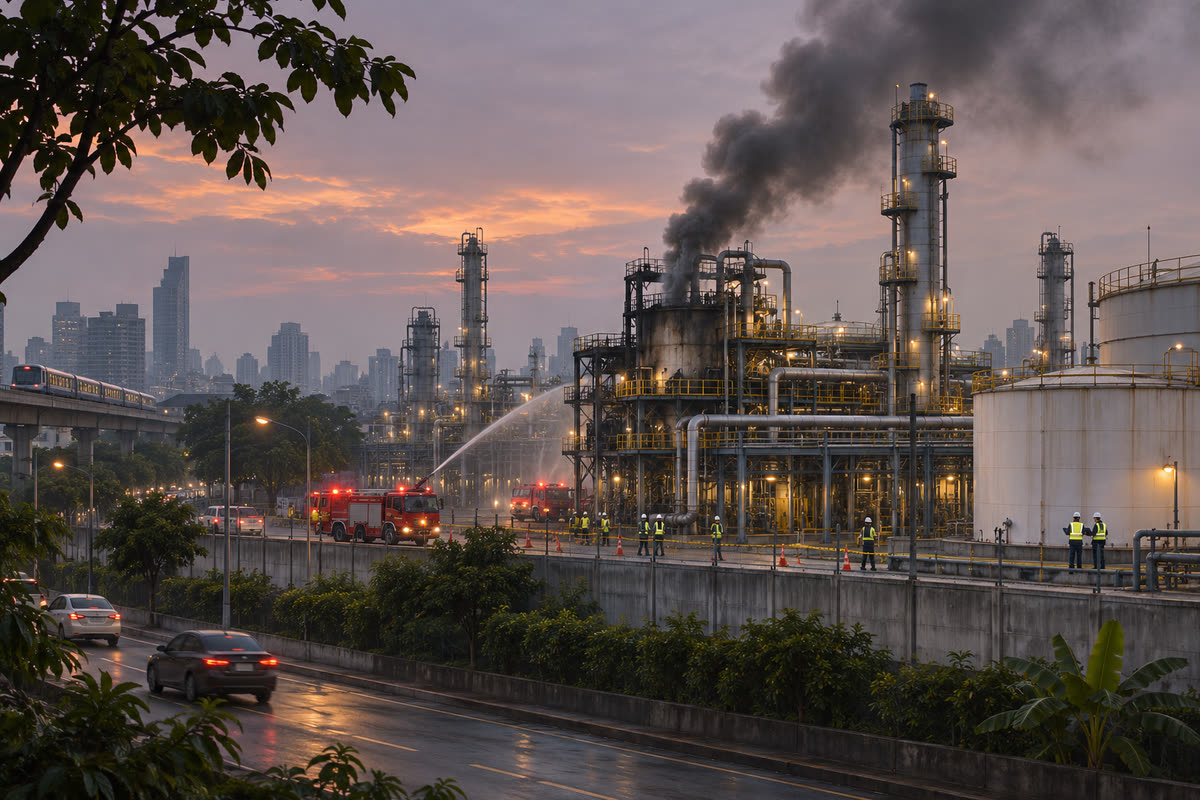
Bangchak's official disclosure said the fire started at approximately 2:45 p.m. on 26 Nov and was fully extinguished by 3:15 p.m. The company immediately shut all production units as a safety precaution. Reuters, in a report carried by Channel NewsAsia, said the incident was under investigation and confirmed the site's maximum processing capacity at 120,000 barrels per day.
The preliminary descriptions identify the affected area as a hydrocracking unit. Thailand's government update also quoted Energy Minister Akanat Promphan as saying the fire was at distillation Unit 4 and had not spread to the oil or gas storage tanks. Those descriptions are not a final technical finding: the cause and equipment damage remain under investigation, and the government has ordered inspections before any restart.
Bangchak said nine personnel were injured, with two later returning home. The Associated Press reported that the incident briefly prompted nearby residents to leave and that officials later allowed them to return while advising people within 5 kilometres to take precautions against smoke. The government said air-quality monitoring was continuing.
Why the shutdown matters for fuel markets
Phra Khanong is not Thailand's largest refinery, but a prolonged outage would still remove a meaningful amount of local processing capacity. Reuters reported that Bangchak's two refineries have combined capacity of about 300,000 barrels per day. On that company-level nameplate comparison, the Bangkok site represents roughly 40% of Bangchak's total refining capacity.
That figure should not be read as a 120,000-barrel-per-day loss from global oil supply. A refinery outage primarily reduces crude processing and the production of refined products; it does not automatically remove the same volume of crude from international trade. The practical questions for fuel users and traders are how long the unit stays offline, whether stocks cover the gap, and whether Thailand needs additional product imports.
Bangchak's preliminary reference to hydrocracking is relevant because that kind of unit upgrades heavier refinery streams into lighter products, including diesel-range fuels. If repairs take longer than expected, the effect could be more visible in product availability and regional diesel buying than in crude benchmarks. This is an implication to watch, not a confirmed market outcome. Officials told AP that Thailand's overall oil supply should not be affected because other refineries remain available.
For drivers outside Thailand, the event is best understood as a regional resilience test rather than a confirmed global price shock. Anyone comparing current pump prices can use FuelPrice's fuel-prices tracker, while a trip-specific estimate can be checked with the fuel-cost calculator.
What changes now
Bangchak has not announced a restart date. The Industry and Energy ministries are assessing the refinery, its storage systems and any repairs or safety improvements required. Thailand's government said the refinery will not be allowed to reopen until the cause is established, the storage systems are confirmed safe and officials are satisfied that the incident cannot recur.
That creates three checkpoints for the next update:
- Damage assessment: whether the hydrocracking or distillation equipment can return after inspection, or needs a longer repair.
- Product balance: whether Bangchak can meet customer commitments from its other refinery, inventories or imports while Phra Khanong is offline.
- Regulatory clearance: whether authorities approve a restart and under what conditions.
Air monitoring is also part of the immediate response. The Thai government said tests around the site showed normal readings, while monitoring continued and residents within 5 kilometres were advised to take precautions. Those findings address the immediate public-safety response; they do not resolve the refinery's operational timetable.
What to watch next
The most useful signal will be Bangchak's next official update on the cause, equipment damage and the expected duration of the shutdown. A short, contained outage would mainly affect one company's output planning. A longer closure would make regional fuel imports, diesel availability and delivery costs more important for transport operators and motorists in Thailand and nearby markets.
FuelPrice will continue to track verified worldwide developments through its worldwide fuel-news section. Until a restart date or a quantified supply response is confirmed, the responsible reading is that Bangkok has a significant refinery offline, but there is no verified evidence yet of a global crude-market disruption from this incident alone.
Sources
- Bangchak Corporation, “Clarification on the Fire Incident at the Bangchak Phra Khanong Refinery”, 26 Nov 2026
- Thailand.go.th, “Update: Bangchak Refinery Fire, Phra Khanong, Bangkok (As of 27 Nov. 10.00 A.M.)”, 27 Nov 2026
- Reuters via Channel NewsAsia, “Thailand's Bangchak shuts all units at Bangkok refinery after fire, says 9 workers injured”, 26 Nov 2026
- The Associated Press, “At least 9 injured by large explosion and fire at major oil facility in Bangkok”, 26 Nov 2026
This article is for general information only and is not financial, insurance or legal advice.