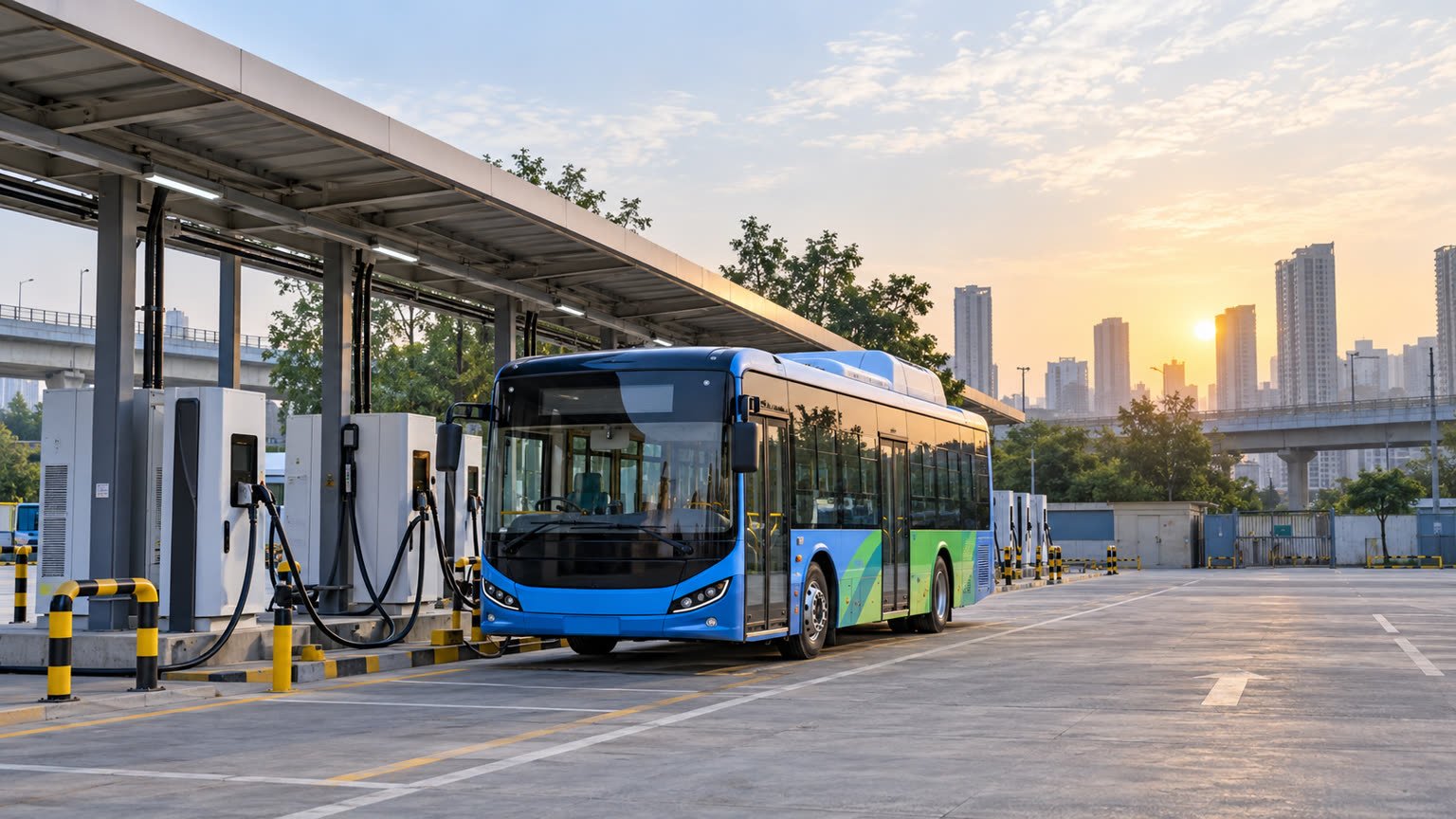
Delhi plans to add 150 electric buses and five high-capacity public EV charging stations, Transport Minister Pankaj Singh said on 12 October 2026. The announcement is relevant to commuters and EV users, but it does not yet set a launch date, bus routes, fares or charging tariffs.
Key takeaways
- Delhi plans 150 new zero-emission electric buses.
- Five high-capacity public charging stations are named at Swami Vivekanand ISBT Anand Vihar and four DTC depots.
- The stated electric-bus fleet would rise to 5,238 within an overall fleet of 6,988 buses, including 1,750 CNG buses.
- No route allocation, passenger fare change, station tariff or commissioning date has been announced.
What Delhi announced
Reports by ThePrint, carrying PTI, and UNI described the same ministerial statement on 12 October. The plan covers 150 new electric buses and five charging stations that the Delhi government says will be launched soon by Chief Minister Rekha Gupta.
The locations named are Swami Vivekanand Inter-State Bus Terminus (ISBT) in Anand Vihar, plus DTC depots at Nand Nagri, Rohini Sector-37, Nangloi and Keshopur. That gives the announcement a public-transport focus: one site is an inter-state bus terminus and four are bus-depot locations.
The word planned matters here. The reports do not give a date for the launch, the routes on which the buses will run, or the operating rules for the charging stations. Until those details are released, the announcement should not be read as an immediate change to a commuter timetable or as proof that every site is already available for private EV charging.
Why the fleet number matters
On the figures in the ministerial statement, the planned electric fleet of 5,238 would represent roughly 75% of the stated 6,988-bus total. The remaining 1,750 buses are identified as CNG buses. This is a useful indicator of fleet composition, but it is not the same as saying that 75% of buses on every route will be electric.
For passengers, the practical effect will depend on where the 150 buses are assigned and whether they replace older buses or expand service. The statement does not specify either point. It does, however, project that the DTC fleet could grow to nearly 14,000 buses by financial year 2028–29, another stated target rather than a guaranteed delivery schedule.
What it means for commuters
More electric buses could increase zero-emission capacity on Delhi routes and reduce dependence on diesel or CNG for the journeys covered by them. It does not automatically mean lower fares, faster trips or a new route. No fare revision, free-ride announcement or route map accompanied the 12 October plan.
Commuters who use Anand Vihar ISBT or a DTC depot named in the announcement should wait for the official launch notice before changing their travel plans. The useful details to check will be the first operating date, route numbers, frequency, accessibility arrangements and whether any depot-area traffic restrictions apply during commissioning.
What it means for EV owners
The five locations may improve charging availability in important public-transport nodes, but the announcement does not publish the information a private EV owner needs to plan a charging stop: connector type, charging power, tariff, payment method, opening hours and access restrictions. Four sites are DTC depots, so public access should be confirmed rather than assumed.
When the stations are commissioned, owners can use the state-wise EV charging directory as one way to check whether a listing is live, then verify the operator details before travelling. A directory listing should not be treated as confirmation that a charger is available at that moment.
For a driver comparing a private-car commute with public transport, the fuel cost calculator can show the fuel component of the same journey. It does not include fares, parking, tolls or charging costs, so the result is a comparison input rather than a promise of savings. For longer journeys starting in Delhi, the road-trip planner can help map the route while station status and access rules are checked separately.
Central scheme context
The Union government’s March 2026 update provides useful context but does not establish that these 150 buses belong to one particular central scheme. The Ministry of Heavy Industries said Delhi had an allocation of 2,800 buses under PM E-DRIVE as of 10 March 2026, while no buses had yet been deployed under that scheme as of 12 March 2026.
That scheme-specific position should not be confused with Delhi’s overall electric-bus count in the October announcement. City fleets can include buses procured through different programmes and contracts. The immediate question for readers is therefore not which label is attached to the buses, but when the city publishes the launch, route and charging-access details.
What to watch next
- Launch date: the government has said the buses and stations will be launched soon, but has not given a public date in the reported statement.
- Route allocation: check whether the 150 buses add frequency, open routes or replace existing vehicles.
- Charging access: confirm connector standards, power, tariff, payment process and whether private vehicles can use each site.
- Fleet delivery: treat the 5,238 and nearly 14,000 figures as stated targets or projected totals until deployment is documented.
Reader questions
Will Delhi bus fares change?
No fare change was included in the 12 October announcement. Any revision would need a separate official notice.
Can private EV owners use the five new charging stations?
The stations were described as public, but the reports do not provide their opening hours, tariffs, connectors or access terms. Those details should be checked after commissioning and before making a charging trip.