Volvo Car India is evaluating plug-in hybrid models but says India’s current tax treatment makes them harder to price competitively. On 12 Oct 2026, the company also said it plans one battery-electric vehicle each year for the next three years, making the powertrain mix—and the tax treatment behind it—relevant to future Indian buyers.
Key takeaways
- Volvo India is evaluating plug-in hybrids, but it has not confirmed a PHEV launch, model or booking date for India.
- Volvo’s reported comparison puts battery EVs at 5% GST and larger plug-in hybrids at 40%, a 35-percentage-point gap under the current treatment.
- The company plans three new battery-electric models over the next three years, or one EV a year, according to its India managing director’s comments reported on 12 Oct 2026.
- Electric models account for about one-quarter of Volvo’s India sales, while mild-hybrid SUVs remain part of its current portfolio.
- The tax difference is not the same as a 35% reduction or increase in a car’s final on-road price; the invoice, registration, insurance and other charges still matter.
What Volvo India said
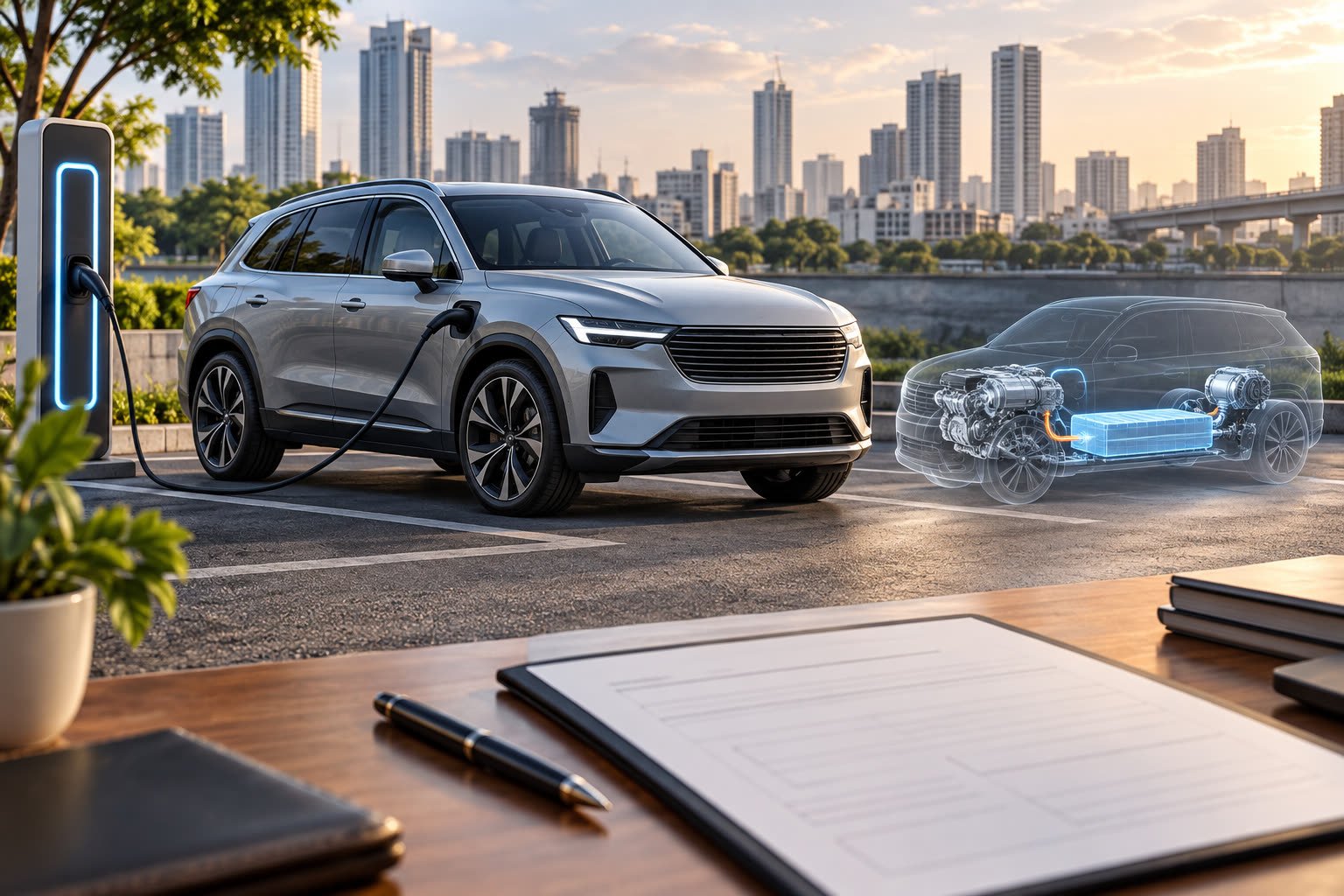
Volvo Car India managing director Jyoti Malhotra said the company is studying whether plug-in hybrids can work in India, but customer willingness to pay and the tax structure are central to that decision. Plug-in hybrids combine a petrol or diesel engine with a rechargeable battery and electric motor, so their price has to absorb both powertrain systems.
In separate reports dated 12 Oct 2026, ETAuto and Autocar Professional attributed the comments to Malhotra, made around the launch of the Volvo EX90. ETAuto reported that Volvo plans three new EV models over the next three years. Autocar Professional reported that a PHEV remains an option rather than a confirmed India programme. That distinction matters: the company has described a direction and an evaluation, not a launch commitment.
This is a material follow-up to FuelPrice’s earlier report on the Volvo EX90 India launch. The earlier story covers a confirmed electric-SUV launch; this update concerns the company’s wider product plan and the tax barrier it says is shaping the choice between battery EVs and plug-in hybrids.
Why the GST gap matters
India’s current GST framework gives battery-electric vehicles a concessional 5% rate. The Ministry of Finance’s GST FAQ, posted on 3 Sep 2025, says the revised rates took effect on 22 Sep 2025 and places mid-size and large cars at 40% GST without compensation cess. The same 5% EV treatment is also stated in a later government note on India’s EV market.
Volvo’s reported tax comparison applies that structure to the vehicles it is considering: 5% for a battery EV versus 40% for a larger plug-in hybrid. The 35-percentage-point difference is a tax-rate comparison, not a promise that a PHEV will cost exactly 35% more on the road. Vehicle classification, the pre-tax price, import or assembly costs, registration, insurance, road tax and dealer pricing all affect the final amount.
| Powertrain treatment | Rate used in the comparison | What it means |
|---|---|---|
| Battery EV | 5% GST | Concessional rate for electrically operated vehicles. |
| Larger PHEV | 40% GST | Rate Volvo said applies to plug-in hybrids above the small-car category. |
| Rate difference | 35 percentage points | Arithmetic difference between the two rates; not an on-road price forecast. |
For a simple illustration only, if the same hypothetical pre-GST value were ₹1,00,00,000, a 5% tax would be ₹5,00,000 and a 40% tax would be ₹40,00,000. The arithmetic gap would be ₹35,00,000 before other charges. That example is not a quote for a Volvo, a PHEV or any buyer; it shows why manufacturers view the tax classification as commercially important.
What the three-EV plan means for buyers
Volvo currently sells battery-electric models alongside mild-hybrid SUVs in India, and the company has said EVs make up roughly one in four of its India sales. A one-EV-a-year approach would keep adding electric choices without requiring Volvo to abandon its mild-hybrid range immediately. It also leaves open the possibility that future products arrive as battery EVs while PHEVs remain conditional on demand and economics.
For buyers, the useful information is what has not yet been announced. Volvo has not published the names, prices, battery sizes, range figures or launch dates for all three future EVs. A reported expectation that the ES90 sedan is next is not the same as a full India launch announcement, so it should be treated as expected until the company confirms the details.
The strategy also sits inside a supply-chain question. Volvo told reporters that imported kits have faced higher costs and longer lead times, and it indicated that a festival-season price increase may be approaching. No amount was announced, so buyers should not turn that comment into a forecast. It is a signal to compare a dated quotation, delivery timing and the terms attached to any booking.
How to compare EV and PHEV ownership
Tax is only one part of the ownership equation. A PHEV can use electric energy for suitable short trips and liquid fuel for longer journeys, while a battery EV depends on charging access and electricity cost. Real-world savings or costs depend on annual distance, charging behaviour, fuel prices, insurance, maintenance, financing and resale value.
For a route-level petrol or diesel benchmark, the FuelPrice fuel-cost calculator can model a trip using a stated distance, mileage and fuel rate. It is not a tax or purchase-price calculator, so the result should be kept separate from the showroom comparison.
EV buyers planning longer journeys can also check the state-wise EV charging directory before comparing a battery model with a PHEV. A listed charger does not guarantee availability, connector compatibility or a particular charging speed, but it helps identify the infrastructure question that a PHEV may avoid on some routes.
What to check before treating the plan as a buying signal
- Confirmed product: wait for the exact India model, powertrain, specification, price and booking terms. A three-year plan is not a delivery schedule.
- Tax classification: check the applicable rate on the dated tax invoice. The 5% versus 40% comparison depends on vehicle classification and should not be applied to every hybrid or every EV without checking the rules.
- Total price: separate ex-showroom price from GST, registration, insurance, road tax, accessories and finance costs. Compare the complete on-road figure for the same city.
- Charging and use: confirm home-charger feasibility, public charging access, expected trip distances and whether regular journeys suit electric driving.
- Delivery risk: ask how imported-kit availability, expected dispatch and price protection are handled if supply-chain conditions change before handover.
What happens next
The next meaningful update should be a named Volvo EV with a confirmed India launch window, specification and price. For a plug-in hybrid, the decision point is different: Volvo would need to establish that enough customers are willing to pay for the more complex powertrain after the current tax treatment is applied. Until then, the PHEV discussion is reported strategy, while the three-EV plan is a future product direction rather than a set of cars available to book.
For Indian buyers, the practical takeaway is to separate three questions: what the GST rules say today, what Volvo has actually confirmed, and what a specific vehicle will cost to own in a particular city. That keeps a company plan and a tax comparison useful without turning either into a promise of savings.
Sources
- ETAuto — “Volvo Cars India flags higher tax for plug-in hybrids, plans 3 EVs in next three years” — 12 Oct 2026
- Autocar Professional — “Volvo Studies Plug-In Hybrids for India, Remains Committed to EVs” — 12 Oct 2026
- Ministry of Finance / Press Information Bureau — “FAQs on the decisions of the 56th GST Council” — 3 Sep 2025
- Press Information Bureau — “Driving Forward: India’s EV Growth Outlook” — accessed 12 Oct 2026
This article is for general information only and is not financial, insurance or legal advice.