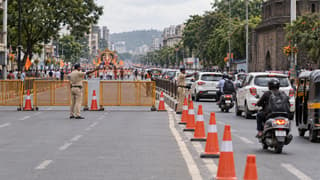
Delhi government has put on hold the implementation of its 14 Sep 2026 traffic-challan notification after objections from district-court lawyers. For motorists, the practical effect is that the proposed process—contesting a challan before a designated administrative authority and depositing 50% of the fine before going to court if the challenge fails—will not be implemented in Delhi for now.
Key takeaways
- The Delhi government has paused the local notification until objections are examined; it has not announced a restart date.
- The proposed process would have sent contested challans first to designated administrative authorities rather than directly to a court.
- Under the disputed mechanism, a driver would have had 45 days to contest a challan through the prescribed portal with supporting documents.
- If that challenge was rejected, the driver would have had to deposit 50% of the challan amount before approaching a competent court.
- The pause is about Delhi’s implementation. It should not be read as a nationwide cancellation of the central Rule 167 framework.
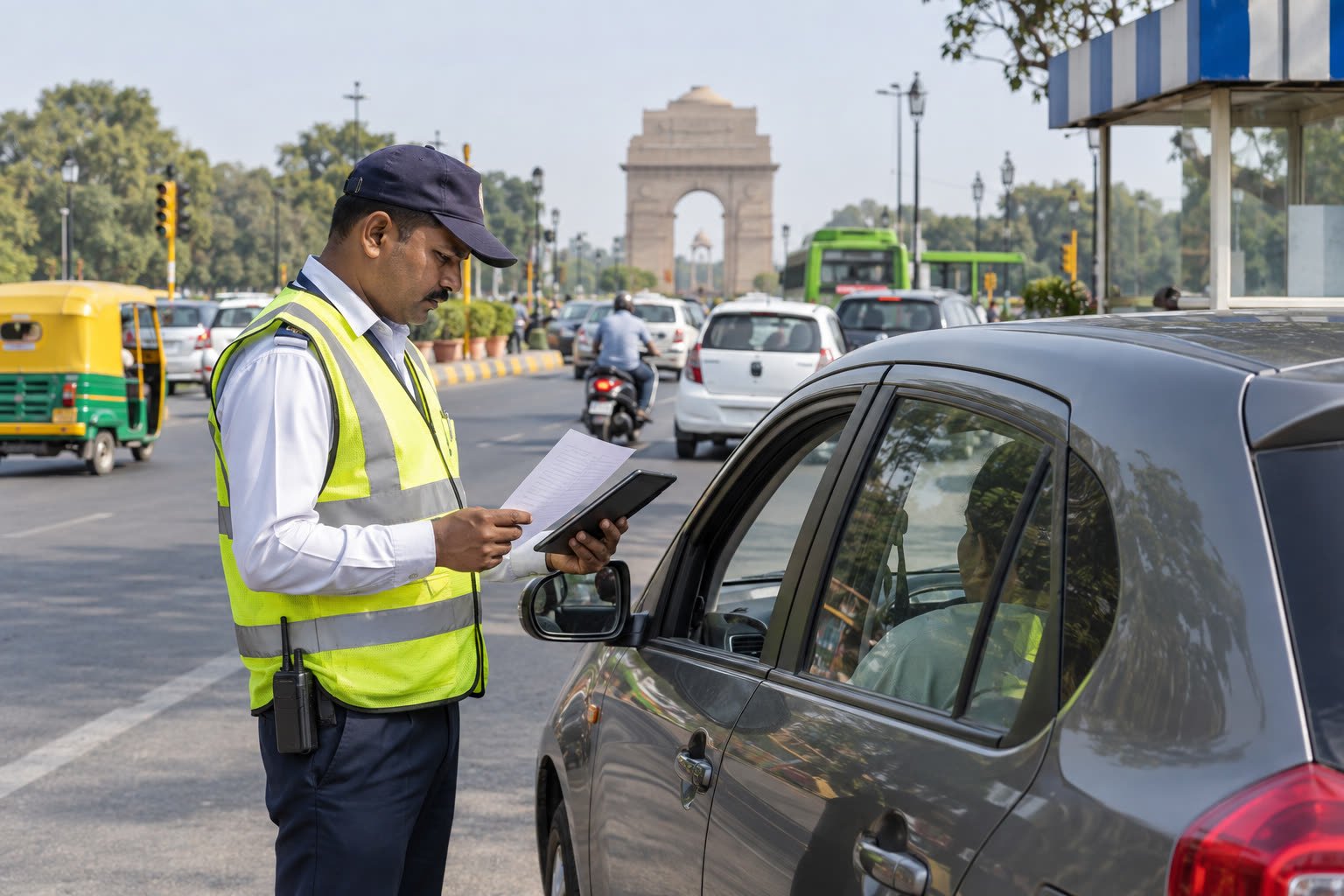
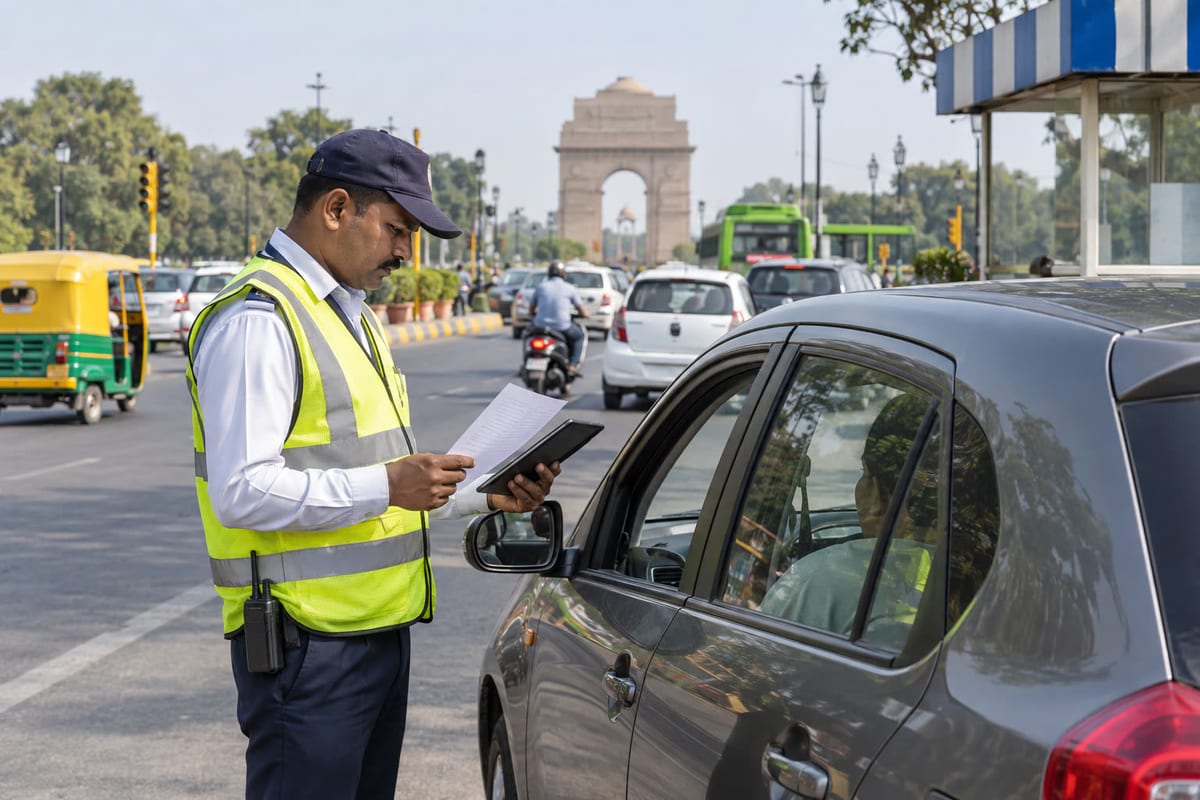 Credit: FuelPrice editorial illustration, AI-generated; no official notice or real enforcement encounter is depicted.
What Delhi has paused
Delhi’s transport authorities have been asked to stop implementing the notification issued on 14 Sep 2026. The pause followed objections from district-court lawyers, who argued that the new route would move an important part of challan adjudication from judicial forums to executive and departmental officers. The Indian Express and India Today reported that the decision followed a meeting involving the Chief Minister, the Law Minister and the Transport Minister.
Transport Minister Pankaj Kumar Singh said the concerns raised by the advocates would be examined. The government’s direction is therefore a hold for review, not a final statement that the mechanism has been withdrawn permanently. The proposed lawyers’ protest and court abstention scheduled around 24 Sep were suspended after the announcement, according to reports from The Indian Express and The Times of India.
What the notification would have changed
The Delhi Gazette notification designated officers from departments including Transport, Revenue, Food and Supplies, Education, Industries and Weights and Measures as authorities for redressal under Rule 167(5) of the Central Motor Vehicles Rules, 1989. It also named Sub-Divisional Magistrates and Additional District Magistrates as supervisory authorities. The notification said it would come into force when published in the Official Gazette.
The disputed procedure described in the reporting was separate from simply paying a fine. A person challenging a challan would first have to use the prescribed portal, submit documentary evidence and approach the authority specified by the state government within 45 days of the challan being issued. If the person did not contest the notice in that period, the challan would be treated as accepted.
The most contentious step was the proposed 50% pre-deposit. If the designated authority rejected the challenge, the person would have to deposit half of the challan amount before approaching the competent court. The figure is a condition of the challenged process, not a new fine, and the current Delhi implementation of that notification is on hold.
Why drivers should care
A challan dispute can involve more than the amount printed on the notice. A driver may need to preserve a receipt, explain a vehicle or identity mismatch, show that the vehicle was elsewhere, or contest an enforcement record that appears incomplete. The proposed process would have added a formal administrative stage before a court route and could have required a substantial payment even when the motorist still wanted to pursue the dispute.
The pause gives Delhi motorists an important status update: do not assume that the 14 Sep mechanism is currently being implemented merely because it was published. The government has said that the Transport Department will examine the representations and place the issue before the Chief Minister and Lieutenant Governor. Until a further direction is issued, the precise process for a contested challan should be checked against the current Delhi transport or e-challan instructions rather than inferred from reports about the paused notification.
Delhi-only pause, not a nationwide reset
The underlying central Rule 167 amendment and Delhi’s local designation notification are not the same thing. The Delhi Gazette concerns which authorities would handle redressal in the National Capital Territory. The announcement reported on 23 and 24 Sep concerns the implementation of that Delhi notification. It does not say that every state must stop using its own challan-dispute process, and it does not cancel the Central Motor Vehicles Rules across India.
This distinction matters for people who drive between states. A notice issued in Delhi and a notice issued elsewhere may be governed by different operational instructions or portals. A driver should therefore identify the issuing authority and the location of the alleged violation before deciding which process applies.
What this means for a Delhi trip
The paused notification concerns challan resolution, not a revision of toll fees or petrol and diesel pump prices. Someone planning a Delhi road journey still needs to budget for the route itself. The toll-charge calculator can help check highway fees, while the fuel-cost calculator can estimate the trip’s running cost. If the review leads to traffic diversions or delays later, the road-trip planner can help organise the route and stops.
That practical separation is useful: a rule dispute may affect how a driver responds to a notice, but it does not automatically change the cost of reaching Delhi or travelling through the capital. Drivers should also avoid making a special detour only to chase an assumed enforcement update; the fuel and time cost can outweigh the value of the information.
What happens next
The next decision belongs to the Delhi government after the Transport Department reviews the objections. It could retain the process, revise the notification, or withdraw it, but no such final outcome has been announced. The important confirmed position as of 24 Sep 2026 is narrower: the 14 Sep notification will not be implemented in Delhi for now.
For motorists, the sensible watchpoints are a fresh Transport Department order, a revised description of the authority that hears a challenge, and any clarification on whether a pre-deposit is required before court access. Until then, the 50% figure should be treated as part of the paused proposal, not as a blanket instruction to pay half of every disputed challan.
FuelPrice takeaway
Delhi has paused a new challan-dispute mechanism after lawyers objected to executive adjudication and the proposed 50% court pre-deposit. The pause is temporary and Delhi-specific, so it changes the immediate status for motorists in the capital without creating a nationwide rule cancellation. The next official Delhi notification will determine whether the process returns, is redesigned or is withdrawn.
Sources
- India Today — Delhi govt puts new traffic challan system on hold after lawyers oppose 50 per cent court deposit rule — 24 Sep 2026
- The Indian Express — Delhi lawyers call off protest march after government pauses controversial 50% traffic challan deposit rule — 23 Sep 2026
- The Times of India — Govt halts new challan system after talk with lawyers — 23 Sep 2026
- Government of NCT of Delhi Transport Department, Delhi Gazette — Designation of Authorities for Redressal under Rule of the Central Motor Vehicles Rules 1989 as amended vide GSR 48E — 14 Sep 2026
- Ministry of Road Transport and Highways — Final notification amending Rule 167 and Rule 167A — 20 Jan 2026