Union Heavy Industries Minister H D Kumaraswamy was reported on 9 Nov 2026 as saying he had seen government planning to raise petrol’s ethanol content from 20% to 30%. The remarks do not announce a rollout date or change what motorists should expect at pumps: official Ministry of Petroleum updates continue to describe E20 as the prescribed nationwide blend, while Karnataka’s fuel-testing dispute remains contested.
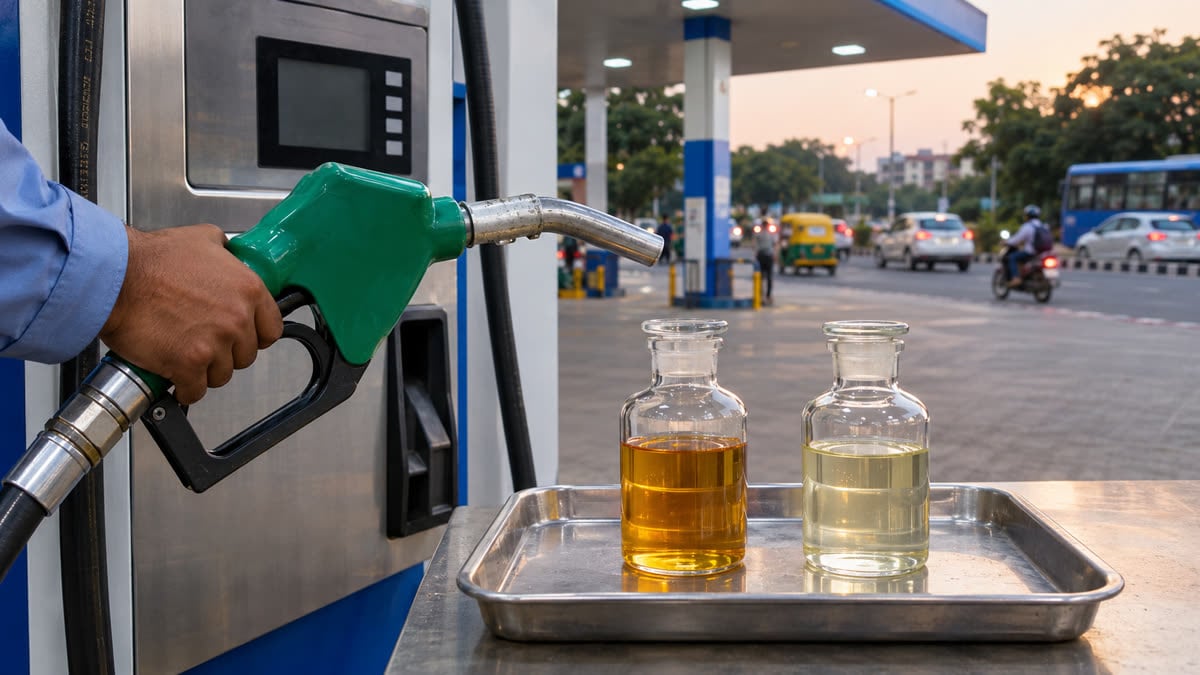
Illustrative image (AI-generated): a generic fuel dispenser and laboratory sample bottles; no specific petrol outlet or test is shown.
Key takeaways
- E30 is a reported discussion or proposal, not a confirmed nationwide fuel rollout.
- India Today and PTI, carried by The Week, reported the minister’s remarks on 9 Nov 2026; neither report announced an effective date or an instruction for oil companies to sell E30.
- A 7 Nov Ministry of Petroleum release said 893 E20 samples tested by public-sector oil companies across 27 states and Union territories met the prescribed range, while Karnataka’s separate findings remain disputed.
- Drivers can treat the current official position as unchanged, check the blend specified in vehicle documentation, and avoid assuming that a reported E30 plan has already changed pump fuel.
What the E30 remark means
India Today reported on 9 Nov that Kumaraswamy said he had seen the Central Government planning to increase ethanol blending in petrol from 20% to 30%. The report also made the important distinction that the comment referred to planning and did not establish that oil marketing companies had already implemented a 30% blend.
PTI’s report carried by The Week on the same date placed the remark in the middle of the Karnataka dispute. Karnataka Food and Civil Supplies Minister Rizwan Arshad referred to Kumaraswamy’s statement while questioning whether a higher blend could be introduced before it was formally announced as government policy. That is a reported political and policy exchange, not a gazetted change in fuel specifications.
For a driver, the practical meaning is simple: there is no new E30 date to put into a trip plan, vehicle budget or maintenance calendar based on these remarks alone. The reported comment may signal that higher blends are being considered, but a change that affects nationwide retail fuel would need a formal government decision, technical specifications and an implementation instruction to the fuel-supply chain.
The confirmed E20 position
The latest primary-source position available in this story is the Ministry of Petroleum and Natural Gas release published by the Press Information Bureau on 7 Nov 2026. It said petrol supplied by Indian Oil Corporation, Bharat Petroleum and Hindustan Petroleum conformed to the Bureau of Indian Standards specification for ethanol-blended motor gasoline, IS 17021.
The same release said 893 samples collected from public-sector oil company depots and retail outlets across 27 states and Union territories were tested under the prescribed method. It reported that all 893 samples fell within the 19–21% ethanol range. For Karnataka, it said 56 samples from different locations and all three public-sector oil companies recorded ethanol levels between 19% and 20%, with an average of 19.30%.
This is the Centre and public-sector oil companies’ quality-monitoring position. It does not erase the need to examine the competing Karnataka results, but it does mean a reported ministerial discussion is not the same thing as an official change to the blend sold nationwide. The ministry’s July 2026 update had also said that no decision had been taken to increase ethanol blending beyond 20% and that any future move would require scientific and technical studies and consultation with vehicle manufacturers, oil companies and research institutions.
FuelPrice’s live fuel prices page can help check the pump rate for a city or state. It cannot, by itself, verify the ethanol percentage in a particular sample, which is a separate fuel-quality question.
Why the Karnataka dispute still matters
Karnataka has presented a different set of findings. The state said it collected 63 petrol samples and sent them for testing after concerns about fuel sold at retail outlets. PTI and India Today reported that the state cited readings above the prescribed 20% blend, with the highest reported result at 31.2% in one sample.
The oil companies rejected the allegation and questioned the sampling and testing process. The Petroleum Ministry’s 7 Nov release said the companies had raised concerns about how samples were drawn, retained, tested and communicated. It also said the companies sought joint sampling and independent testing under the prescribed standards.
That leaves two claims that must not be blended into one headline: Karnataka’s reported laboratory results, and the OMCs’ official quality survey. Until a jointly verifiable test or an authoritative adjudication reconciles them, neither set of numbers should be presented as proof of the nationwide fuel blend. Our earlier report on the Centre’s 893-sample E20 findings explains the official testing position in more detail.
What changes for drivers today
There is no confirmed nationwide E30 rollout to act on today. A driver does not need to treat the minister’s remark as a new pump instruction, and there is no announced effective date in the reports reviewed for this article. The immediate information gap is fuel verification: what was sold at a particular outlet, how it was sampled, which method was used and whether the result was independently reproducible.
For a vehicle owner monitoring mileage or drivability, it is useful to separate three things: the vehicle’s approved fuel specification, the retail price paid, and the measured fuel economy over a consistent route. The official release says vehicle-specific effects should be assessed scientifically rather than assumed from a single disputed test. FuelPrice’s fuel-cost calculator can help compare a measured petrol cost over a known distance, but it cannot establish whether a fuel sample was E20 or E30.
If a driver believes a fuel-quality problem has occurred, the ministry says complaints can be raised through the outlet’s complaint register, the concerned oil company’s customer channels and the government’s grievance system. Keeping the date, outlet, fuel type and receipt details makes the report more useful; it does not by itself prove the ethanol percentage.
What to watch next
The next meaningful development would be a formal notification or government release that names the proposed blend, its technical standard, the vehicle-compatibility requirements and an effective date. A credible update should also explain whether the change applies to all petrol or only to fuel supplied for flex-fuel vehicles, and how testing and lab verification will work.
On the Karnataka side, the key evidence would be a joint inspection, access to retained samples, complete laboratory reports and a test conducted under the prescribed referee method with all parties represented. On the national side, the key question is whether the government moves from a reported discussion to a documented policy decision. Until then, E30 is a policy possibility being discussed in public, not a new fuel rule for every Indian motorist.
Reader takeaway
The 9 Nov remarks have reopened the debate over higher ethanol blending, but they have not changed the confirmed nationwide fuel position. Official updates continue to describe E20 as the prescribed blend and report compliant OMC quality checks, while Karnataka’s higher readings and the companies’ objections remain unresolved. Check confirmed notices and vehicle-specific documentation before treating any E30 claim as a change at the pump.
Sources
- India Today — E20 row: Karnataka stands by 31% ethanol claim, questions oil firms’ explanation (9 Nov 2026)
- The Week / PTI — Karnataka government stands by findings of excess ethanol blending in petrol (9 Nov 2026)
- Press Information Bureau, Ministry of Petroleum and Natural Gas — E20 Petrol Supplied by PSU Oil Marketing Companies Meets Prescribed Quality Standards (7 Nov 2026)
- Press Information Bureau, Ministry of Petroleum and Natural Gas — Government Highlights Safety, Performance and National Benefits of Ethanol-Blended Petrol (23 Jul 2026)
- The News Minute — E20 row: Karnataka defends sampling process, rejects objections by three oil marketing companies (9 Nov 2026)