Eicher Trucks & Buses launched Uptime NXT Services in India on 13 Oct 2026, adding connected-vehicle data, fuel advisory and AI-assisted service tools to its fleet-support setup. For truck and bus operators, the change is less about a new vehicle and more about using operating data to reduce avoidable downtime and make fuel and maintenance decisions with better visibility.
Key takeaways
- The Uptime NXT launch was announced by Eicher Trucks & Buses, a VE Commercial Vehicles business unit, on 13 Oct 2026.
- The service ecosystem combines an AI-enabled Uptime Centre, a generative-AI Service One platform for technicians and an Uptime Control Tower for service monitoring.
- Its listed functions include fuel advisory, driver scorecards, vehicle-operation insights, immobiliser support and proactive service interventions.
- Eicher said on 13 Oct 2026 that the My Eicher platform supported more than 200,000 customers and connected over 460,000 vehicles.
- The announcement does not publish a guaranteed fuel saving, a standard subscription fee or a universal repair-response time for every fleet.
What Eicher has launched
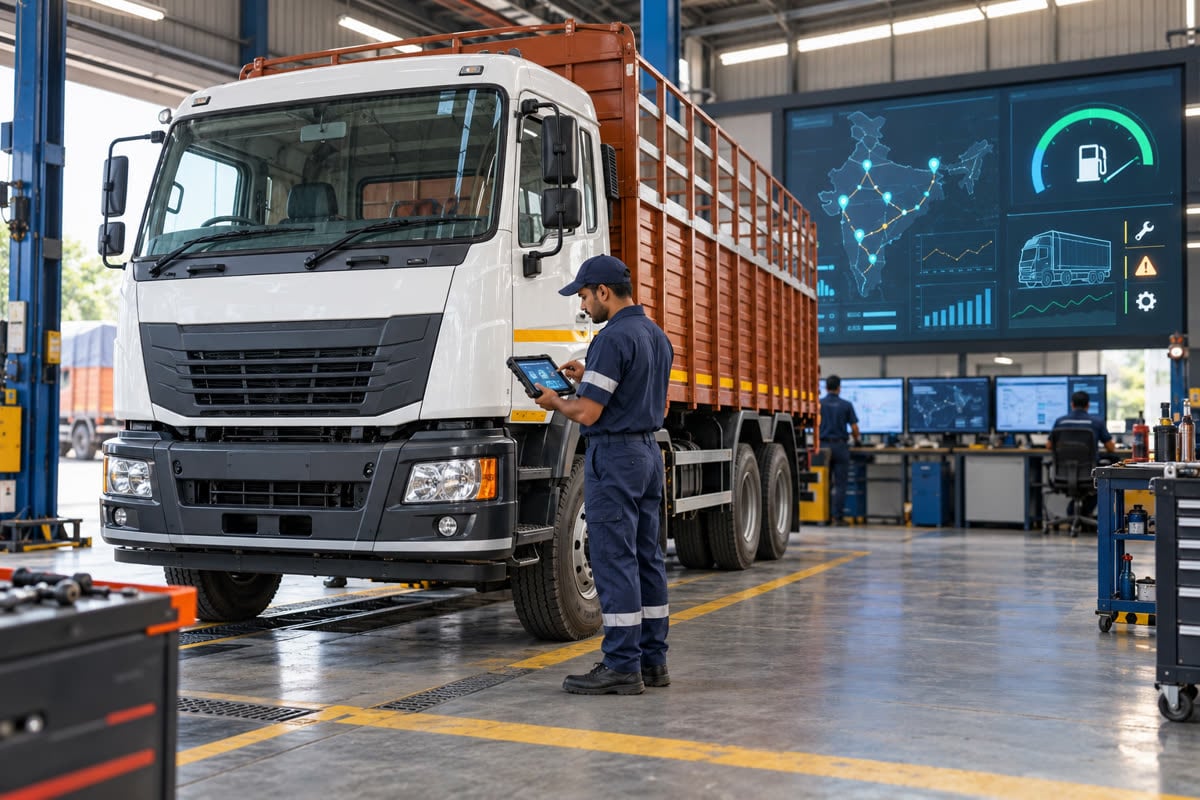
Uptime NXT is a service and data layer around commercial-vehicle ownership, not a new truck or bus model. Eicher says the system brings customers, technicians, engineers and technical experts together through an AI-enabled Uptime Centre so that vehicle information and service information can be used in the same workflow.
The company’s official release describes the move as a shift towards more proactive support. ETAuto’s independent report on 13 Oct 2026 also described the offer as an ecosystem using AI-enabled tools intended to improve fleet productivity, reduce vehicle downtime and help operators manage running costs. Those are the stated objectives of the launch; they are not a promise that every vehicle or route will deliver the same outcome.
How the new tools are meant to work
Fuel advisory and driver scorecards
Fuel advisory and driver scorecards are designed to bring fuel-use patterns and driving behaviour into fleet reviews. An operator may use that information to identify unusual consumption, excessive idling or route-specific differences, but the useful comparison is always against the fleet’s own baseline. A dashboard by itself does not lower fuel use; the result depends on vehicle condition, payload, traffic, road gradient, driving style and the actions taken after an alert.
For a practical baseline, a fleet manager can enter distance, mileage and the relevant city rate in the FuelPrice fuel-cost calculator. That calculation can then be compared with actual fuel records and the data supplied by the service platform. The point is to test a change in fuel per kilometre or fuel per operating hour, rather than accept an unmeasured efficiency claim.
AI support for technicians
Eicher’s Service One platform uses generative AI to support mechanics and workshop operations. The company says it is intended to bring actionable information closer to technicians, improve diagnosis and increase first-time-right repairs. The Uptime Control Tower is meant to give service teams a real-time view of end-to-end service delivery, helping them coordinate interventions.
For a transporter, the operational question is not simply whether a workshop uses AI. It is whether the system shortens the time between a fault being detected, a diagnosis being confirmed, parts being made available and the vehicle returning to work. Those stages should be measured separately because a faster diagnosis does not automatically mean a faster repair.
Connected fleet and trip data
The My Eicher app supports live vehicle tracking, fuel management, trip management, fleet performance, predictive uptime, driver safety and service support, according to the company. Eicher said the platform supported more than 200,000 customers and connected over 460,000 vehicles as of its 13 Oct 2026 launch announcement; ETAuto reported the same figures.
That scale matters because connected-service results depend on data quality and coverage. A fleet should still ask which vehicles are compatible, whether connectivity is continuous on its routes, how long data is retained and how an operator can export records when comparing suppliers or changing service arrangements.
What this means for fleet costs
Commercial transport costs are shaped by more than the diesel bill. A truck that spends less time waiting for diagnosis, parts or workshop attention can protect delivery schedules, but the value depends on how often downtime occurs and how the operator measures a missed trip, an idle driver or a replacement vehicle.
The most useful before-and-after review should therefore track fuel per kilometre, idle hours, unplanned workshop visits, mean time to diagnose, repair turnaround and repeat faults. Fuel prices can be checked through the live fuel-price hub, while the road-trip planner can help separate route length and road conditions from the vehicle or driver factors being assessed. These tools provide a comparison framework; they do not establish a saving from Uptime NXT.
Checks before relying on the service data
- Coverage: confirm the exact truck or bus models, telematics hardware, network requirement and the routes where the data is expected to be available.
- Fuel metric: ask whether the dashboard reports fuel per kilometre, fuel per hour, idling, route-level consumption or another measure, and set a baseline before changing driver or maintenance practices.
- Service terms: check whether Uptime NXT features are included with the vehicle, workshop support or a separate plan, and ask what response or escalation terms are written into the agreement.
- Repair measurement: ask how first-time-right performance, parts availability and downtime are recorded, rather than treating a faster alert as proof of a faster return to service.
- Data control: clarify who can view vehicle, driver and route records, how long they are stored and what happens to the data if a vehicle changes hands or a fleet changes service providers.
What to watch next
The launch gives fleet operators a clearer picture of Eicher’s connected-service direction, but it does not disclose a rupee fee, a model-by-model availability list, a common uptime guarantee or measured fuel savings from the new package. The next useful evidence will be a published service schedule, operator-level performance data and examples showing how alerts translated into shorter repair cycles or lower fuel intensity.
For now, the reader takeaway is practical: Uptime NXT brings fuel, driver, vehicle and workshop information closer together, which may help operators manage a complex fleet. Any financial benefit still has to be demonstrated against the operator’s own routes, fuel records, maintenance history and downtime cost.
Sources
- Eicher Power Solutions / VE Commercial Vehicles — “Eicher Trucks & Buses launches Uptime NXT Services powered by AI enabled Uptime Centre” — 13 Oct 2026
- ETAuto — “Eicher Trucks & Buses launches AI-powered Uptime NXT services to improve fleet productivity” — 13 Oct 2026
- Eicher Trucks & Buses — “Eicher Uptime Center: 24×7 Fleet Monitoring & Support” — accessed 15 Oct 2026