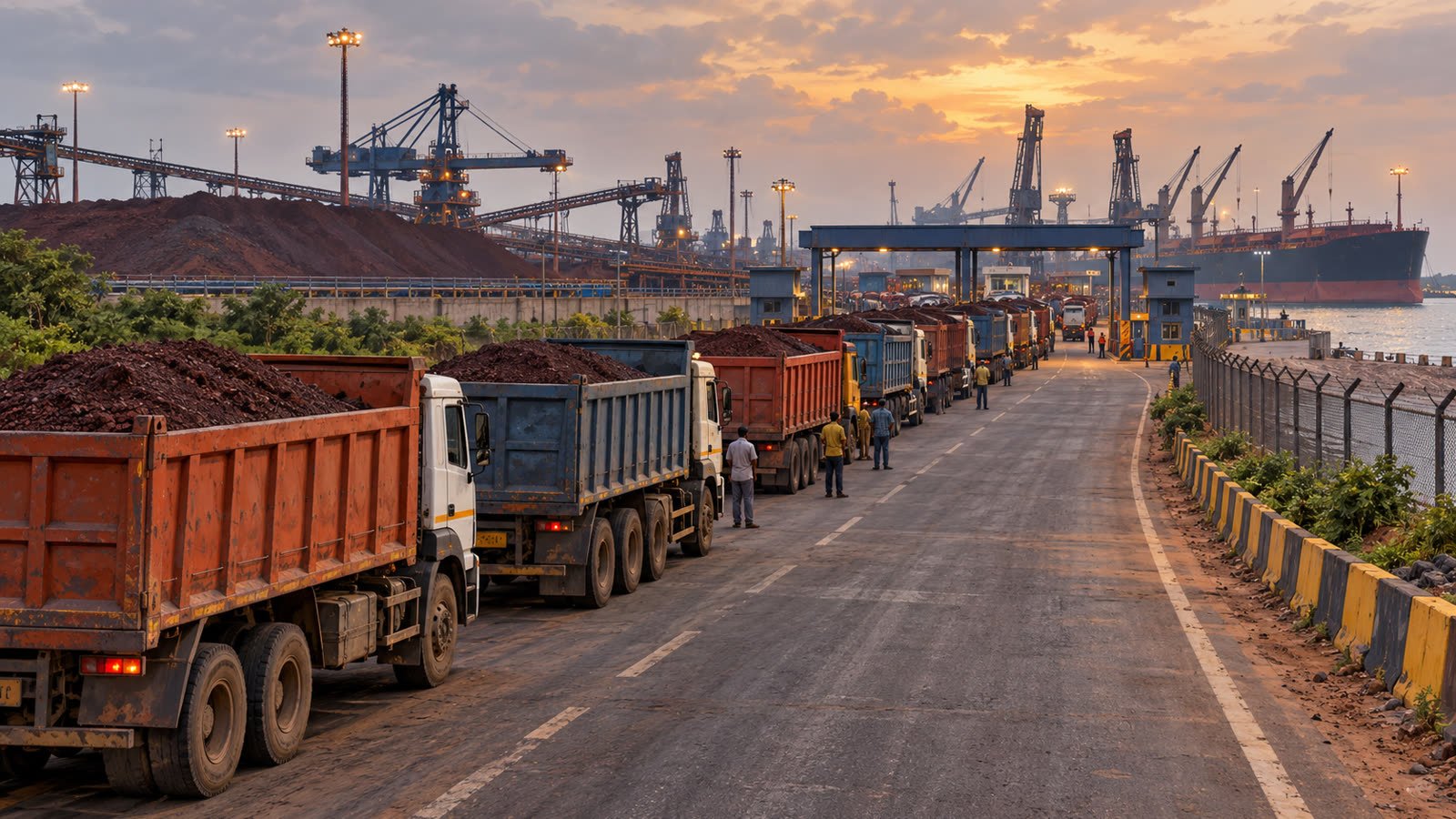
Hundreds of truck drivers staged a protest at Gate 2 of Odisha’s Paradip Port on Monday, 12 Oct, over a reported delay in unloading iron ore fines at a JSW-designated plot, according to The New Indian Express. The report said the resulting queue of loaded trucks had stretched 15–20 km on the Paradip–Chandikhole highway and roads in Paradip town, creating a local mobility and freight-access problem.
The development matters beyond the port gate: a truck held for days can lose earning time and add fuel, battery, crew and maintenance costs, while the queue can slow other freight and local traffic. The figures below are reported or alleged unless specifically identified as coming from the Paradip Port Authority (PPA); there is no confirmed clearance timetable in the cited material.
Key takeaways
- The New Indian Express reported that hundreds of drivers held a dharna at Paradip Port’s Gate 2 on 12 Oct 2026.
- Drivers alleged that trucks had waited 10–12 days, while a reported queue extended 15–20 km towards Bhutmundai and Marshaghai.
- The reported bottleneck involved unloading at a JSW-designated plot; the PPA said inadequate plot space and the non-arrival of vessels had worsened the delay.
- Drivers told the newspaper that renewing an expired entry barcode cost ₹100 and restarting or charging some truck batteries cost about ₹500; these are reported expenses, not an announced port tariff.
What happened at Gate 2
The New Indian Express said the protest followed a delay in unloading cargo inside the port. The affected trucks were carrying iron ore fines and other material from different mines. Drivers told the newspaper that they had been waiting for nearly 10–12 days and that the stoppage had caused financial hardship because loaded vehicles could not complete their next trips.
The same report said the queue had built up from Paradip towards Bhutmundai and Marshaghai, affecting traffic movement around the town and the approach to the port. It described the queue as 15–20 km long, but that distance is a media-reported estimate rather than a live traffic measurement published by a road authority.
Why the unloading slowed
The reported operational explanation is a mismatch between cargo arriving by road and the space available for storing or exporting it. The drivers said the cargo could not be unloaded at the JSW plot because vessels had not arrived to take the material onward and the stockyard did not have enough space for more consignments.
JSW officials declined to comment to the newspaper. A senior PPA official, however, acknowledged that a lack of adequate space at the JSW plot had affected unloading and that the non-arrival of vessels at the designated berths had compounded the issue. The PPA’s own traffic update for 13 Oct lists ongoing bulk-cargo movements, including iron-ore activity, but it does not give a clearance date for the truck queue.
The PPA’s own trading-across-borders page identifies JSWPTPL as a terminal for iron-ore export and describes QR-based gate-entry processes. It also notes that truck movements and gate operations are part of the port’s congestion-management system. That context helps explain why a berth or stockyard constraint can quickly spill back onto the road: trucks cannot complete the delivery cycle until the terminal can receive the cargo.
What the delay means for drivers and operators
Idling costs are the immediate pressure
Drivers told The New Indian Express that expired entry barcodes had to be renewed at a reported cost of ₹100, with some drivers travelling 15–20 km to do so. They also alleged that batteries on several parked trucks had drained, with about ₹500 spent on charging and restarting. Those figures describe the drivers’ reported out-of-pocket burden; they should not be read as a general PPA fee or a confirmed charge applied to every truck.
For fleet operators, the bigger exposure is the combined cost of a lost trip, driver time, fuel used during repositioning and roadside support. A route-level estimate can be prepared with the fuel-cost calculator, but the result will depend on the vehicle’s mileage, load, idling and the actual delay.
Local traffic may remain slow
The reported queue is concentrated around Paradip and the Paradip–Chandikhole approach, not across Odisha’s road network. The newspaper did not report a formal road closure or a state-wide freight restriction. Drivers and other road users travelling through the area should therefore treat this as a reported local obstruction and check current local traffic information before entering the corridor.
If the journey is flexible, the road-trip planner can help compare a different route’s distance and fuel requirement. A longer detour may also change toll exposure, so the toll-charge calculator is useful for checking that part separately.
What happens next
The PPA official told the newspaper that steps were being taken to facilitate unloading at the earliest, but neither a reopening time nor a confirmed queue-clearance schedule was published in the report. The next meaningful update will be whether vessels arrive at the designated berths, stockyard space becomes available and trucks begin moving into the terminal.
Until that happens, the reported 10–12-day wait and 15–20 km queue should be treated as a developing local logistics disruption. It is not, on the information currently available, a new nationwide fuel-price, toll-fee or FASTag rule. Transporters planning movement through Paradip should separate confirmed port updates from driver estimates when calculating delivery time and trip cost.
Sources
- The New Indian Express — “Truckers’ stir at Odisha’s Paradip port gate over cargo unloading delay” (13 Oct 2026)
- Paradip Port Authority — “Daily Traffic Update for 12-10-2026 held on 13-10-2026” (13 Oct 2026)
- Paradip Port Authority — “Trading Across Borders: JSWPTPL and truck-entry systems” (accessed 14 Oct 2026)