India’s EV registrations reached 24.1 lakh in calendar 2025, according to a 25 Sep 2026 analysis of Vahan data, while NITI Aayog’s India Electric Mobility Index 2025 shows that adoption and charging readiness still vary sharply by state. For buyers, the national growth number is useful context—but the practical question is whether the state, route and daily parking pattern can support the vehicle.
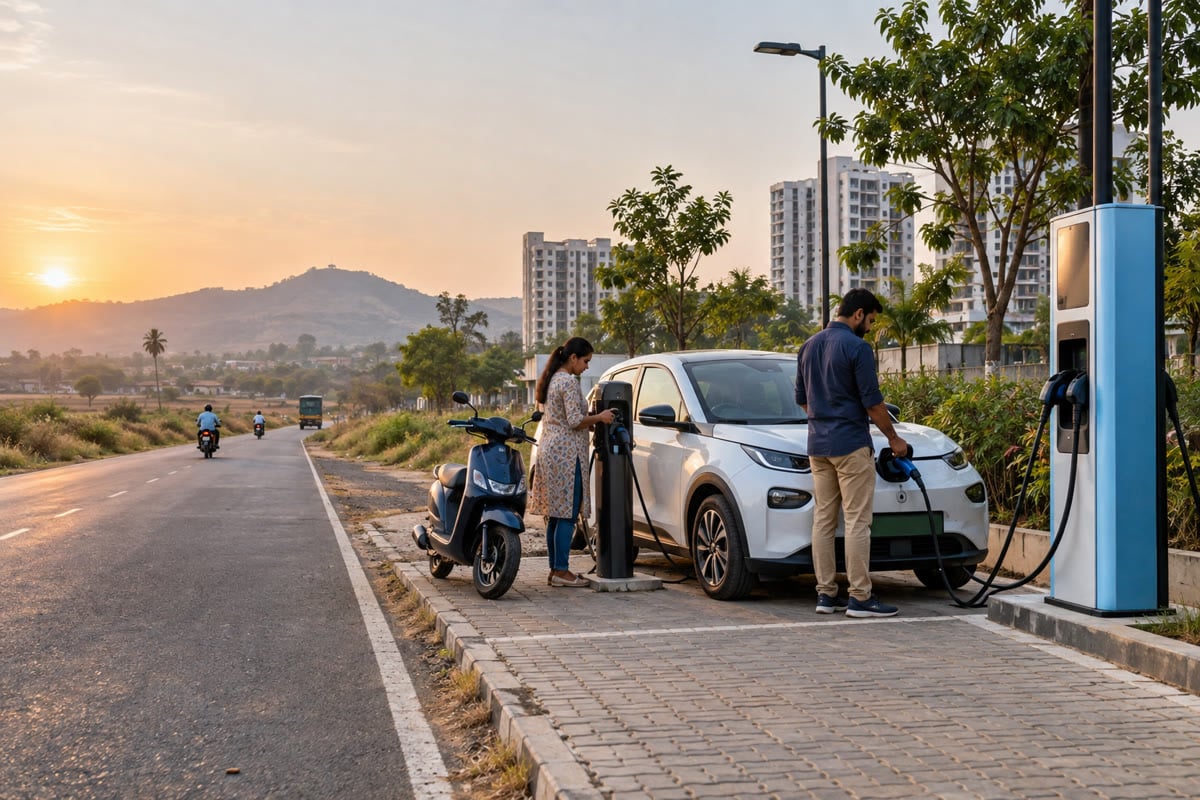
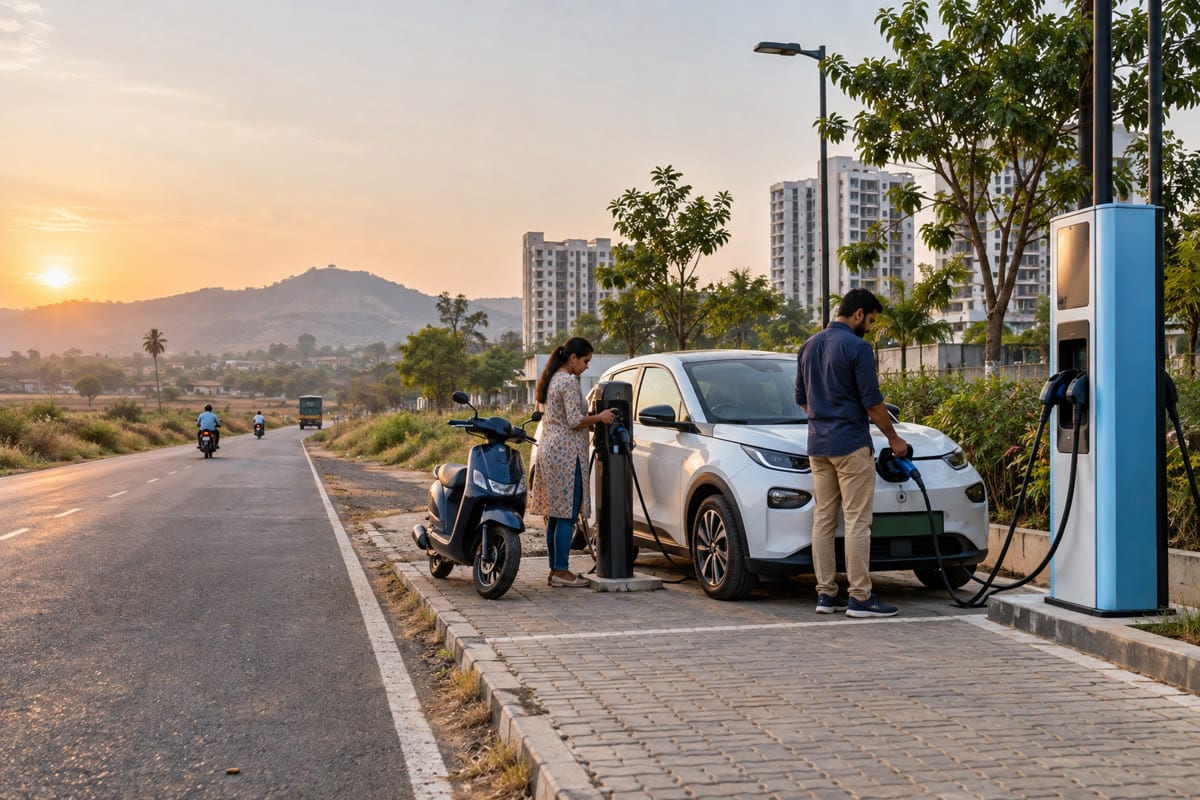 Illustrative editorial image generated for FuelPrice; it is not an official product or charging-site photograph.
Key takeaways
- Vahan registrations rose from about 1.3 lakh EVs in 2018 to 24.1 lakh in 2025, according to Dataful’s 25 Sep 2026 analysis.
- NITI Aayog’s IEMI 2025 report puts EV penetration at 8.25% of vehicle sales in FY 2025–26, up from 0.5% in 2018.
- The index’s Transport Electrification Progress score ranges from 77 in Delhi to 4 in Nagaland.
- Charging readiness can move at a different speed: Karnataka scores 97, while Uttar Pradesh scores 36 on that IEMI theme.
The national EV curve is moving up
Dataful’s 25 Sep 2026 analysis, based on registration data from the Ministry of Road Transport and Highways’ Vahan system, shows a sharp rise over the past several years. Registrations reached about 1.3 lakh in 2018, 10.6 lakh in 2022, 20.3 lakh in 2024 and 24.1 lakh in 2025. The analysis also puts registrations above 21.5 lakh between January and August 2026—about 90% of the full-year 2025 count.
| Year or period | Registrations (lakh) |
|---|---|
| 2018 | 1.3 |
| 2022 | 10.6 |
| 2024 | 20.3 |
| 2025 | 24.1 |
| Jan–Aug 2026 | More than 21.5 |
The periods are not perfectly interchangeable: the table uses calendar-year registration counts, while NITI Aayog’s index uses a financial-year view and a wider assessment of the EV ecosystem. Registrations also show vehicles recorded by transport authorities; they are not the same as a count of active vehicles, charging sessions or total wholesale sales.
NITI Aayog’s official IEMI 2025 report, published on 15 Sep 2026, provides the broader national context. It says EVs accounted for 0.5% of vehicle sales in 2018 and 8.25% in FY 2025–26, with more than 8.7 million EVs on Indian roads by FY 2025–26. Close to 2.5 million EVs were registered during that financial year, around 25% more than in FY 2024–25. The report also records public charging stations rising from about 5,151 in December 2022 to more than 29,000 by June 2025.
Why a national average can mislead buyers
The IEMI does not treat EV progress as one number. Its Transport Electrification Progress theme combines adoption with state-level initiatives, incentives and other conditions that support electric mobility. Its Charging Infrastructure Readiness theme measures a different part of the system. Both scores are out of 100 and refer to the 2025 assessment.
| State or UT | Transport electrification | Charging readiness |
|---|---|---|
| Delhi | 77 | 88 |
| Karnataka | 55 | 97 |
| Maharashtra | 68 | 91 |
| Haryana | 19 | 91 |
| Uttar Pradesh | 58 | 36 |
The contrast is important. Haryana’s charging-readiness score is high, but its transport-electrification score is the lowest among the large states in the index. Uttar Pradesh shows the reverse pattern: stronger transport-electrification progress but the lowest charging-readiness score among large states. This means a high charger count does not automatically translate into high EV uptake, and a fast-growing EV market does not guarantee equally convenient charging.
For a private owner, that difference can affect how often a vehicle can be charged at home, work or a regular destination. For a delivery rider, taxi operator or small fleet, it can affect route planning, turnaround time and the number of vehicles needed to cover a shift. A national registration milestone therefore says less about day-to-day usability than the local network around the vehicle.
What EV buyers and operators can check now
- Charging on the real route: Check whether public chargers are available near the home, workplace and regular inter-city corridors. FuelPrice’s state-wise EV charging station directory can help with the first location check, but availability and uptime should still be confirmed with the operator.
- State policy details: NITI Aayog says 26 of India’s 36 States and Union Territories had active EV policies by December 2025. Those policies can differ in eligibility, vehicle category, registration treatment and implementation, so a national headline should not be read as a uniform state benefit.
- Vehicle duty cycle: A commuter, delivery rider and inter-city fleet have different charging needs. Range, charging time, service access and payload matter alongside the headline registration growth.
- Running-cost baseline: When comparing an EV with an existing petrol or diesel vehicle, calculate the actual route and usage pattern. FuelPrice’s fuel cost calculator can provide an ICE baseline, while the road-trip planner helps expose where charging stops may affect a longer journey.
What the growth means for the wider market
The data points to a market that is expanding beyond a small early-adopter base, but not at the same speed in every vehicle category or region. NITI Aayog reports that electric two-wheelers accounted for about 1.3 million of the close to 2.5 million EVs registered in FY 2025–26. It also says commercial goods-vehicle EV penetration rose from 0.6% in 2024 to 1.4% in 2025. For manufacturers, charging operators and fleet providers, the next opportunity is therefore likely to be shaped by local use cases and infrastructure rather than by a single nationwide adoption rate.
For petrol and diesel users, the 8.25% FY 2025–26 EV share still means most newly registered vehicles were not electric. The figure signals a changing market, but it does not by itself imply an immediate nationwide change in fuel prices or a uniform reduction in fuel demand. The practical impact will depend on how quickly electric two-wheelers, three-wheelers, cars and commercial vehicles move from high-adoption pockets into other states.
What to watch next
The next useful signal will be whether state policy implementation and charging deployment begin to close the gap between vehicle adoption and infrastructure. The IEMI report notes that transport, power, industry and urban planning are largely shaped at the state and Union Territory level, making local execution central to the transition. Readers comparing an EV purchase or fleet replacement should therefore track the latest state policy, charger availability and route economics together, rather than relying on India-wide registration growth alone.