The Reserve Bank of India (RBI) absorbed ₹75,026 crore from banks through a one-day Variable Rate Reverse Repo (VRRR) auction on 23 Sep 2026, as surplus liquidity stood at ₹4.45 lakh crore on 22 Sep. The move is part of the RBI's effort to keep short-term money-market conditions orderly; it does not by itself change every car-loan EMI.
For vehicle buyers, the useful takeaway is narrower but important: a floating-rate car loan can respond to its contracted benchmark and reset schedule, while the latest RBI liquidity operation is not an automatic rate hike. Buyers comparing festive-season finance offers need to separate a bank's advertised rate from the benchmark, spread, fees and total repayment terms.
Key takeaways
- The RBI accepted ₹75,026 crore in a one-day VRRR auction on 23 Sep, against a notified ₹75,000 crore.
- Bids totalled ₹87,993 crore and the cut-off and weighted-average rate was 5.24%.
- RBI data cited by Business Standard and News On AIR put surplus banking-system liquidity at ₹4.45 lakh crore as on 22 Sep.
- The policy repo rate remained 5.25% on the RBI's current-rates page as of 25 Sep; the VRRR rate should not be read as a new repo-rate decision.
- For a car loan, the benchmark, lender spread, reset frequency and fees matter more than a single day's liquidity headline.
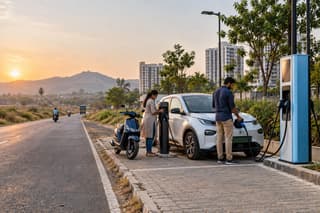
 Editorial illustration generated for FuelPrice; a representative vehicle-financing scene, not a lender's offer.
What the RBI did on 23 Sep
The RBI's overnight VRRR operation temporarily takes surplus funds from banks and pays an auction-determined rate for the short tenor. Business Standard, in a Press Trust of India report, said the central bank received bids worth ₹87,993 crore against the ₹75,000 crore notified amount and accepted ₹75,026 crore at a 5.24% cut-off and weighted-average rate on 23 Sep 2026. News On AIR independently reported the same auction result and said the banking-system surplus was ₹4.45 lakh crore on 22 Sep.
The operation followed other liquidity measures. The RBI had sold government securities worth ₹50,000 crore on 17 Sep and ₹25,000 crore on 21 Sep, with another ₹25,000 crore tranche scheduled for 28 Sep, according to both reports. Together, those open-market operations were announced as a ₹1 lakh crore programme. These actions manage the amount and distribution of money available to banks; they are different from a formal change in the policy repo rate.
Why this matters for car-loan EMIs
RBI's current-rates page lists the policy repo rate at 5.25% and call rates between 4.30% and 5.25% as on 24 Sep 2026. The 5.24% VRRR cut-off is therefore close to, but not the same as, the policy repo rate. It is the price accepted in a short-term liquidity auction, not a new rate announced for every retail borrower.
That distinction matters because a car-loan offer can be fixed or floating. Under the RBI's external-benchmark framework, banks price new floating-rate retail loans with reference to an external benchmark such as the policy repo rate or an eligible market benchmark. The lender also applies a spread and follows the reset terms in the loan contract. A change in banking-system liquidity can influence market conditions, but it does not mean every lender must immediately reprice every vehicle loan by the same amount.
Existing borrowers therefore need to check the terms of their own agreement. A floating-rate loan may change its interest rate at the stated reset frequency, while a fixed-rate loan normally follows its fixed-rate terms. RBI's EMI guidance also says borrowers should be told about the possible impact of a benchmark change and, when a reset occurs, the resulting change in EMI or tenure.
What buyers should check before signing
A headline rate is only one part of the cost. The offer documents should make clear:
- whether the rate is fixed or floating;
- which benchmark is used and how often it resets;
- the lender's spread over that benchmark and the circumstances in which the spread can change;
- processing, documentation, foreclosure and other applicable charges; and
- how a higher benchmark would affect the EMI, tenure or both.
The running cost of the vehicle sits alongside the financing cost. A buyer comparing a petrol, CNG or electric model can use the fuel cost calculator for a typical trip or monthly use before comparing loan offers. The site's petrol, diesel, CNG and electric cost guide can help put the financing decision in the context of the vehicle's likely operating costs.
Fuel prices do not move in lockstep with the RBI's liquidity operations either. For the latest city and state-wide rates, readers can check the live fuel prices page separately from the loan quote.
What to watch next
The next signals are the RBI's remaining liquidity operations, the call-rate range and any change in the policy repo rate at a future monetary-policy meeting. The scheduled 28 Sep OMO tranche may affect the amount of surplus cash still available to banks, but its effect on retail car-loan pricing will depend on lenders' funding costs, competition and the benchmark written into each offer.
For now, the latest RBI action is best read as a liquidity-management development with a possible indirect bearing on financing conditions, not as a confirmed increase in car-loan EMIs. Buyers and existing borrowers can make a clearer comparison by recording the benchmark, reset date, spread, fees and total repayment shown in their own documents.
Sources
- Business Standard/PTI — RBI absorbs ₹75,026 cr via overnight VRRR auction amid surplus liquidity — 23 Sep 2026
- News On AIR — RBI absorbs ₹75,026 crore through overnight VRRR auction amid surplus liquidity — 23 Sep 2026
- Reserve Bank of India — Money Market Operations database — accessed 25 Sep 2026
- Reserve Bank of India — Current rates and official data — accessed 25 Sep 2026
- Reserve Bank of India — External benchmark lending rates and monetary transmission — accessed 25 Sep 2026
- Reserve Bank of India — FAQs on reset of floating interest rate on EMI-based personal loans — 10 Jan 2025
This article is for general information only and is not financial, insurance or legal advice.