Rural India accounted for 55% of India’s two-wheeler registrations between January and June 2026, according to JATO Dynamics data reported by HT Auto. For riders and buyers, the split matters because the country’s largest two-wheeler market is still built around petrol commuter vehicles, while electric adoption remains materially lower outside cities.
The data is a market snapshot, not a forecast of the next six months. It does, however, show where manufacturers, dealers and charging providers need to meet buyers as the festive buying season approaches.
Key takeaways
- Rural markets made up 55% of two-wheeler registrations in January–June 2026, compared with 32% in urban markets and 13% in metros.
- Petrol vehicles accounted for 94% of rural two-wheeler registrations in the period.
- Rural EV penetration was 5.9%, versus 10.7% in urban markets and 10.9% in metros.
- TVS Motor and Bajaj Auto together represented 56% of rural electric two-wheeler registrations, according to the reported JATO analysis.
- The practical buying question is local: fuel cost, charging access, service support and the vehicle’s daily use all matter.
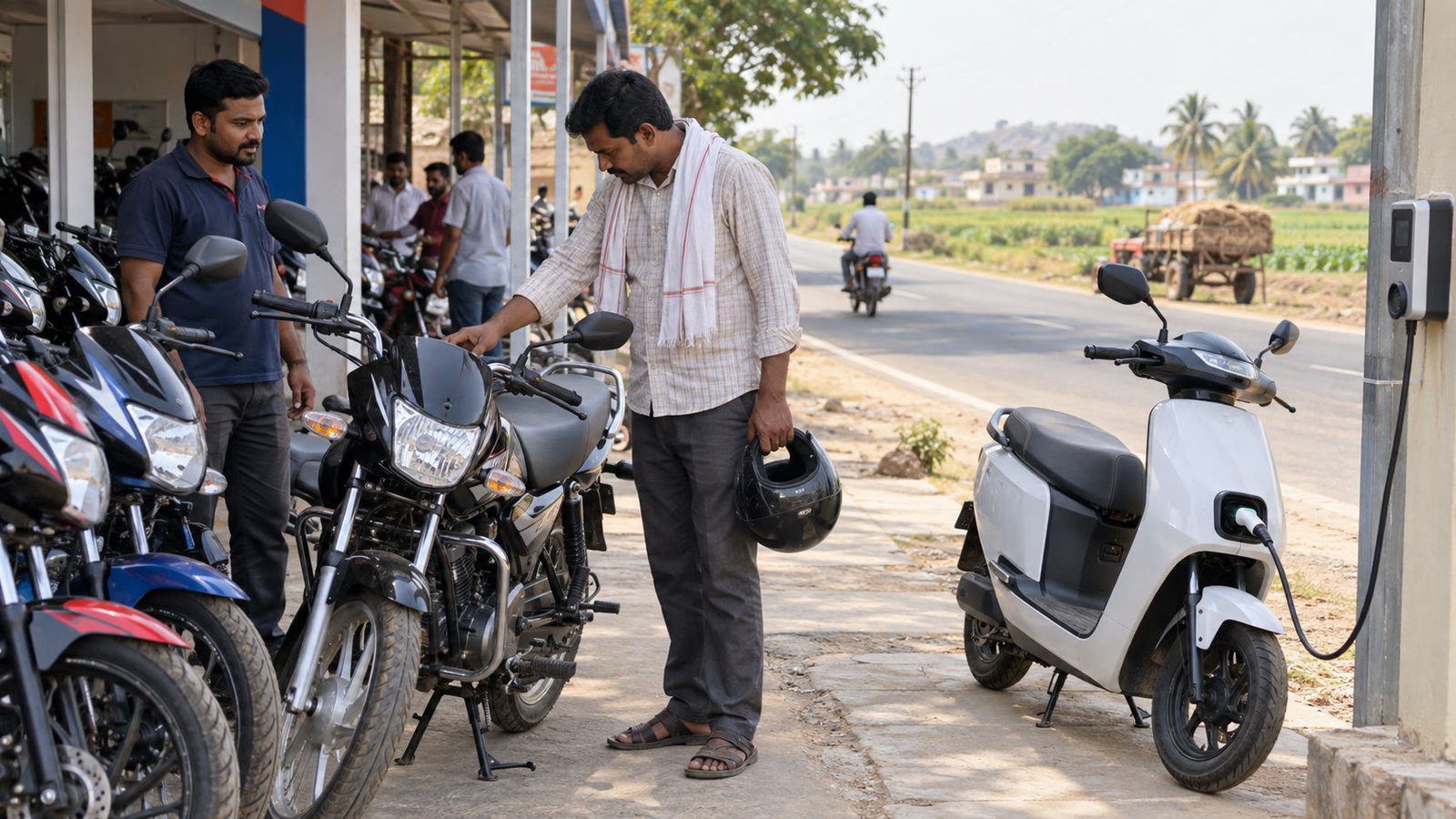
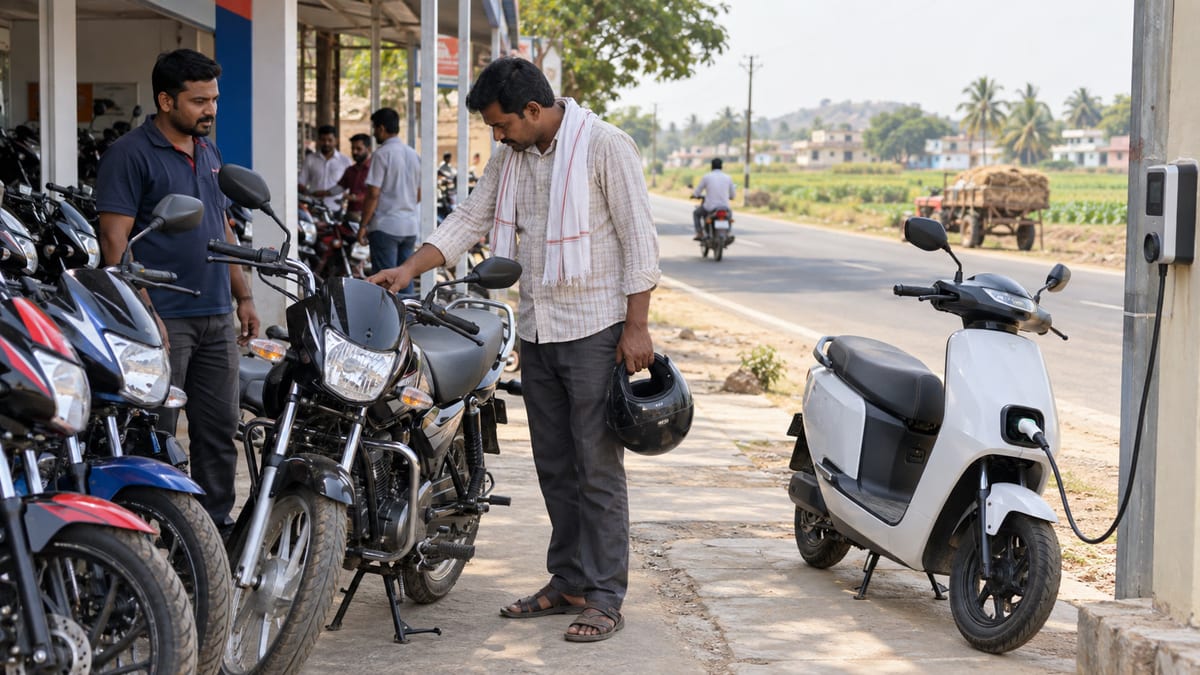 Illustrative editorial image of the rural two-wheeler market and its emerging electric option. Credit: FuelPrice editorial image, generated for this article.
What the registration split shows
JATO’s H1 2026 report describes rural India as the centre of gravity for two-wheeler demand, with more than half of registrations coming from rural markets. HT Auto’s report puts the rural share at 55%, with urban markets at 32% and metros at 13%. Business Standard’s separate report on the same JATO analysis records the same distribution.
The three-way split is more useful than a simple national sales headline. It shows that a model, fuel type or financing offer that works in a large city may not be equally relevant in a village or small town. JATO says rural preferences vary by state and that manufacturers need local product planning, financing access and after-sales support. That is an important distinction for buyers: availability of the right model and dependable service can be as important as a brochure’s mileage or range claim.
Why petrol still dominates rural two-wheelers
Petrol accounted for 94% of rural two-wheeler registrations in the first half of 2026, according to the JATO analysis reported by HT Auto and Business Standard. That dominance is consistent with the role of commuter motorcycles and scooters in everyday mobility, where buyers may prioritise familiar refuelling, a wide service network and a purchase price that fits their budget.
This does not mean fuel cost is unimportant. For riders who travel regularly for work, education, farm-related tasks or local commerce, the running-cost difference can accumulate over time. Readers can check live fuel prices for their state and compare the result with their actual travel pattern instead of relying only on a national average.
Rural EV adoption is lower and more concentrated
Electric two-wheelers represented 5.9% of rural registrations in January–June 2026, compared with 10.7% in urban markets and 10.9% in metro markets. The gap suggests that the shift to electric mobility is not moving at the same speed everywhere. It should be read as a difference in current adoption, not as proof that rural buyers will not adopt EVs.
The rural EV market is also concentrated among established manufacturers. TVS Motor accounted for 29% and Bajaj Auto for 27% of rural electric two-wheeler registrations, giving them a combined 56% share in the reported analysis. For a prospective EV buyer, the more immediate issue is whether charging and service are practical at home and along regular routes. FuelPrice’s state-wise EV station directory can help readers check the local charging picture before comparing models.
State differences matter too. Business Standard’s analysis notes that Rajasthan’s rural motorcycle registrations were heavily weighted towards the 100–110 cc segment, while other states showed a wider mix. The broader point is that “rural India” is not one uniform market: road conditions, trip lengths, household income, service reach and local charging availability can vary sharply.
What buyers should check now
Compare the cost of the actual commute
A buyer comparing petrol and electric options should start with the vehicle’s real daily distance, not a headline efficiency figure. The fuel-cost calculator can help estimate petrol or diesel use for a known route. For an EV, the equivalent check is the local electricity tariff, charging time, access to a reliable socket and the cost of any public charging used.
Check support beyond the showroom
Rural ownership can depend on how far the nearest authorised service point is, whether routine parts are stocked locally and how a breakdown is handled. EV buyers should add battery warranty terms, charging equipment and service response to that checklist. Petrol buyers should also compare service intervals and the availability of the chosen model in their area.
Separate market share from a buying recommendation
The registration data tells us what buyers selected in H1 2026; it does not identify a universally suitable vehicle. A high rural share for petrol two-wheelers reflects current conditions, while the lower EV share highlights the infrastructure and affordability questions that still need to be answered locally. Buyers should compare on-road cost, financing terms, insurance, service access and intended use without assuming that one powertrain is right for every route.
What to watch through the festive season
Two signals deserve attention in the months ahead. First, manufacturers and dealers will have to stock different products for different rural markets rather than treating the country as a single demand pool. Second, EV growth will depend not only on new models but also on charging and after-sales coverage outside the biggest cities.
For FuelPrice readers, the takeaway is straightforward: rural India is already the volume engine of the two-wheeler market, but its powertrain mix remains overwhelmingly petrol-led. The next phase of the transition will be decided by the practical economics of each trip and by whether local infrastructure makes an electric option dependable.
Sources
- JATO — Rural India accounts for more than half of India’s two-wheeler registrations in H1 2026 (September 2026)
- HT Auto — Rural India accounts for 55% of India’s two-wheeler registrations in H1 2026 (25 Sep 2026)
- Business Standard — Rural India drives two-wheeler demand, but petrol retains 94% share (9 Sep 2026)