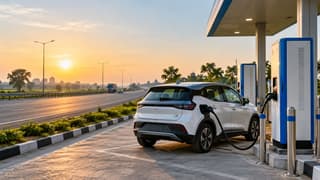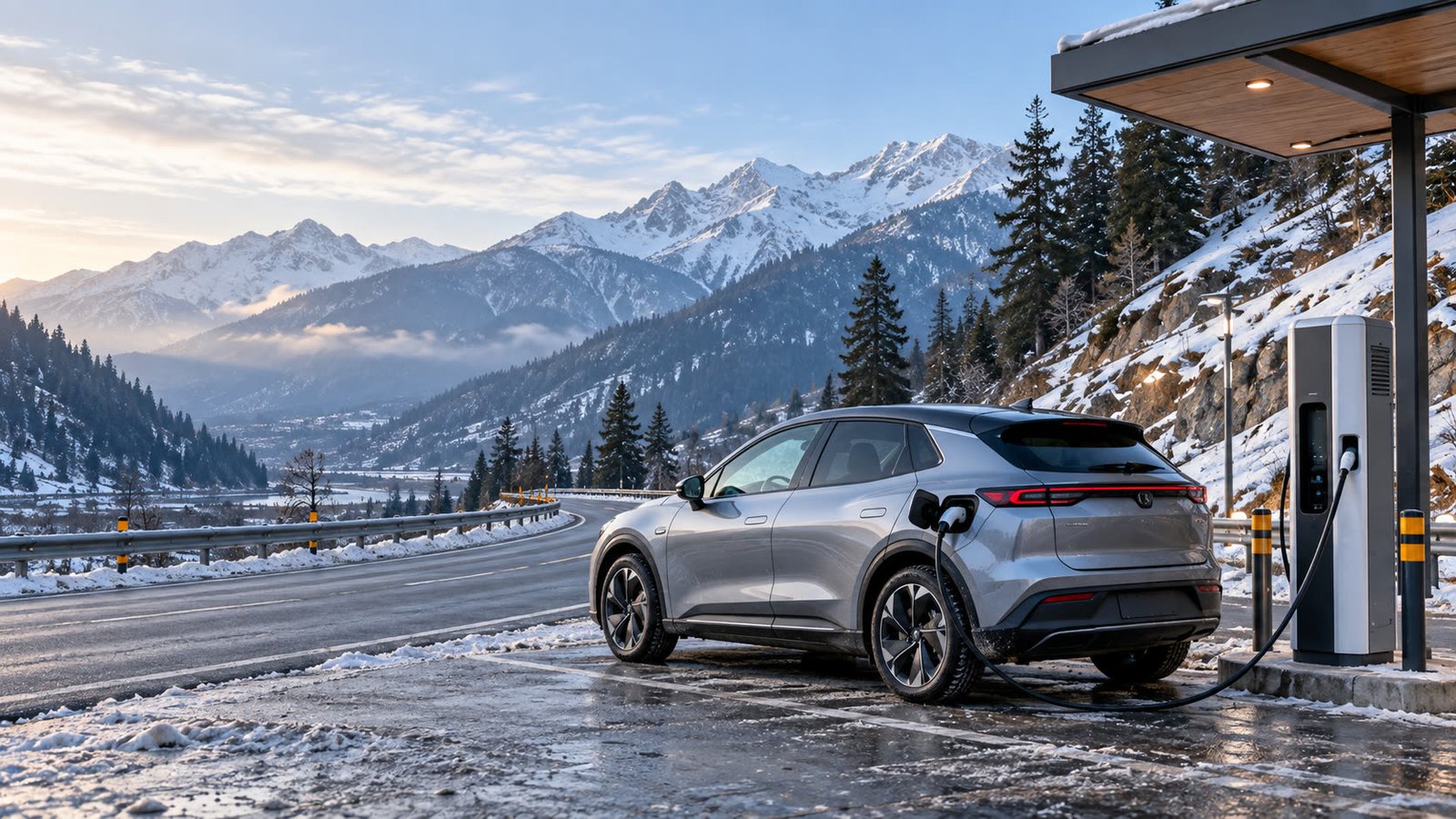
 Illustrative image of an electric vehicle charging beside a winter mountain highway in Jammu and Kashmir; AI-generated for FuelPrice.
Jammu and Kashmir has notified its Electric Vehicle Policy 2026, setting a six-year roadmap through 2032 with a target of 1.40 lakh electric vehicles and 900 public charging sites. For residents, tourists, fleet operators and vehicle buyers, the significance is a planned combination of charging expansion, cold-weather performance checks and eligibility-based financial support—not an automatic discount at every dealership.
Key takeaways
- The notified policy covers 2026–32 and targets 1.40 lakh EVs across all 20 districts of Jammu and Kashmir.
- The infrastructure roadmap includes 900 public charging sites, including 140 fast-charging hubs on urban grids and highway corridors.
- Building bye-laws will require EV-readiness for 20% of parking capacity, according to the policy details reported on 1 October 2026.
- Eligible EV loans can receive 3–5% interest subvention for up to 36 months, subject to the policy’s conditions.
- The policy adds a winter-validation protocol and scrappage-linked support, but the application and disbursement process still needs to be checked when operational guidance is issued.
What J&K’s EV policy changes
The Jammu and Kashmir government notified the policy on 1 October 2026 after approval by the Council of Ministers chaired by Chief Minister Omar Abdullah. The Chief Minister’s Office described it as a framework for clean, affordable and weather-resilient mobility, while reporting by The Economic Times and Kashmir Life set out the targets and buyer-facing measures.
The policy period is 2026–32 and the target is 1.40 lakh electric vehicles by 2032. It is designed to cover all 20 districts, so the plan is not limited to the larger urban centres of Jammu and Srinagar. It also links vehicle adoption with charging infrastructure, power-system integration, public-private partnerships, fleet electrification, skills and employment.
Charging expansion is the practical test
The roadmap envisages 900 public charging sites, including 140 fast-charging hubs along urban grids and highway corridors. For someone using an electric car or two-wheeler beyond a home-charging routine, this is more important than the headline vehicle target: route confidence depends on where a charger is located, whether it is working, how payment is handled and whether the site supports the vehicle’s connector and charging speed.
The 900-site figure is a policy roadmap, not a statement that all 900 sites are already live. Drivers planning a Jammu and Kashmir journey can use the state-wise EV charging directory to check available locations, then confirm live status and access arrangements with the operator. The road-trip planner can help map charging stops around the intended route, but it cannot replace a current check of the station before departure.
The plan also calls for managed integration of EV charging demand with the power system. That matters because a larger public-charging network needs grid capacity and predictable operating rules, not only chargers installed at visible locations. The policy’s emphasis on power integration and private participation suggests that rollout quality will be measured by usable, dependable capacity rather than by site count alone.
Cold-weather checks are a distinct J&K provision
Jammu and Kashmir’s policy introduces a Specialised Winter Validation Protocol under which EVs will undergo winter-performance validation, particularly for operation in snow and sub-zero conditions. The announcement does not publish a model-by-model test result or a universal winter-range number. Buyers therefore should not treat the policy as a guarantee that every EV will deliver the same range in every mountain or sub-zero setting.
The useful question for a prospective buyer is what the final protocol will measure and how the result will be communicated. Battery performance, charging access, roadside support and the availability of service technicians can all affect a winter journey, even when the vehicle’s headline range remains unchanged. These details are especially relevant to residents, taxi operators and fleet managers who cannot plan around ideal weather or a private charging point.
What financial support is included
The policy details reported by PTI in The Economic Times and independently by Kashmir Life include several forms of support. They are eligibility-dependent provisions of a notified policy, not a universal cash benefit.
- EV-loan support: an interest subvention of 3–5% for up to 36 months, subject to the conditions prescribed under the policy and the participating finance process.
- Scrappage support: an annual budgetary provision of ₹50 crore for incentives linked to replacing older vehicles with electric vehicles. The provision is not the same as a fixed ₹50 crore payment to each buyer.
- Early-adopter top-ups: support for the first 15,800 eligible adopters, including ₹15 lakh for the first 300 e-buses, ₹1 lakh for the first 1,500 personal electric cars and ₹5,000 for the first 10,000 electric two-wheelers.
The early-adopter figures are capped by vehicle category and adopter count, and the reports specify that eligibility and other conditions apply. A buyer comparing an EV with a petrol or CNG vehicle should wait for the notified application route, documents, participating lenders and treatment of state or central incentives before calculating the final on-road cost. For a running-cost comparison, the fuel cost calculator can show the petrol or diesel cost for the same trip; home-charging tariffs, public-charging fees, insurance and financing remain separate inputs.
Parking and fleet rules will shape rollout
The policy provides for EV-ready parking through building bye-laws that will require 20% of parking capacity to be EV-ready. The practical meaning will depend on how the requirement is applied to new buildings, public facilities and existing parking areas. It can reduce one of the barriers to ownership for residents without a dedicated charging point, but the policy announcement does not say that every existing parking space will immediately receive a charger.
It also envisages phase-wise electrification of vehicle fleets, greater private-sector participation and skills development. That could matter beyond private cars: taxis, delivery operators, tourist vehicles, buses and government fleets may need charging depots, maintenance capacity and replacement schedules that differ from those of individual owners.
What changes now and what to watch next
The policy is now notified for the 2026–32 period, but its reader-facing value will depend on the implementation documents that follow. The most useful checks for buyers and operators are:
- Which vehicle categories and applicants qualify for the loan, scrappage and early-adopter provisions?
- What is the application channel, documentation list and release timeline for each support measure?
- Which of the 900 charging sites will be prioritised first, and how will live availability and uptime be reported?
- What tests and disclosure format will be used under the winter-validation protocol?
- How will the 20% EV-ready parking requirement apply to new construction and public facilities?
For now, the notification is best read as an infrastructure and ownership signal. It gives J&K a defined direction for EV adoption, but a buyer’s actual cost and trip reliability will still depend on vehicle eligibility, financing terms, charging access, weather and the final operating rules.
Sources
- Office of the Chief Minister, J&K: Electric Vehicle Policy 2026 announcement — 1 Oct 2026.
- The Economic Times: Jammu and Kashmir government notifies Electric Vehicle Policy 2026 — 1 Oct 2026.
- Kashmir Life: Jammu Kashmir Govt Notifies Electric Vehicle Policy-2026, Targets 1.4 Lakh EVs By 2032 — 1 Oct 2026.
This article is for general information only and is not financial, insurance or legal advice.