As of 15 Nov 2026, Assam Police allege that the mandatory speed-limiting device on the minibus involved in the Kaziranga collision was removed. NDTV separately reported that Bokakhat Police arrested the vehicle owner, putting commercial-passenger safety and operator accountability at the centre of the continuing investigation.
The development is a material follow-up to the earlier crash report: police are now examining whether alleged vehicle-rule violations, rather than only road or traffic conditions, contributed to the tragedy. The collision near Rongajan on National Highway 715 on 13 Nov killed 26 people, according to reports from The Indian Express and NDTV. There is still no final finding that the alleged device removal caused the crash.
Key takeaways
- Assam Police allege the minibus owner and driver removed a mandatory speed limiter to enable more trips.
- Bokakhat Police arrested the vehicle owner, who faces allegations linked to motor-vehicle regulations.
- An earlier account from Assam Transport Minister Charan Boro said a limiter was found installed but its functioning still required technical examination.
- The investigation is still assessing speed, the vehicle’s compliance history, the driver and the road conditions.
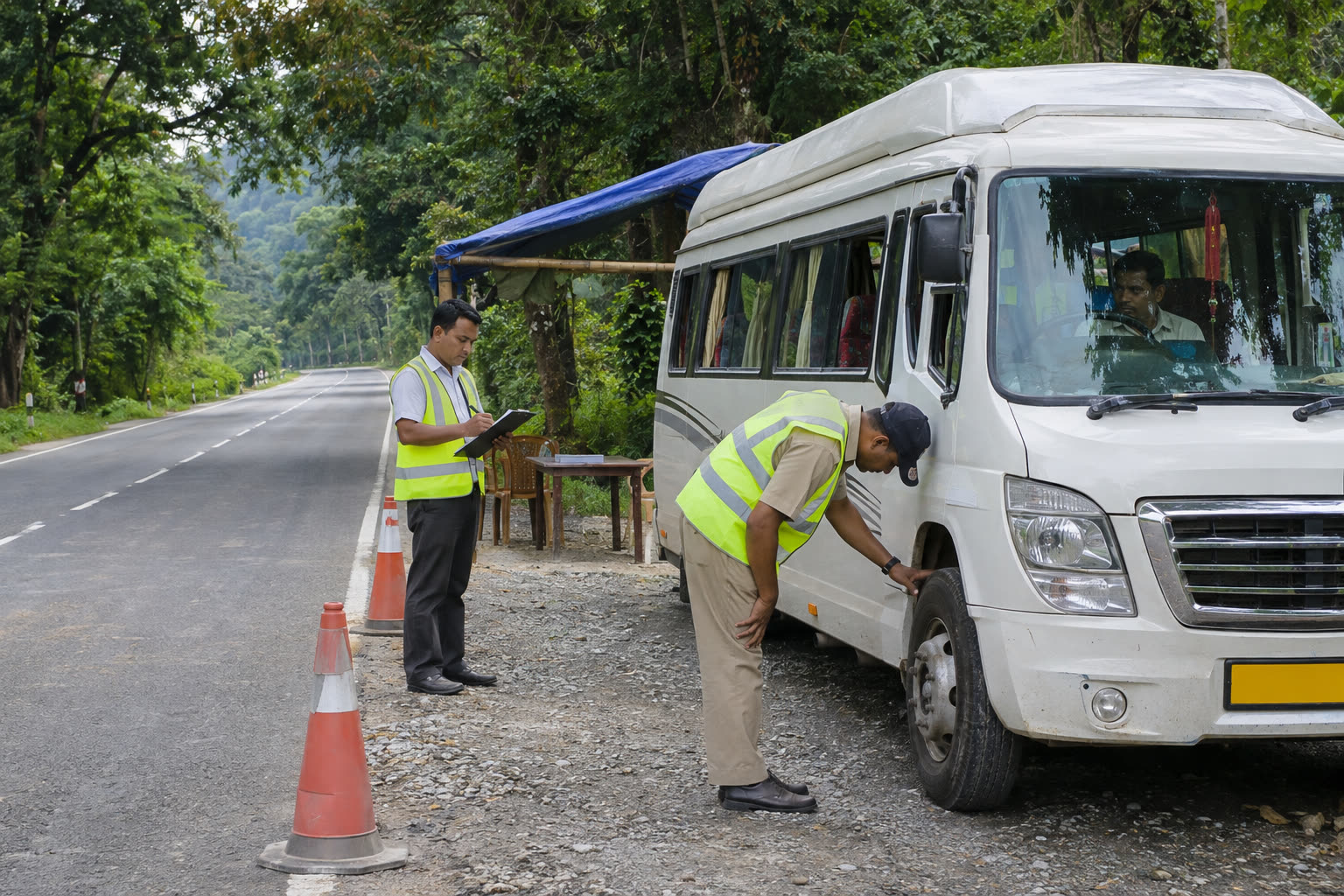
Image note: This is an illustrative FuelPrice visual of a commercial-vehicle inspection and does not depict the Kaziranga crash.
What the latest investigation says
The Indian Express reported on 15 Nov that Golaghat Senior Superintendent of Police Swapnaneel Deka told the newspaper that the minibus owner and driver had intentionally removed the speed-limiting device. Police allege the change was intended to let the vehicle complete more trips and earn more fares. The report described the allegation as part of the police probe, not as a court-established finding.
NDTV, also reporting on 15 Nov, said the Force Traveller owner, identified as Anjir Ali, was arrested by Bokakhat Police from Nagaon. It said investigators were examining alleged overspeeding incidents and possible violations of motor-vehicle rules connected to the vehicle. Police are also examining how the vehicle entered the opposite lane before the head-on collision, while the cause of that movement remains under investigation.
Why the speed-limiter account needs technical confirmation
There is an important difference between the latest police account and an earlier statement reported by The Assam Tribune. After visiting the crash site on 14 Nov, Assam Transport Minister Charan Boro said transport officials had inspected the vehicle and found a Speed Limiting Device installed, but could not yet confirm whether it was functioning. He said NHAI officials from Delhi and a team from Pune would assist with examining the circumstances.
That apparent conflict should remain visible in the reporting. A device may have been present but non-functional, or the later police finding may relate to an earlier removal; the available reports do not settle that question. A technical examination of the vehicle, its records and any recovered components will be needed before the allegation can be treated as an established fact.
Why this matters for Indian road users
A speed limiter is one part of a commercial vehicle’s safety system. It cannot by itself establish that a trip was safe, because passenger protection also depends on vehicle fitness, maintenance, driver condition, passenger loading, route conditions and enforcement. The case therefore matters beyond one operator: it tests whether safety equipment is present, functional and checked in practice.
For passengers, the practical lesson is to treat repeated speeding, overloading or visibly poor vehicle condition as a safety warning. Passengers may not be able to inspect a limiter, but they can note the vehicle registration number, use a registered operator and avoid boarding when a vehicle appears overcrowded or the driver appears unfit to drive. The road-trip document checklist also explains the basic records travellers and operators should keep in order.
For fleet owners and transport managers, the case highlights the value of maintaining a traceable inspection record: permit and fitness documents, insurance and PUC validity, scheduled maintenance, speed-control checks and driver duty records. Those records do not replace enforcement, but they can show whether a vehicle was being operated within its permitted safety framework.
What changes now
The owner’s arrest is an investigation step, not a finding of guilt. Police and transport officials still have to establish what happened to the speed-limiting device, whether the vehicle was speeding, whether earlier violations were acted on and how the driver’s condition and the road environment affected the collision.
The Assam Transport Minister’s statement that NHAI teams would examine the crash stretch matters because the inquiry is not limited to the minibus. A complete account should cover the carriageway, signage, speed enforcement, the container truck’s data and the vehicle’s compliance history. The Indian Express reported that the state government had promised stricter measures after the crash, but the scope and timing of any new enforcement action were not yet detailed.
What travellers should check before a commercial road trip
- Use a registered operator and record the vehicle number before departure.
- Check that the vehicle is not visibly overloaded and that seat belts and emergency exits are accessible where fitted.
- Ask the operator to confirm that fitness, insurance and PUC documents are current.
- Report dangerous speeding to the operator and local authorities, and do not pressure a driver to add an unsafe extra trip.
For route timing, rest stops and a clearer view of the journey before boarding, travellers can use the road-trip planner. FuelPrice’s earlier report on the Kaziranga NH-715 crash probe covers the initial accident response; this follow-up focuses on the new vehicle-compliance allegations.
FuelPrice takeaway
The Kaziranga investigation has moved from the crash response to the harder question of whether commercial-vehicle safety controls were actually working. Until technical and legal findings are complete, the speed-limiter allegation should remain attributed to police. For drivers, passengers and fleet operators, the immediate takeaway is simple: a valid permit or a visible safety device is not enough unless the vehicle is maintained, the driver is fit and speed rules are followed on every trip.
Sources
- The Indian Express — “Kaziranga crash: Speed limiter removed to make more trips, police find” (15 Nov 2026)
- NDTV — “Kaziranga Crash Vehicle Owner Arrested, Overspeeding Record Under Scanner” (15 Nov 2026)
- The Assam Tribune — “NHAI teams from Delhi, Pune to examine fatal Kaziranga crash: Transport Minister” (14 Nov 2026)