Long-weekend traffic has slowed the Kalka-Shimla National Highway-5 and the Joshimath-Badrinath route, with current reports describing queues several kilometres long and journeys taking hours longer than usual. The disruption matters to anyone driving to Himachal Pradesh or Uttarakhand this weekend because a route that looks open on the map can still require a large time, fuel and toll buffer.
The congestion followed the October 2 public holiday and the adjoining weekend. Reports from October 2 and 3 describe heavy tourist and pilgrim movement, slow traffic on hill corridors and pressure on roads used by local residents as well as visitors.
Key takeaways
- Several-kilometre queues were reported on the Kalka-Shimla NH-5 and on the Joshimath-Badrinath route.
- Reports put the Joshimath-area queue at roughly 7–9 km; the difference reflects changing endpoints and traffic conditions.
- Tourists, pilgrims, local residents and essential-service vehicles were all affected by the slow movement.
- Parwanoo and Mussoorie were also reported as pressure points on the wider hill-travel network.
- Drivers should check current local updates, keep a practical fuel margin and allow time for stops before entering a congested hill section.
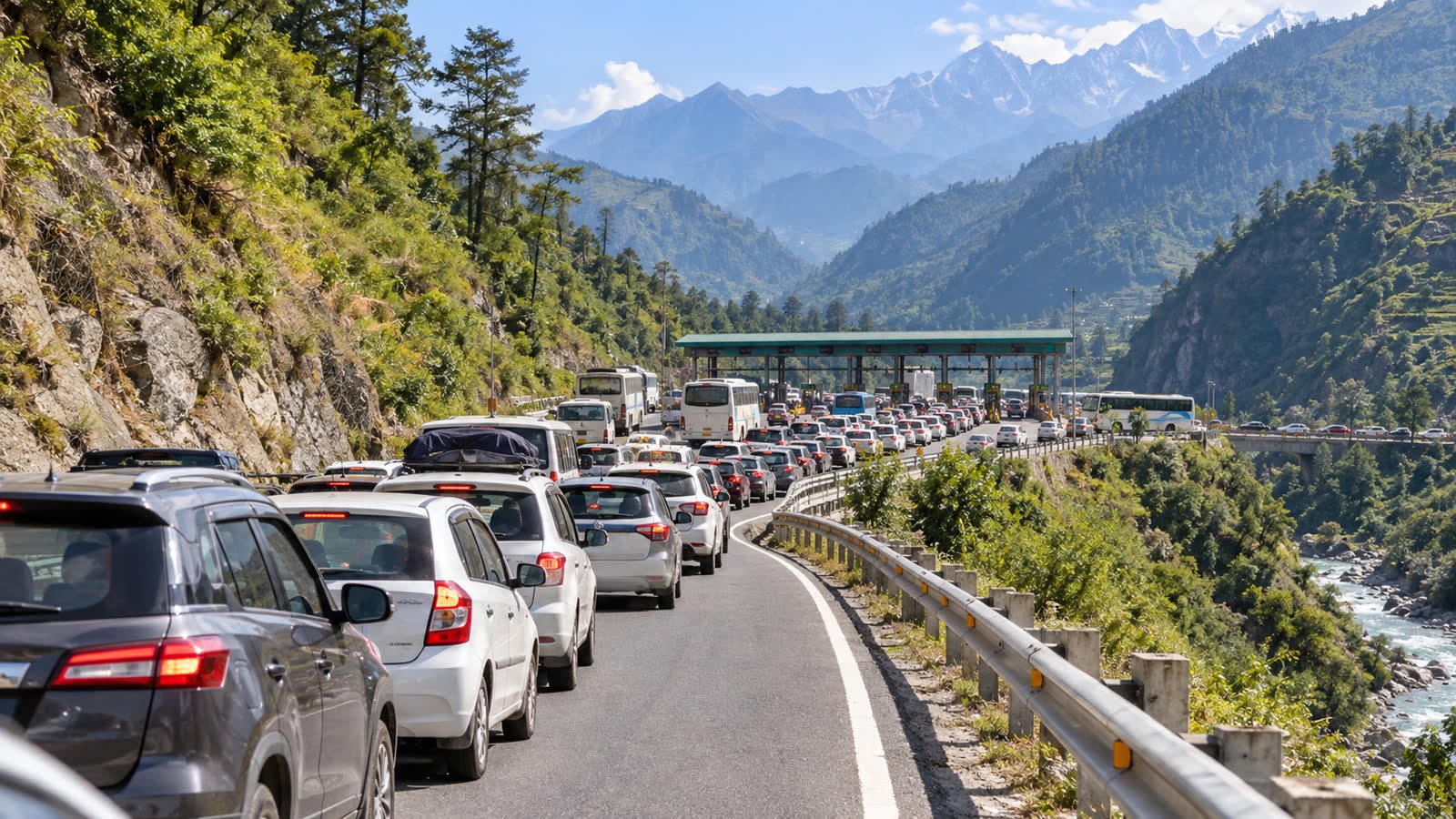
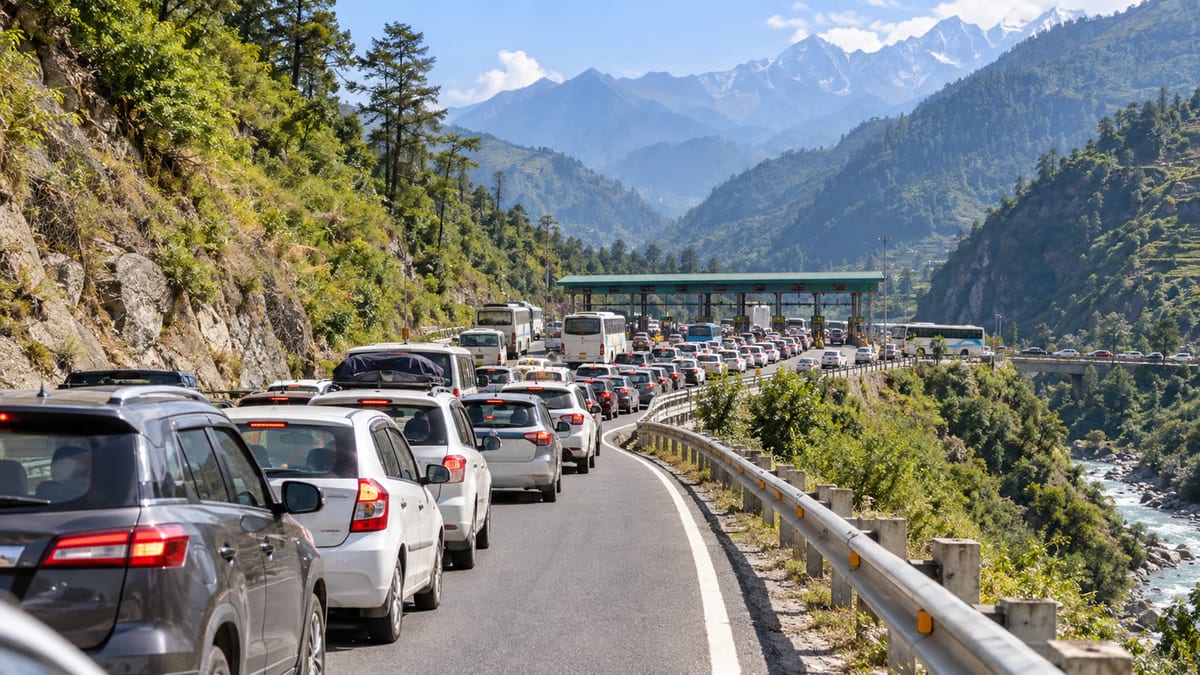 Illustrative mountain-highway traffic scene; this is not a photograph of the reported Kalka–Shimla or Joshimath–Badrinath queues. Image generated for FuelPrice.
Where the congestion is being reported
Kalka–Shimla NH-5
India Today reported on October 3 that queues on the Kalka–Shimla highway stretched for several kilometres and that traffic was moving slowly for hours. The report said the normal journey was taking several additional hours as the number of vehicles rose sharply. It also noted that the slowdown affected local residents and essential-service traffic, not only holiday visitors.
Aaj Tak’s October 2 report also described a multi-kilometre jam on National Highway-5. The two reports point to the same practical issue: the corridor can remain technically passable while the actual travel time becomes much longer than a route planner’s normal estimate.
Joshimath–Badrinath and Hemkund Sahib route
The exact distance reported for the Uttarakhand queue varies. Aaj Tak put the line between Joshimath and Vishnuprayag at about 7–9 km, while India Today described a queue of around 7 km between Joshimath and Marwari. Because the endpoints and traffic conditions were not identical, the safest reading is that this was a large, moving-but-crawling queue rather than a fixed measurement that will remain unchanged.
Both reports linked the pressure to the combination of the long weekend and pilgrim movement towards Badrinath Dham and Hemkund Sahib. Vehicles were reported to move in short bursts and then stop again, leaving travellers and local traffic facing prolonged delays.
Other hill-route pressure points
Dainik Jagran reported heavy congestion on the Mussoorie–Dehradun road and connected Mussoorie routes during the same holiday period. A separate local report from Himachal Punjab Kesari described long queues near the Parwanoo toll plaza on the Chandigarh–Shimla approach. These reports matter to drivers planning a hill trip because a delay can begin before the main climb, at a town approach or toll-plaza entry.
Why a traffic jam changes the trip cost
A slow hill journey can raise the real cost of a trip even when the toll and distance do not change. Stop-start movement keeps the engine, air-conditioning and electrical systems running for longer, while an enforced detour can add both kilometres and another toll point. The effect is especially relevant for families carrying food, water or medicines, and for taxi and commercial drivers whose schedules depend on predictable arrival times.
Before leaving, put the complete route into the road-trip planner and note the normal travel time as a baseline. Treat that estimate as a clear-road reference, not a promise for a holiday weekend. If a local advisory shows a queue, compare the main route with a practical alternative only after checking road width, daylight and the likely effect on fuel and tolls.
For the fuel side, use the fuel cost calculator with the expected distance and a sensible detour allowance. It cannot predict idling precisely, but it helps show how even a modest change in distance can affect the trip budget.
Where a route uses National Highway fee plazas, the toll-charge calculator can help separate the known toll outlay from the uncertain cost of delay. Keep the two figures separate: a traffic jam does not automatically mean that the published toll has changed.
What drivers can check before entering the hills
- Check the latest traffic message from the relevant state police or district administration close to departure, because queue length can change within the same day.
- Keep the tank or battery at a comfortable level before the uphill section. A crowded route can make a quick fuel or charging stop harder to access.
- Carry drinking water and essential medicines, and plan a safe stop before the narrowest section of the route rather than stopping on a bend or at the road edge.
- Leave space for emergency and local vehicles. Do not use the shoulder or opposing lane to bypass a stationary queue.
- If the journey is flexible, consider travelling outside the main arrival and return waves, while still checking the latest local update before setting out.
What to watch next
The present reports describe a holiday-led surge, not a permanent closure or a new toll rule. Conditions may ease after the peak inflow, but return traffic can create a second slowdown on the same corridors. Drivers should therefore recheck the route for the return journey rather than relying on the morning’s conditions.
For FuelPrice readers, the useful takeaway is simple: if a trip crosses the Kalka–Shimla, Parwanoo, Mussoorie–Dehradun or Joshimath–Badrinath corridors, allow a substantial time buffer, keep fuel and water plans realistic, and confirm the latest local traffic position before climbing into the hills.
Sources
- India Today — “Long weekend rush chokes Himachal, Uttarakhand roads with hours-long jams” — 3 Oct 2026
- Aaj Tak — “Long weekend traffic jam from Joshimath-Badrinath route to Shimla” — 2 Oct 2026
- Dainik Jagran — “Mussoorie sees major traffic jam during long weekend rush” — 3 Oct 2026
- Himachal Punjab Kesari — “Weekend tourist rush causes traffic jam at Parwanoo toll plaza” — 2 Oct 2026