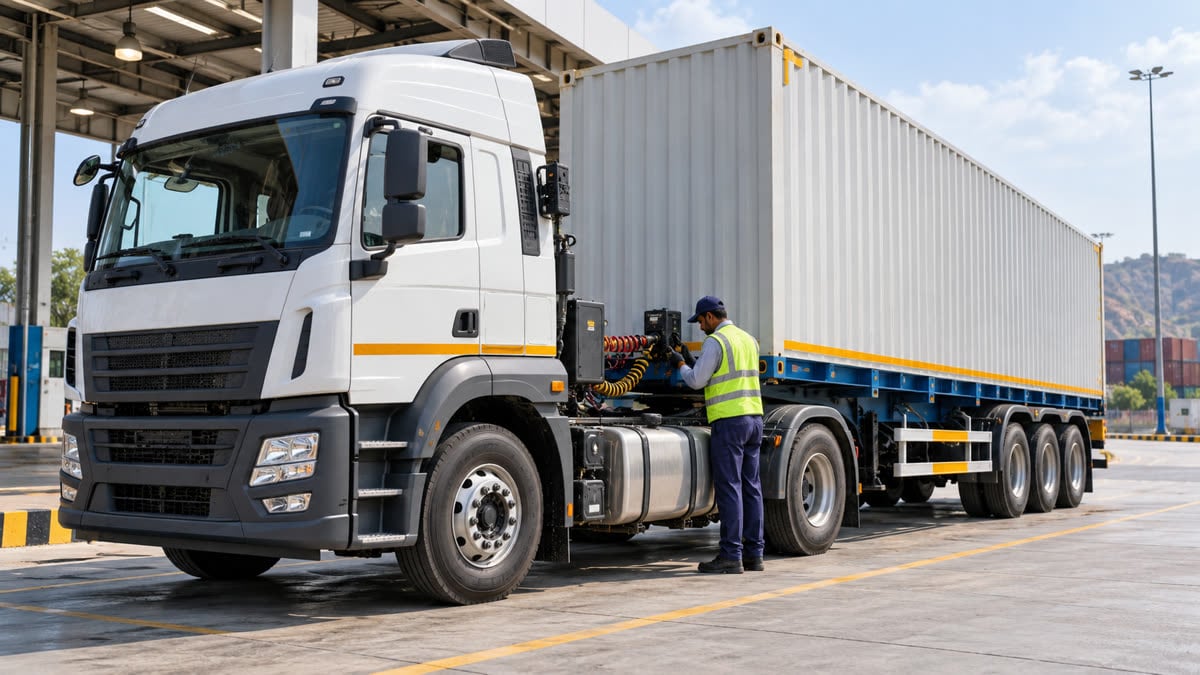
From 1 October 2026, the first compliance dates under MoRTH's Central Motor Vehicles (Fourth Amendment) Rules, 2025 are in force for covered haulage tractors and trailers. The rules require specified commercial combinations to carry AIS-140 tracking and RFID capability, while trailers must meet a 13-pin-or-more connector standard; this matters mainly to freight fleets, not private-car owners.
The final notification, G.S.R. 819(E) dated 3 November 2025, also sets a second milestone for 1 April 2027. That later date covers event data recorders and updated fifth-wheel coupling standards, so fleet operators need to separate what is live now from what is still ahead.
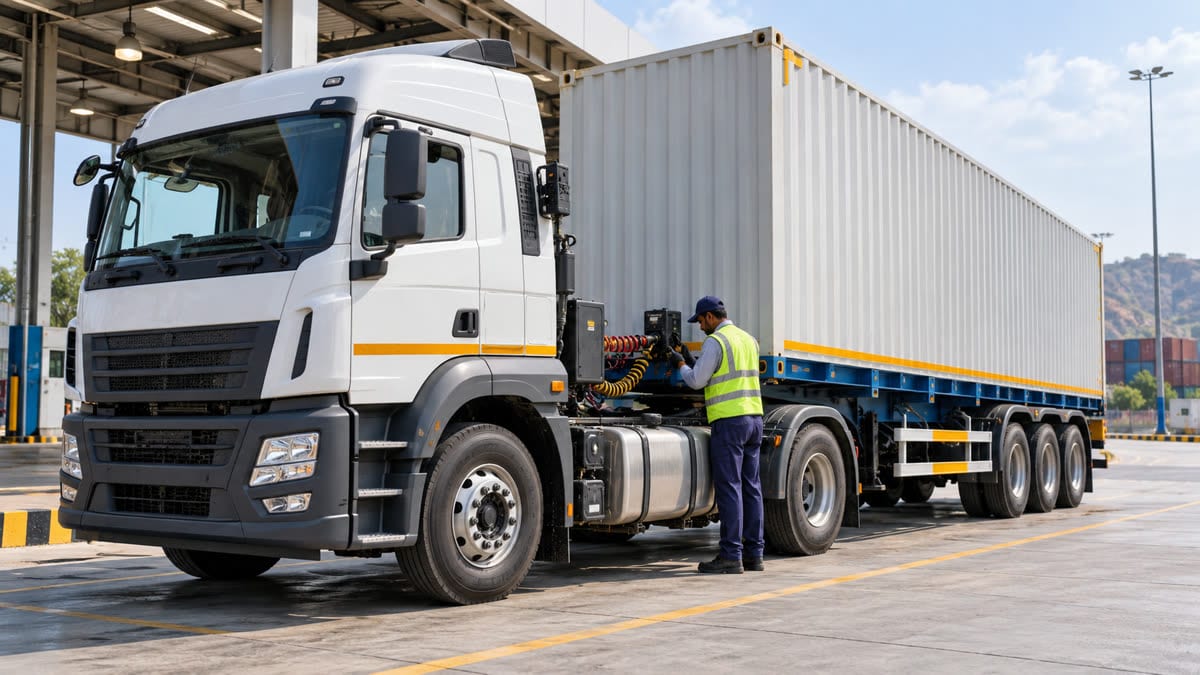 Illustration: a haulage tractor and trailer being checked for connector and tracking compliance. Credit: FuelPrice editorial image; shown for context, not an official operator photograph.
Key takeaways
- The first compliance date is 1 October 2026 for covered haulage combinations.
- N2 and N3 haulage tractors, other than agricultural tractors, are the main tractor categories in the notification.
- Covered tractors need an AIS-140 vehicle location tracking device linked to RFID capability, while T3 and T4 trailers need passive RFID identification.
- Trailers must have a 13-pin, 13-pole or higher-pin connector from 1 October 2026; event data recorders and updated fifth-wheel standards follow from 1 April 2027.
- Private cars and ordinary two-wheelers are not automatically brought under these haulage requirements.
What the 1 October rule covers
The 3 November 2025 notification defines the affected haulage tractors by category rather than by a broad reference to every commercial vehicle. N2 covers a goods vehicle with a maximum mass above 3.5 tonnes and up to 12 tonnes. N3 covers a goods vehicle above 12 tonnes. Agricultural tractors are excluded from the haulage-tractor provisions.
On the trailer side, T3 covers category T trailers above 3.5 tonnes and up to 10 tonnes, while T4 covers those above 10 tonnes. This distinction matters for mixed fleets: a light goods vehicle, pickup or locally used trailer should not be assumed to be covered merely because it carries cargo. The vehicle category and approval record are the starting point.
For the covered N2 and N3 haulage tractors, the notification requires an AIS-140:2016-compliant vehicle location tracking device, or the corresponding notified BIS specification. The tracker must be integrated with an RFID transceiver conforming to IS 16722:2018 so that it can read the identification of the coupled trailer and transmit that information to the backend. T3 and T4 trailers must carry passive RFID tags for electronic identification and pairing.
Two dates, two sets of work
| Effective date | Requirement | Who needs to pay attention |
|---|---|---|
| 1 October 2026 | AIS-140 tracking and RFID integration for covered N2/N3 haulage tractors; passive RFID tags for T3/T4 trailers; 13-pin, 13-pole or higher-pin trailer connectors. | Manufacturers, dealers and operators of covered tractor-trailer combinations. |
| 1 April 2027 | AIS-220 event data recorders for covered N2/N3 haulage tractors; updated fifth-wheel coupling requirements for the applicable tractor and trailer combination. | Covered haulage fleets planning new fitment, replacement or approval work. |
The split is important because a summary that calls every requirement an October 2026 mandate is incomplete. The event data recorder and fifth-wheel provisions have the later 1 April 2027 date. Fleet work can be staged, but the first date is already live.
What changes for freight operators
The notification does not create a new nationwide toll or fuel tax. Its immediate effect is a vehicle-compliance and records checkpoint. A covered tractor must be able to identify the trailer it is pulling, and the trailer must have compatible electrical and identification hardware. That adds coordination between the fleet owner, vehicle manufacturer or dealer, telematics installer and maintenance team.
Costs are not fixed by the notification. They can vary with the existing wiring, the tracker and RFID equipment selected, retrofit access, installation time and the way a fleet's backend records tractor-trailer pairings. A fleet should not treat a generic GPS device as proof of compliance: the rule specifies the relevant AIS and RFID standards and the integration function.
The practical check is especially important when a trailer moves between tractors or when a fleet buys a used combination. An operator can record the vehicle category, the device certification, the trailer tag and the connector inspection together, rather than relying on a sales description that says only "GPS fitted" or "road legal".
Checklist before the next dispatch
- Read the registration and approval documents to confirm whether the tractor is an N2 or N3 haulage tractor and whether the agricultural-tractor exclusion applies.
- Confirm that the vehicle location tracking device meets AIS-140:2016 or the applicable BIS specification, and that it is integrated with the required RFID transceiver.
- Check that each covered T3 or T4 trailer has the required passive RFID identification and that the pairing can be recorded by the fleet system.
- Inspect the trailer connector against the 13-pin, 13-pole or higher-pin requirement that applies from 1 October 2026.
- Keep fitment, inspection and maintenance records, and confirm any state-level fitness or enforcement procedure with the relevant transport authority before putting a disputed combination on a long route.
Do not confuse the final rule with the earlier draft
Some online summaries still rely on draft notification G.S.R. 485(E) dated 18 July 2025. That draft was published for objections and used broader wording. The controlling text is final notification G.S.R. 819(E) dated 3 November 2025, which specifies the N2, N3, T3 and T4 categories and the two effective dates. Operators comparing quotations or retrofit proposals should use the final notification and any current instructions from their registering authority.
What private road users will notice
For a private car or two-wheeler owner, this change does not by itself alter the vehicle's insurance, fuel price or toll rate. For fleet managers and transporters, however, it can affect dispatch readiness if a tractor-trailer combination is missing the required hardware or if its records cannot show the pairing and inspection status.
The rule also does not change the amount charged at a toll plaza. Operators can separately use the toll-charge calculator for route-level user fees and the fuel-cost calculator to estimate the fuel outlay for scheduled freight runs. The compliance question comes first: identify the covered vehicle category, confirm the fitment and keep evidence that the combination meets the applicable date.
Sources
- Ministry of Road Transport and Highways, “G.S.R. 819(E) — Central Motor Vehicles (Fourth Amendment) Rules, 2025,” 3 Nov 2025
- Press Information Bureau, “Year End Review 2025 — Ministry of Road Transport & Highways,” 30 Dec 2025
- AutoPDP, “G.S.R. 819(E): Hydrogen vehicle HSRP and associated CMVR amendments,” 3 Nov 2025