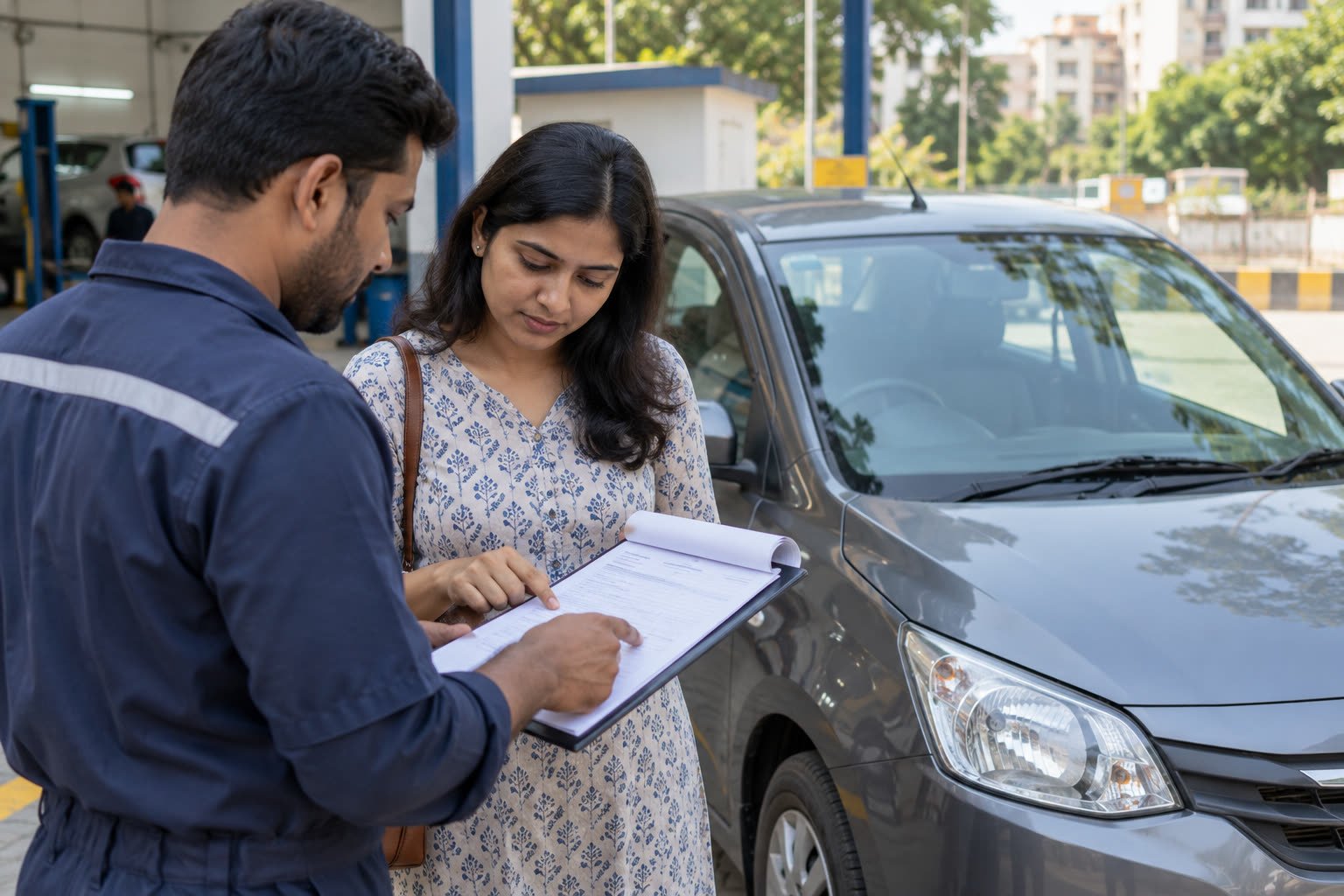
India’s provisional General Insurance Council data shows motor premium income rose 13.2% to ₹44,885.43 crore through August 2026. That does not set every owner’s renewal price, so the useful question for motorists is what the market data says—and what it does not.
Key takeaways
- Motor gross direct premium income (GDPI) reached ₹44,885.43 crore for April–August 2026, up 13.2% from the comparable period.
- Motor own-damage (OD) premium income was ₹18,798.99 crore, up 15.8%, while motor third-party (TP) premium income was ₹26,086.43 crore, up 11.4%.
- The General Insurance Council report is provisional and unaudited; its figures cover premium written by insurers, not the average renewal bill paid by an individual.
- Owners should compare the policy period, insured declared value (IDV), deductibles, claim record and add-on terms on their own renewal documents.
 Illustrative image generated for FuelPrice; it represents motor-insurance renewal and inspection context, not an insurer’s product photo.
What the August 2026 data shows
The General Insurance Council’s “Segment wise report August 2026” records gross direct premium income underwritten in India through August 2026. The report covers April–August of financial year 2026–27 and labels the figures provisional and unaudited.
| Segment | April–August FY27 (₹ crore) | April–August FY26 (₹ crore) | Year-on-year change |
|---|---|---|---|
| Motor total | ₹44,885.43 | ₹39,654.71 | 13.2% |
| Motor own damage | ₹18,798.99 | ₹16,234.71 | 15.8% |
| Motor third party | ₹26,086.43 | ₹23,420.01 | 11.4% |
| All non-life insurers | ₹1,46,760.61 | ₹1,33,940.32 | 9.6% |
The motor segment therefore grew faster than the industry’s overall 9.6% rise through August. A 1 October analysis by (Re)in Asia also described health and motor insurance as the main drivers of the recovery after July’s slower growth. The pattern matters because motor is a large, recurring household expense, but it remains an industry-level measure rather than a price list for every car or two-wheeler.
Why market growth is not a 13.2% renewal hike
GDPI is the premium insurers underwrite across a portfolio. It can increase because more vehicles are insured, the mix shifts towards newer or higher-value vehicles, more owners buy own-damage cover or add-ons, or prices change for some risks. The headline percentage does not isolate any one of those effects.
That distinction is important at renewal. IRDAI’s motor-insurance guidance says different insurers can charge different premiums for similar own-damage coverage and that multiple quotes are worth comparing. It also says third-party liability insurance is mandatory for vehicles plying on public roads. The individual quote can therefore vary with the vehicle, location, use, claims history, selected IDV, voluntary deductible and cover options.
The council also flags a reporting caveat in the August report: following a change in IRDAI reporting formats from 1 October 2024, long-term-policy premium figures are treated differently, so the reported growth rates should not be read as a perfect like-for-like measure for every long-term policy. That is another reason to treat the 13.2% as a market direction, not a promise about a renewal notice.
What vehicle owners should check now
Read the quote line by line
Check whether the renewal document separates third-party liability from own-damage cover, shows the policy start and end dates, and states the IDV. A lower total can reflect less cover or a higher deductible, while a higher total can include add-ons or a different insured value. The comparison is meaningful only when the coverage and excess are comparable.
For a plain-language background on third-party, comprehensive and IDV terms, readers can use FuelPrice’s car insurance coverage guide. It explains the terminology without turning an industry statistic into a product recommendation.
Check claim and vehicle details
Verify the no-claim bonus entry, registration number, vehicle variant, declared use and any approved modifications. IRDAI specifically notes that a CNG or LPG kit should be recorded with the registering authority and disclosed to the insurer so the kit can be considered in the policy. Owners should also check whether an add-on has exclusions, claim limits or a separate deductible.
EV owners have an additional comparison point because battery, charger, roadside assistance and repair terms can differ. Our EV insurance cover checks explain the items that need separate attention at renewal.
What to watch in the next data release
The next monthly council report will show whether the motor segment’s momentum continues beyond August and whether the balance between own-damage and third-party premium changes. For policyholders, the more useful signal will be whether their own renewal quote changes alongside the cover, IDV and claim terms—not whether the industry total moves by the same percentage.
FuelPrice has also reported on the separate debate around motor-insurance claim ratios and distribution commissions. That context is useful for understanding why market growth, claim experience and policyholder pricing can move on different timelines; it does not establish that any individual insurer must change a customer’s premium.
The practical takeaway is simple: use the industry data to understand the direction of the market, then assess the document in front of you on its own terms. For more vehicle and insurance updates, follow the latest FuelPrice news.
Sources
- General Insurance Council, “Segment wise report August 2026” — August 2026, provisional and unaudited
- (Re)in Asia, “India’s GI direct premium growth rebounds to 10% in August as health, motor advance” — 1 Oct 2026
- Insurance Regulatory and Development Authority of India, “Motor Insurance - Policy Holder” — accessed 2 Oct 2026
This article is for general information only and is not financial, insurance or legal advice.