Mumbai’s five entry-point tolls increased for specified commercial vehicles on 1 Oct 2026, lifting the per-trip charge to ₹90 for mini buses and light commercial vehicles, ₹180 for trucks and buses, and ₹225 for heavy motor vehicles. Private cars and SUVs remain exempt at these entry points, so the immediate change is aimed at commercial operators and the cost of moving goods into and out of the city.
Key takeaways
- The revised rates took effect on 1 Oct 2026 at five Mumbai entry points.
- Mini buses and LCVs now pay ₹90 per trip, up from ₹75; trucks and buses pay ₹180, up from ₹150; heavy motor vehicles pay ₹225, up from ₹190.
- The affected locations are Vashi, Airoli, Dahisar and the two Mulund entry points.
- Private cars, SUVs, public transport buses, auto-rickshaws and taxis remain exempt under the existing arrangements reported by major Mumbai news outlets.
- MSRDC’s coupon option, as reported for the revised schedule, offers discounts for advance books of 50 or 100 coupons.
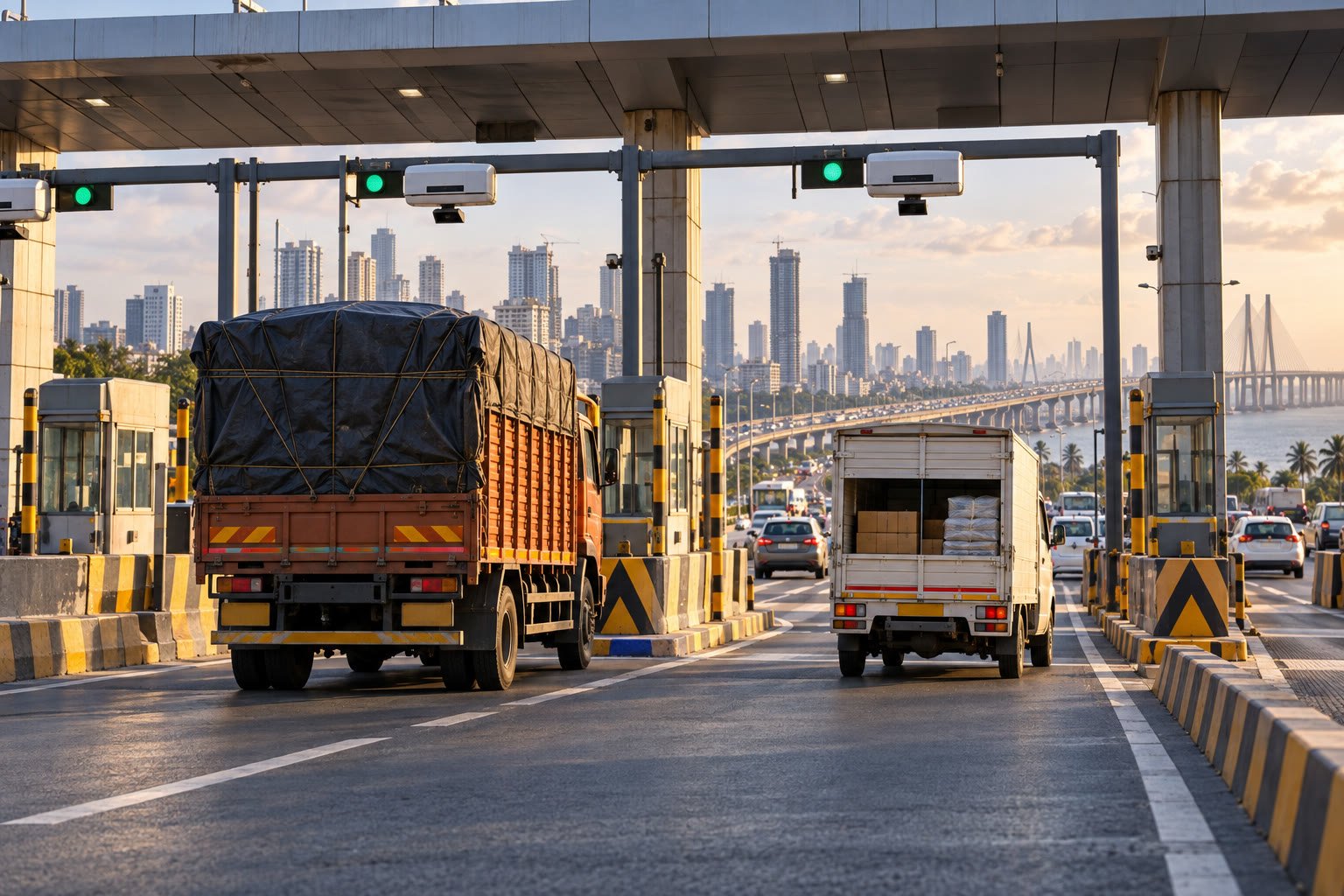
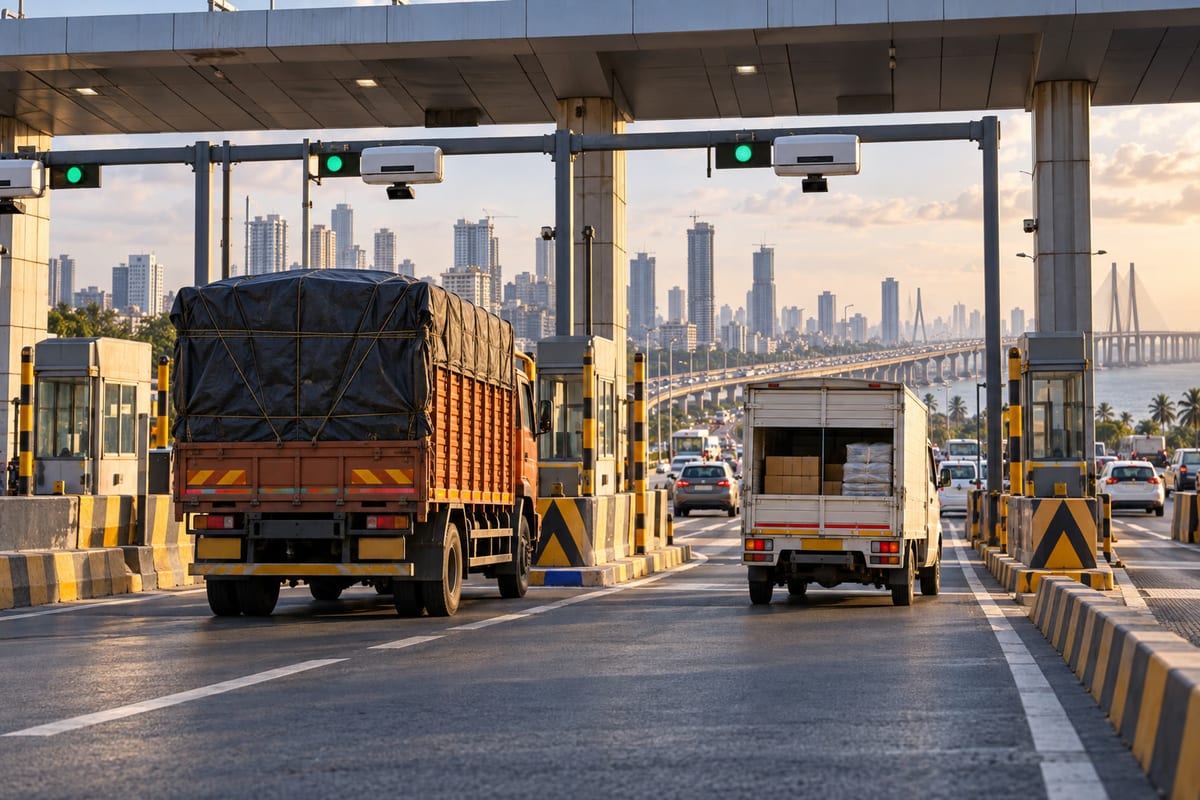 Illustrative editorial view of commercial vehicles at an urban FASTag toll entry; generated for FuelPrice and not a photograph of a specific Mumbai toll plaza.
What changed at Mumbai’s entry points
The Maharashtra State Road Development Corporation, or MSRDC, announced the revised charges for commercial vehicles entering and exiting Mumbai. The Economic Times reported on 30 Sep 2026 that the new schedule would apply from 1 Oct 2026, while The Times of India reported the live rates after the change took effect. The new amounts replace the schedule that had applied from 1 Oct 2023.
| Vehicle category | Earlier rate per trip | Rate from 1 Oct 2026 | Increase per trip |
|---|---|---|---|
| Mini bus or LCV | ₹75 | ₹90 | ₹15 |
| Truck or bus | ₹150 | ₹180 | ₹30 |
| Heavy motor vehicle | ₹190 | ₹225 | ₹35 |
The Economic Times and The Times of India both reported these per-trip amounts and described the change as a scheduled revision after the previous three-year rate cycle. The increase is charged each time an affected vehicle passes an entry point; it is not a monthly flat fee.
Which routes and vehicles are covered
The five toll points are Vashi on the Sion–Panvel Highway, Airoli Bridge, Dahisar on the Western Express Highway, Mulund on Lal Bahadur Shastri Marg and Mulund on the Eastern Express Highway. The Atal Setu toll is charged separately, so this revision should not be read as a change to the bridge’s separate rate structure.
The immediate impact is not on ordinary private-car commuters. Hindustan Times and The Times of India reported that private cars and SUVs remain exempt, alongside exemptions covering school buses and state transport buses. Public transport buses, auto-rickshaws and taxis were also reported as exempt. Fleet owners need to identify the vehicle category and the exact toll point on the route rather than assume that every vehicle entering Mumbai faces the same charge.
What the increase can add to a regular run
The absolute increase looks small on a single passage, but repeated crossings change the calculation. The Times of India illustrated the effect for a vehicle that crosses one toll point once in each direction on 26 working days, without adding extra trips.
- An LCV would add about ₹780 a month: ₹15 extra per passage × two passages a day × 26 days.
- A truck or bus would add about ₹1,560 a month on the same pattern: ₹30 × two × 26.
- A heavy motor vehicle would add about ₹1,820 a month: ₹35 × two × 26.
These are illustrations, not a universal fleet cost. A vehicle that crosses more than one of the five points, makes multiple deliveries, uses a different schedule or travels on fewer days will have a different total. Operators can use FuelPrice’s toll-charge calculator hub to separate the toll portion of a route estimate, then add the vehicle’s fuel use through the fuel cost calculator.
Coupon discounts and what operators should check
MSRDC’s public notice for the previous rate cycle recorded a discount mechanism for advance coupon books: 50 coupons carried a 25% discount and 100 coupons carried a 50% discount for the specified vehicle. The Economic Times reported that the option is available under the revised schedule, with discount journey smart cards issued at the toll plazas. The relevant vehicle, toll point and validity terms should be checked before treating a coupon as a monthly saving, because the discount applies to the particular vehicle and journey arrangement.
For a fleet comparing routes, the useful comparison is the total trip cost rather than toll alone. Fuel prices, loading time, empty return kilometres and the number of Mumbai entries can outweigh the ₹15–₹35 change on one passage. FuelPrice’s live fuel-price hub can be checked alongside toll estimates when a route budget is updated.
Why freight costs are part of the story
Transporter representatives told the Economic Times that the higher toll directly raises operating costs and could be reflected in freight charges. That is a reported concern, not an automatic price increase: the final effect depends on contracts, vehicle utilisation, route choices, fuel costs and whether operators can use the coupon structure. Goods moving through Mumbai may therefore see a gradual cost effect if transporters pass on the additional expense, but the toll revision by itself does not set retail prices.
The revised charge also sits within a longer concession arrangement. Hindustan Times and The Times of India reported that toll collection at the five entry points, earlier expected to end in Nov 2026, has been extended to 17 Sep 2029. The three-year revision pattern means operators will need to keep checking official schedules rather than assume that the 1 Oct 2026 rates are permanent.
What changes now
From 1 Oct 2026, affected commercial vehicles should be budgeted at the new per-trip rates when they use Vashi, Airoli, Dahisar or either Mulund entry point. Private-car users do not face a new Mumbai entry toll under this revision, and Atal Setu remains a separate tolling facility. The practical checklist for a transporter is the vehicle category, number of daily crossings, coupon eligibility and the route’s fuel and toll total.
Sources
- The Economic Times: Mumbai entry/exit toll for commercial vehicles to rise from October 1; transporters fume — 30 Sep 2026
- The Times of India: Mumbai’s toll bill gets costlier for goods vehicles: New rates kick in at 5 entry points — 1 Oct 2026
- Hindustan Times: Toll rates at Mumbai’s 5 entry points to increase by 20% starting October 1 — 30 Sep 2026
- MSRDC: Public Notice on revised Mumbai Entry Points toll rates and coupon discounts — 2023 rate cycle