Nayara Energy has raised petrol prices by ₹5 per litre and diesel prices by ₹3 per litre at its retail network with effect from the early hours of Saturday, 3 Oct 2026, according to reports by Business Standard and Rediff Moneynews. The move affects refuelling at the private retailer’s pumps; it is not a nationwide increase announced for every petrol station, so the outlet brand and displayed rate matter.
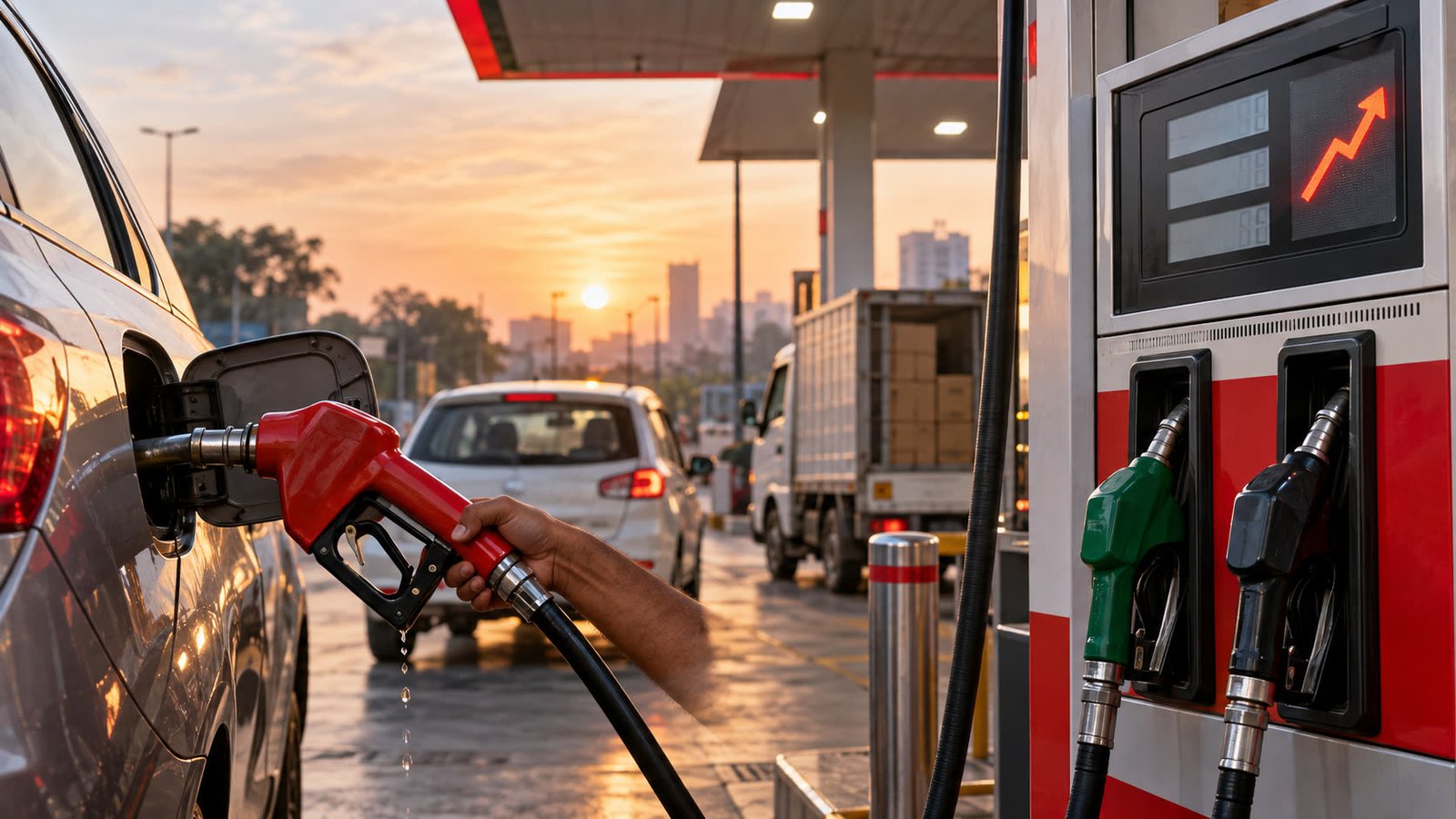
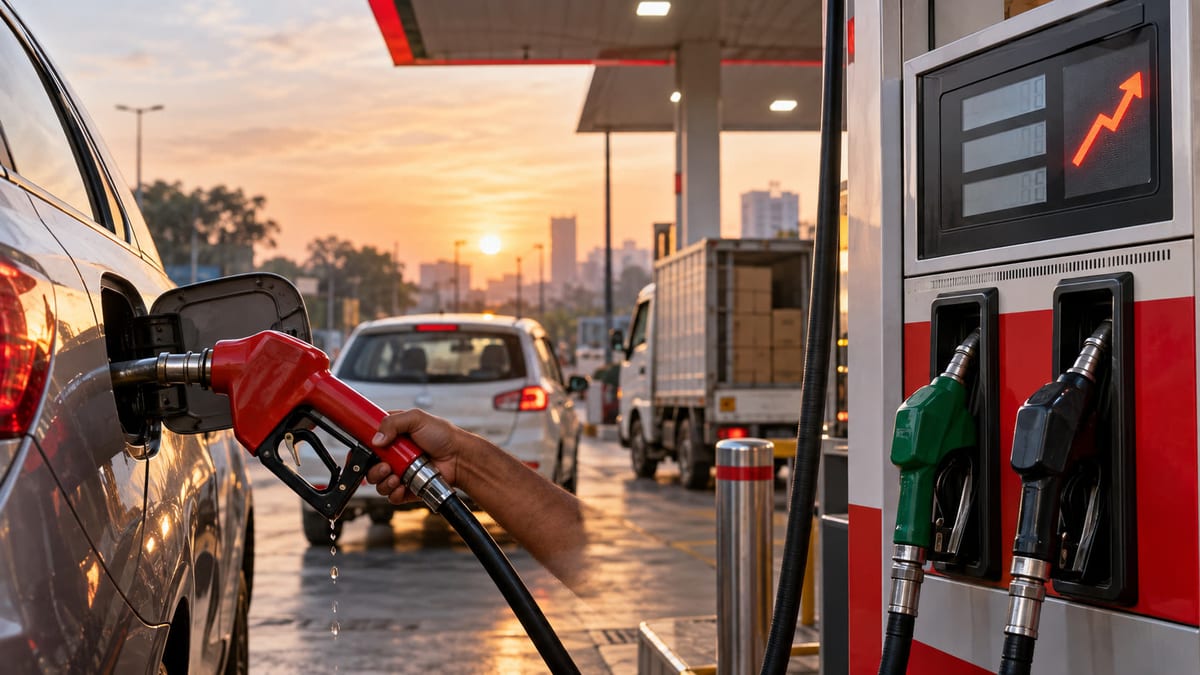 Illustration: a generic Indian fuel forecourt showing a reported price increase; this is not a photograph of a Nayara Energy outlet. Credit: FuelPrice, generated editorial illustration.
Key takeaways
- Petrol is reported to be ₹5 per litre costlier and diesel ₹3 per litre costlier at Nayara outlets from 3 Oct 2026.
- The reported change applies to Nayara’s network, which the current reports describe as 7,108 petrol pumps across India.
- Using the reported increments, a 40-litre petrol fill-up would be ₹200 higher and a 60-litre diesel fill-up ₹180 higher, before any other price or volume difference.
- The report does not announce a matching change at every fuel retailer. Check the pump display and receipt for the actual rate charged.
What changed at Nayara pumps
The latest revision was reported as an immediate price increase, with the new rates taking effect in the early hours of 3 Oct. Business Standard said Nayara was seeking to narrow the gap between retail prices and higher international crude and refined-product costs. An email seeking comment from a Nayara spokesperson had not been answered when that report was published, so the change should be described as reported rather than as a company-issued public notification.
This is a renewed change after the retailer’s earlier price moves in 2026. Business Standard reported that Nayara had reduced petrol by ₹5 per litre and diesel by ₹3 per litre on 1 Jul after global crude prices eased, reversing its March increase. The 3 Oct revision therefore puts the focus back on how quickly private retail prices can respond when the cost of crude and finished fuel rises.
Drivers who want a broader view of current city and state rates can compare them on FuelPrice’s live fuel prices page. The rate shown there should still be checked against the display at the specific outlet, because the current reports concern Nayara’s network and do not establish one uniform rate for all brands.
What the increase means for a fill-up
The direct effect is easy to estimate from the reported per-litre change. The examples below are arithmetic illustrations based on the 3 Oct revision; the final bill depends on the litres dispensed and the rate shown at the outlet.
| Fuel use | Illustrative volume | Extra cost from reported hike |
|---|---|---|
| Petrol car | 40 litres | ₹200 |
| Diesel car or SUV | 60 litres | ₹180 |
| Diesel fleet purchase | 1,000 litres | ₹3,000 |
For a private car, the extra amount appears each time the vehicle is refuelled at the revised Nayara rate. For a delivery operator, taxi owner or small goods carrier, the larger issue is the monthly total: a fleet using 1,000 litres of diesel in a month would face ₹3,000 of additional fuel cost if every litre were bought at the reported ₹3-per-litre increase. That is a calculation, not a forecast of what any particular operator will pay.
Readers planning a commute or road trip can put their vehicle’s mileage and distance into the fuel cost calculator and then update the result with the rate displayed at the chosen pump. A per-litre change can look small on one visit but become material when multiplied across regular trips, commercial kilometres or repeated monthly fills.
Why the timing matters for fuel users
The price revision comes after a week in which fuel availability and retail pricing were both under scrutiny. The Economic Times reported on 2 Oct that Oil Secretary Neeraj Mittal said no company was allowed to cap fuel sales at pumps, amid reports that Nayara Energy and Jio-bp had limited some diesel volumes. That was a separate government warning about sales restrictions; the new reported price change does not, by itself, confirm a shortage or guarantee that every Nayara station will have identical stock and pricing.
FuelPrice’s earlier report on private-pump diesel sales caps and Nayara’s supply position covered that availability question. The new development is the retail-rate revision. For transporters, the two issues need to be tracked separately: whether fuel is available in the required quantity, and what price is printed on the receipt.
State-owned oil marketing companies supply the large majority of India’s petrol pumps and have historically adjusted retail rates differently from private retailers. The current reports do not establish a nationwide revision by all companies. A driver moving between brands should therefore avoid carrying over a Nayara rate to an Indian Oil, BPCL, HPCL or Jio-bp outlet without checking the local display.
What drivers and fleet operators should check now
- Confirm the retailer name and fuel grade before authorising the fill. The reported ₹5 and ₹3 changes are tied to Nayara’s petrol and diesel network.
- Look at the per-litre rate on the dispenser and retain the receipt with the date, time and outlet. This is especially useful for business or fleet expense records.
- Recalculate a regular route using the actual quantity normally purchased, rather than assuming that a full tank has the same volume for every vehicle.
- For a longer trip, use the road-trip planner to review route distance and estimated fuel needs, then confirm the live pump rate before departure.
What to watch next
The next signals will be whether other private retailers revise their rates, whether state-owned companies announce a separate change, and whether international crude and refined-product costs remain high enough to keep pressure on retail margins. A formal clarification from Nayara would also help establish the exact outlet coverage and whether the reported increase varies by state because of local taxes.
For now, the clear reader takeaway is limited but useful: at Nayara outlets, reports dated 3 Oct 2026 put petrol ₹5 per litre higher and diesel ₹3 per litre higher with immediate effect. That does not mean every fuel station in India has raised its price. Compare the displayed rate, record the receipt and use the actual price in any trip or monthly fuel calculation.