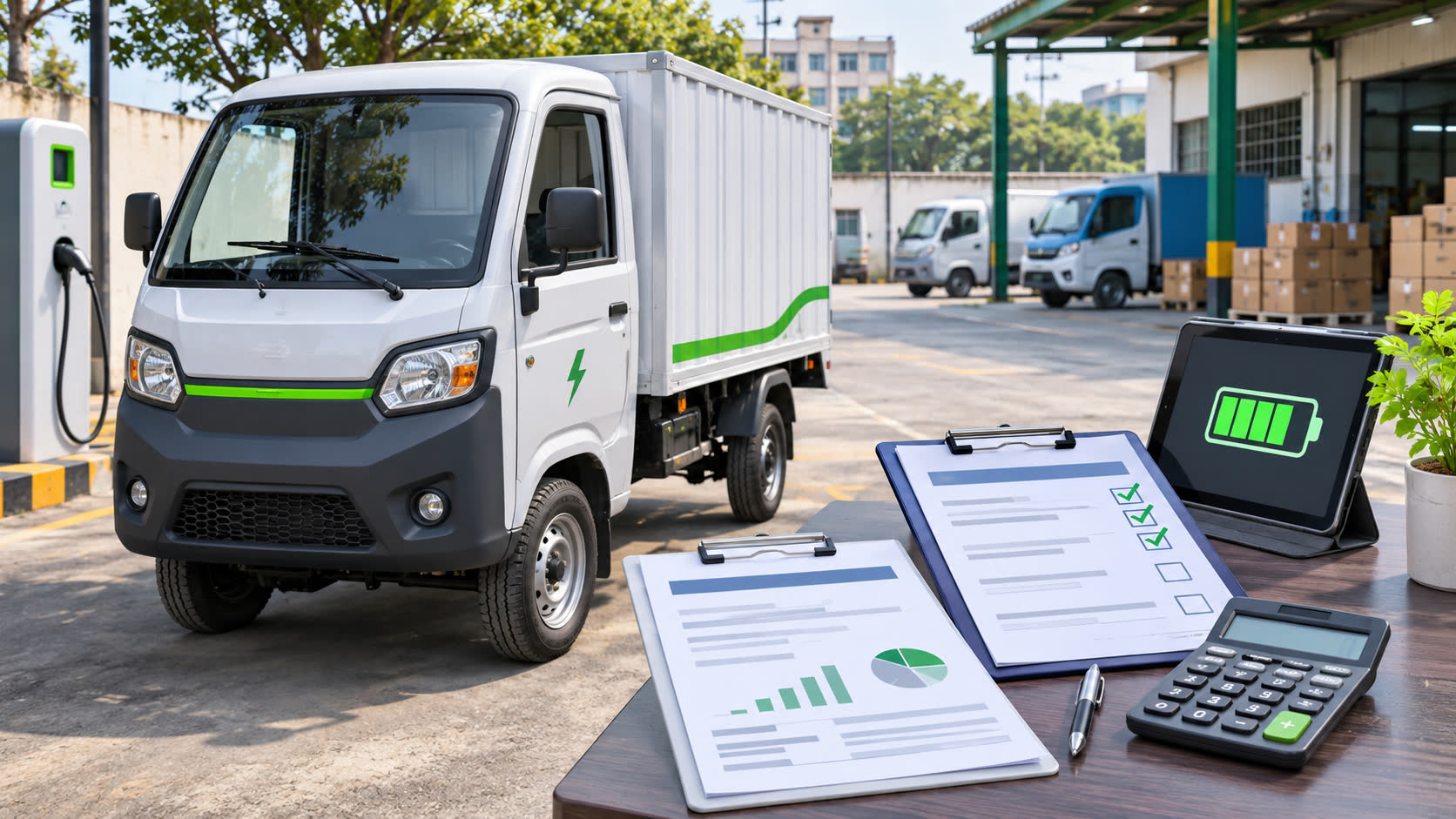
Tata Motors and Finzo EV Solutions, which operates under the Turno brand, announced a memorandum of understanding on 11 Nov 2026 covering customised financing, faster loan disbursals and flexible repayment plans for Tata's electric small commercial vehicle and pickup customers. The arrangement also includes a 25% assured buyback guarantee, but operators still need the written valuation basis, eligibility rules and tenure before treating that figure as part of their vehicle economics.
Key takeaways
- The MoU announced on 11 Nov 2026 covers Tata Motors' electric small commercial vehicles and pickups, not a general passenger-car finance offer.
- Turno will support customised financing, quicker disbursals and flexible repayment plans, while bringing battery-intelligence and EV lifecycle capabilities.
- The reported buyback figure is 25%; the public announcement does not state whether it is based on invoice value, financed amount or another valuation.
- No fixed interest rate, EMI, vehicle price or universal savings promise has been announced; actual offers can vary by lender, vehicle and operator profile.
What Tata Motors and Turno announced
PTI, in a report published by The Week, and Autocar Professional separately reported on 11 Nov 2026 that Tata Motors had partnered with Finzo EV Solutions through an MoU for its electric small commercial vehicle and pickup customers. The announced support combines customised financing with quicker loan disbursals and repayment plans that can be structured around commercial-vehicle ownership.
Turno's role is linked to battery intelligence and electric-vehicle lifecycle management. Its own company description says it works on commercial EV financing, battery valuation and lifecycle solutions. That background helps explain why the partnership addresses both the loan stage and the vehicle's eventual resale, but it does not by itself define the terms available to every operator.
The announcement is not a stated cut in Tata Motors' ex-showroom prices, a government subsidy or a fixed-interest-rate offer. The reports do not provide a model-wise price, annual interest rate, EMI, down payment or loan tenure. Those details remain important because a faster disbursal does not necessarily mean a lower total borrowing cost.
Why financing and resale matter to electric SCV operators
For a last-mile operator, the monthly instalment is only one part of the ownership calculation. Daily kilometres, payload, charging access, electricity tariff, downtime, maintenance, insurance and the expected exit value all affect whether an electric small commercial vehicle fits a delivery route. A buyback commitment can reduce uncertainty at the end of the holding period, but it does not automatically lower the monthly outgo or guarantee a positive business return.
Operators comparing a mixed fleet can use FuelPrice's fuel cost calculator to establish a diesel-route baseline, then check the EV station directory for charging access along the operating area. The road-trip planner can help map distance and time assumptions before a claimed running-cost advantage is treated as a fleet-wide result. These tools do not replace a lender's repayment schedule or a vehicle-specific quotation.
What the 25% buyback figure does—and does not—tell operators
The 25% figure reported by PTI and Autocar Professional is an announced assured buyback guarantee. It should not be read automatically as 25% of the original invoice price. Coachbuilders India noted that the public announcement did not specify the valuation basis, eligibility criteria or tenure of the guarantee.
That missing detail is material. A contract could calculate the percentage against an agreed residual value, a vehicle's assessed value at hand-back or another defined base. It may also set conditions around the holding period, kilometres, battery health, accident history, service records, outstanding finance and inspection. Until those conditions are published, the headline percentage cannot be converted into a guaranteed rupee amount for a particular vehicle.
Before using the buyback in a business case, an operator should seek written answers to five points:
- What value is the 25% applied to, and on what date is that value fixed?
- What vehicle variants, payload configurations and customer profiles qualify?
- What tenure, mileage, battery-health and service conditions apply?
- Who funds the buyback, and how is any outstanding loan settled at hand-back?
- What happens if the vehicle is damaged, modified, transferred or taken out of the programme early?
Financing checks before comparing offers
The financing portion also needs a contract-level comparison. A commercial buyer should look for the lender and product name, annual interest rate or APR, down payment, repayment tenure, processing and documentation charges, late-payment terms, foreclosure conditions and any bundled insurance or service products. A flexible repayment plan can be useful for a business with uneven cash flow, but the total amount payable still depends on the rate, tenure and fees.
The same comparison should identify whether Turno's buyback support is separate from the loan, whether the lender has to approve the exit, and whether the guaranteed amount is paid to the operator or adjusted against the finance balance. These are factual terms to confirm in the offer documents, not assumptions to make from the word “guarantee”. Actual financing offers may vary by lender, vehicle, credit assessment and business profile.
Which Tata electric commercial vehicles are in view?
Autocar Professional reported that Tata Motors' electric SCV and pickup portfolio includes the Ace Pro EV, Ace EV 1000 and Intra EV Pickup, with different load-deck and payload configurations. The practical question for a buyer is therefore not only whether the brand is covered, but whether the exact variant, use case and delivery route fall within the financing and buyback programme's written terms.
In the near term, the partnership creates a new announced ownership-support channel for electric commercial vehicles. The next useful development will be the publication of lender names, model-level eligibility, repayment examples and the buyback policy. Until then, the 25% headline is best treated as a reported programme feature that requires documentation before it is included in a fleet-cost calculation.
The reader takeaway
Tata Motors' Turno tie-up is relevant to Indian delivery businesses because it targets two practical barriers to electric SCV adoption: access to finance and uncertainty over resale. It confirms a reported 25% assured buyback figure and customised financing support, but it does not yet disclose enough to calculate a specific EMI, saving or resale amount. The useful next step for an operator is to compare the written finance schedule, battery and service conditions, charging plan and buyback formula together.
Sources
- The Week (PTI) — “Tata Motors partners with Finzo EV Solutions to make electric commercial vehicles more accessible” — 11 Nov 2026
- Autocar Professional — “Tata Motors Partners Turno To Offer Financing And Buyback For Electric SCVs” — 11 Nov 2026
- Coachbuilders India — “Tata Motors Partners With Turno To Address EV Financing And Resale Concerns” — 11 Nov 2026
- Turno — “Battery Intelligence for Commercial EV in India” — company overview accessed 11 Nov 2026
This article is for general information only and is not financial, insurance or legal advice.