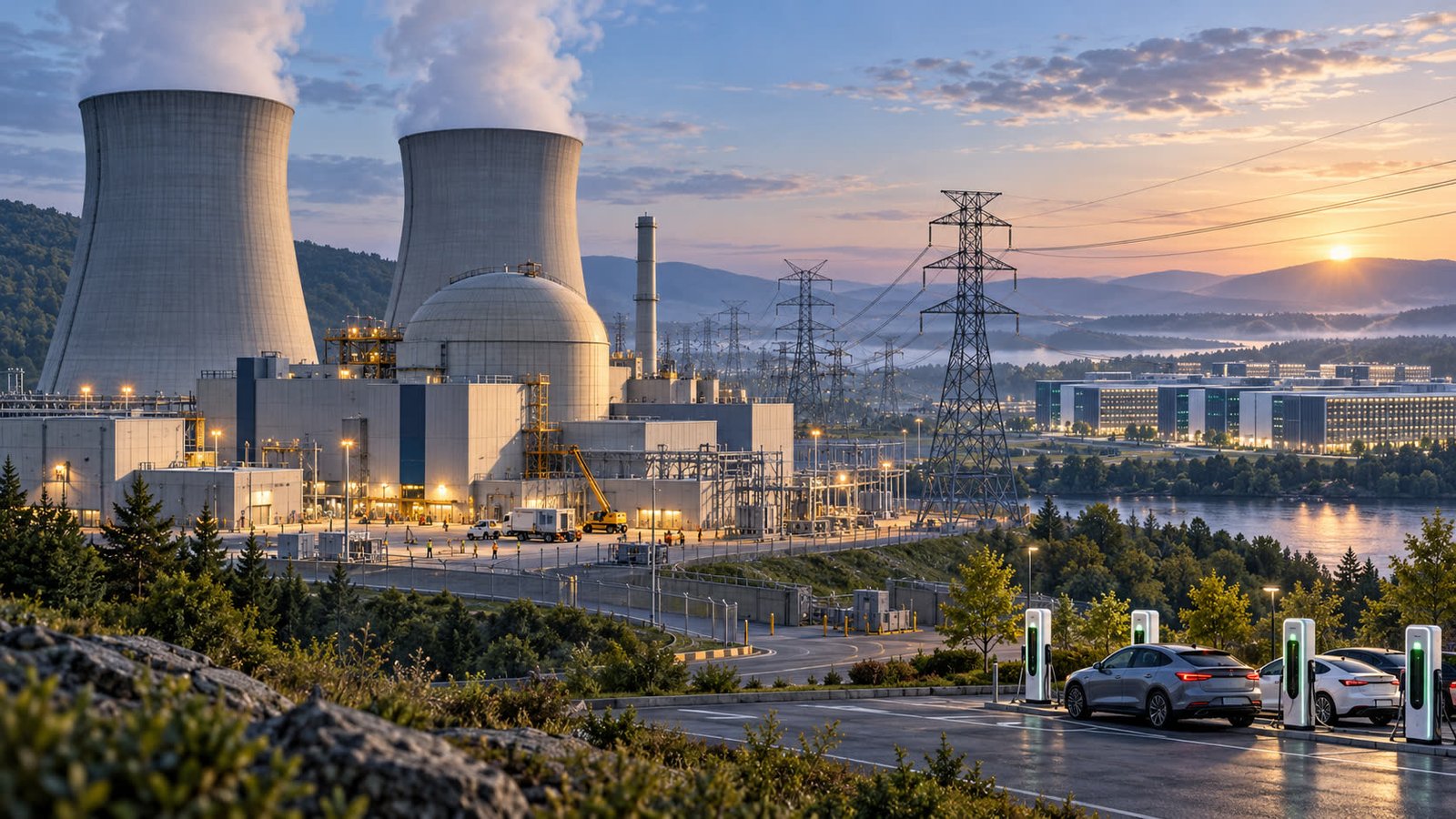
Federal financing in the United States is supporting the restart of three shuttered nuclear plants that could return about 2.25 gigawatts (GW) of baseload electricity to the grid. The move, reported by the Associated Press on 16 Oct 2026, is a test of whether existing nuclear sites can be brought back to meet rising demand from data centres, manufacturing and electrified transport.
Key takeaways
- The projects are Palisades in Michigan, the Crane Clean Energy Center in Pennsylvania and Duane Arnold in Iowa.
- U.S. Department of Energy project records list up to $4.42 billion in combined loans or loan support across the three sites, while AP reports the programme as up to $4.4 billion.
- The combined nameplate capacity is 2,250 megawatts, or 2.25 GW, but the plants still need regulatory approvals and refurbishment before they can deliver power.
- The immediate story is about grid supply, not a sudden change in petrol, diesel or electric-vehicle charging prices.
What the US is financing
AP reported on 16 Oct that the Energy Department is lending as much as $4.4 billion to restart the three plants. The department's project records give the more precise breakdown: $1.52 billion for the 800 MW Palisades station, $1.0 billion for the 835 MW Crane restart, and up to $1.9 billion for the 615 MW Duane Arnold project. Added together, those listed amounts total up to $4.42 billion; the financing is not one single grant and does not mean every dollar has been drawn.
| Project | Location | Listed capacity | Financing | Latest timing |
|---|---|---|---|---|
| Palisades | Michigan | 800 MW | $1.52 billion loan | Power-purchase agreements require service by March 2027 |
| Crane Clean Energy Center | Pennsylvania | 835 MW | $1.0 billion loan | Company hopes to return it in 2027 |
| Duane Arnold | Iowa | 615 MW | Up to $1.9 billion loan | Targeted for early 2029 |
Why retired reactors are back in focus
The plants closed when their power was no longer competitive or, in Duane Arnold's case, after storm damage. The economics have changed as utilities and technology companies look for large volumes of firm, low-carbon electricity. AP reported that Microsoft has a contract tied to Crane and that Google and NextEra are collaborating on the Duane Arnold restart.
That demand is important because a nuclear restart is not the same as switching on a spare generator. Owners must bring back specialised staff, check equipment, secure fuel and satisfy the U.S. Nuclear Regulatory Commission. AP quoted a University of Michigan nuclear engineering expert who said an existing connected site can be quicker to revive than building a new large reactor, but also stressed that the process remains complex.
What it means for EVs, drivers and fleets
For drivers, the federal financing does not reduce a petrol or diesel pump price overnight. Nuclear plants produce electricity, so the potential benefit appears in regional grid supply and reliability rather than directly in the price of road fuel. A fleet operator can still isolate the fuel portion of a journey with the fuel cost calculator, independent of this long-term power project.
Electric-vehicle users may eventually see a more reliable supply of low-carbon power as additional firm generation supports charging and other electrified loads. That does not guarantee cheaper charging: local tariffs, network charges, contracts and the timing of demand still determine what a driver pays. Readers planning an EV journey can use the EV station directory to check charging access while this generation remains under development.
The wider significance is international. Governments and utilities in several markets are weighing whether existing nuclear, gas, renewables and storage assets can be preserved or repurposed as energy security concerns and electricity demand rise. If these three projects return on schedule, they will offer a visible test of whether old nuclear sites can add capacity faster than wholly new projects. If approvals or refurbishment take longer, the headline capacity will remain a plan rather than power available to consumers.
What happens next
Licensing is the key gate. The DOE records say the restarts remain subject to NRC approvals. Palisades is the furthest along, but AP reported that fuel loading was paused after a fuel assembly tilted and the operator reviewed what happened. Crane is expected to work toward a 2027 return, while the Duane Arnold plan points to early 2029. Those dates are targets, not guarantees.
For energy users, the useful signals to watch are the NRC decisions, confirmed grid-connection milestones, the condition of each plant's long-term power contracts and whether the projects reach commercial operation. Those updates will show whether federal financing is translating into dependable electricity for industry, data centres and transport electrification. Follow the worldwide fuel and energy news archive for the next developments.
Reader takeaway
The U.S. is using federal loan support to bring three closed nuclear sites back into the energy conversation, with up to 2.25 GW of potential capacity. It is a long-term grid and energy-transition story: drivers should not expect an immediate change at the pump, while EV users and fleets should watch local charging reliability, electricity tariffs and the projects' actual commissioning dates.
This article is for general information only and is not financial, insurance or legal advice.
Sources
- Associated Press — “US is reviving shuttered nuclear plants to meet growing electricity demand and to power data centers” — 16 Oct 2026
- U.S. Department of Energy — “Palisades” project record — loan closing September 2024; accessed 17 Oct 2026
- U.S. Department of Energy — “Crane Restart” project record — loan closing November 2025; accessed 17 Oct 2026
- U.S. Department of Energy — “Duane Arnold” project record — loan closing September 2026; accessed 17 Oct 2026