As of 05 October 2026, EV charging in India is usually cheapest at home, but the amount actually billed depends on the local electricity tariff, the public charger's service fee, GST and the route. The dependable method is simple: multiply energy used in kilowatt-hours by the payable rate, then divide the bill by kilometres driven. Delhi's reported approval of 382 charging sites makes the calculation more useful for future users, but approved sites are not the same as live chargers.
This guide explains the mechanism, shows the rupee math, and gives a practical checklist for home charging and road trips. For the latest context, see the Delhi charging-site rollout update.
Key takeaways
- Use cost per km = kWh used × payable rate ÷ kilometres driven. Do not estimate from battery percentage alone.
- Home charging is billed under the applicable domestic electricity tariff. The Ministry of Power says an existing home connection can be used, subject to sanctioned-load requirements.
- Tata.ev's charging-support page lists a public tariff range of ₹14–₹24 per kWh and says 18% GST is added; this is a published operator range, not a universal India-wide price.
- Government charging-tariff benchmarks and the driver's final public bill are different: service charges, GST, parking and idle fees can change the payable amount.
- For a comparable 15 kWh/100 km illustration, ₹8/kWh at home works out to ₹1.20/km, while the published public range plus GST works out to about ₹2.48–₹4.25/km.
1. Start with the right EV charging formula
An EV's battery capacity tells you how much energy it can store. It does not, by itself, tell you the cost of a trip. The useful inputs are the electricity drawn, the price applied to that electricity and the distance covered.
- Energy used: record the kWh shown by the charging app, wall meter or electricity bill. If you only know efficiency, calculate kWh as kilometres driven × kWh per kilometre.
- Session cost: kWh billed × the applicable per-kWh rate, plus any fixed session, parking, idle or booking fee and applicable tax.
- Running cost: total session cost ÷ kilometres driven. This produces a figure that can be compared with petrol, diesel or CNG.
- Monthly cost: monthly kilometres × kWh per kilometre × the rate you actually pay. Keep fixed electricity charges separate unless you want to allocate the whole bill to the vehicle.
For example, if a car uses 15 kWh per 100 km, it needs 150 kWh for 1,000 km. The rate that matters is the rate on your bill or charging app, not a headline about the battery size or maximum charger power.
2. Home vs public charging: what the rate really means
The Ministry of Power's 17 September 2024 charging guidelines say an EV owner may use an existing electricity connection at home and that domestic electricity rates apply. If the charger needs more power than the sanctioned load, the owner must approach the distribution licensee for a load increase. A separate metered connection is also possible under the applicable process.
Public charging has more layers. The station pays for electricity, the operator recovers equipment and site costs, and the customer may see a service fee and GST in the app. A government benchmark is therefore not automatically the final price at the socket.
| Charging route | Published or applicable figure | What it means for the driver | Check before paying |
|---|---|---|---|
| Home charging | Domestic electricity tariff; no single all-India rate | Usually the cleanest way to estimate a regular commute because the bill shows the energy cost. | Marginal slab, power-purchase adjustment, duty, fixed charges and any load-upgrade cost. |
| Public network | ₹14–₹24/kWh plus 18% GST on Tata.ev's charging-support page, accessed October 2026 | A published operator range for public charging; the actual app price can vary by location, charger and time. | Connector, current tariff, GST, parking or idle fee, minimum session fee and payment method. |
| Policy benchmark | MoP's 03 April 2025 summary lists AC charging at ₹3–₹4/kWh and DC charging at ₹11–₹13/kWh across solar and non-solar periods. | A policy-level public/community charging benchmark, not a promise of an all-in consumer bill. | Whether the displayed rate includes service charges and taxes; do not substitute this benchmark for the operator's live price. |
The Ministry of Power's 2025 summary also describes a tariff cap linked to average cost of supply until 31 March 2028, a 30% solar-hour discount and a 30% non-solar-hour surcharge for the electricity side of public charging. These provisions help shape the charging ecosystem, but the driver still needs to read the live tariff shown by the network.
Why the same EV can have different charging bills
- Location: land rent, power connection and local electricity costs differ across cities and highways.
- Charger type: a fast DC site has a different equipment and utilisation profile from an AC point at a workplace or parking facility.
- Time: operators may publish time-based prices, while parking or idle charges can begin after charging stops.
- Tax and extras: GST, convenience fees, memberships and parking conditions may be shown separately or bundled.
- Energy losses: the kWh drawn from the wall can be higher than the energy stored in the battery. The bill or charger meter is the better input for a real-world calculation.
3. Worked example: convert a tariff into ₹ per km
Use this as an illustration, not as a claim about every EV. Assume the car consumes 15 kWh per 100 km. Assume the marginal home electricity rate is ₹8/kWh; replace that assumption with the rate on the latest bill. For public charging, use the ₹14–₹24/kWh range published by Tata.ev and add the 18% GST stated on its support page.
- Energy for 100 km: 15 kWh.
- Home: 15 × ₹8 = ₹120, or ₹1.20/km.
- Public, lower end: 15 × ₹14 × 1.18 = ₹247.80, or about ₹2.48/km.
- Public, upper end: 15 × ₹24 × 1.18 = ₹424.80, or about ₹4.25/km.
For a 1,000 km month under the same assumptions, home energy cost would be 150 × ₹8 = ₹1,200. Public charging would be about ₹2,478–₹4,248 before any separate parking, idle, membership or route-detour cost. The comparison is useful because it separates energy price from the car's efficiency: a less efficient EV will use more kWh for the same distance even when the tariff does not change.
Do not treat ₹8/kWh as a national home-charging rate. It is a transparent placeholder for the example. Your slab, subsidy, surcharge, fixed charge and charging losses can produce a different bill. For the same reason, do not carry a public tariff from one app to another city without checking the current session screen.
4. What changes the cost of an EV road trip
Charging cost per kilometre is only one part of a trip budget. A long-distance driver should also price the time and the risk of an unavailable charger.
- Plan from the usable route: include detours to a charger, tolls and the distance to the next reliable stop. The road-trip planner can help organise the route before the trip.
- Check live availability: use the EV charging directory to identify stations, then confirm status, connector compatibility and opening access in the operator app.
- Carry a buffer: traffic, heat, air-conditioning, gradients and payload can increase energy use. A route that works on a brochure efficiency figure may need a different charging stop in real traffic.
- Compare time as well as rupees: a lower-energy price is not automatically the lowest trip cost if it requires a long detour or a wait at a busy charger.
Delhi's current infrastructure story illustrates the distinction. Reports on 04–05 October 2026 said 382 sites had been approved and 160–180 high-readiness locations were moving towards a first tender. Delhi Transco's 01 October 2026 notice is about stakeholder inputs for the bidding process. Until a site is commissioned and its status is visible, it should be treated as a planned option rather than a guaranteed stop.
5. Compare EV charging fairly with petrol, diesel or CNG
A fair comparison uses the same distance, the same route and prices dated to the same month. It should also separate running cost from ownership cost.
- For an EV, use actual kWh drawn divided by kilometres driven.
- For an internal-combustion vehicle, use kilometres divided by actual km per litre, multiplied by the current price per litre.
- Use the fuel cost calculator for the petrol, diesel or CNG side and keep the fuel price date visible.
- Compare insurance, maintenance, tyres, financing and depreciation separately. A lower energy bill does not prove a lower total ownership cost for every driver.
- For a longer view, the existing petrol-versus-EV running-cost guide provides a related framework; replace old prices with the current figures before making a comparison.
Monthly driving pattern matters. A commuter with dependable home parking can use a mostly home-charging rate, while an apartment resident or frequent highway traveller may use more public charging. The percentage of kilometres charged at each type should be part of the calculation.
6. Home-charging checks before installation
Charging at home can be convenient, but the physical setup and the bill need checking before the first session.
- Confirm whether the parking space has an authorised electrical route and whether the housing society or landlord has a process for installation.
- Check the sanctioned load on the electricity bill and ask the distribution licensee about an increase if the charger requires it.
- Use the charger manufacturer's installation and protection requirements; do not rely on an extension arrangement that was not designed for sustained load.
- Record the meter reading or charger-app kWh for a week. This shows the vehicle's real energy use on your commute rather than an advertised efficiency figure.
- Keep the electricity bill's fixed charges and any household consumption separate when estimating the car's marginal charging cost.
- For a shared building, clarify how a sub-meter, common-area power, billing period and maintenance responsibility will be handled.
7. Checklist before a public charging session
- Open the operator app and check the live status, price per kWh and taxes.
- Confirm the connector standard and whether the charger can deliver the power your vehicle accepts.
- Check access hours, parking rules, idle-time charges and whether a reservation is required.
- Estimate the kWh needed, rather than paying for a full battery by habit.
- Keep a second nearby station in the route plan in case the first charger is occupied or offline.
- Save the receipt or session record with kWh, tariff, tax and total amount.
- After the trip, divide the billed amount by actual kilometres to update your own ₹/km figure.
Frequently asked questions
Why is public EV charging costlier than home charging?
Home charging normally uses the applicable domestic electricity tariff. A public session also helps pay for the charger, site, software, maintenance and operating service, and may include GST, parking or idle charges. The final difference depends on the city, network and session terms.
Is there one EV charging rate for all of India?
No. Electricity tariffs, service-charge rules, operators and site costs vary. A national guideline can shape the electricity component, but the live app price at the station is the figure to use for a trip budget.
How do I calculate EV charging cost per kilometre?
Multiply the kWh used by the final payable rate, add any separate session charges, and divide by the kilometres driven. For a monthly estimate, multiply your average kWh per kilometre by monthly kilometres and by the relevant home, public or blended rate.
What should I check before relying on a new charging site?
Check that the site is commissioned, open to your vehicle, compatible with its connector, available in the operator app and clear about the tariff. An approved location or tender is an infrastructure milestone, not proof that a usable charger is already live.
Sources
- Hindustan Times, MHI approves 382 sites for EV charging infrastructure in Delhi — 04 Oct 2026
- The Tribune, Delhi's EV race hits charging test as 2027 deadline nears — 05 Oct 2026
- Delhi Transco Limited, Electrical Vehicle: stakeholder inputs for public EV charging and battery swapping — 01 Oct 2026
- Ministry of Power, Guidelines and Standards for Electric Vehicle Charging Infrastructure — 17 Sep 2024
- Ministry of Power, summary of charging-network tariff benchmarks — 03 Apr 2025
- TATA.ev, Charging Support — accessed 05 Oct 2026
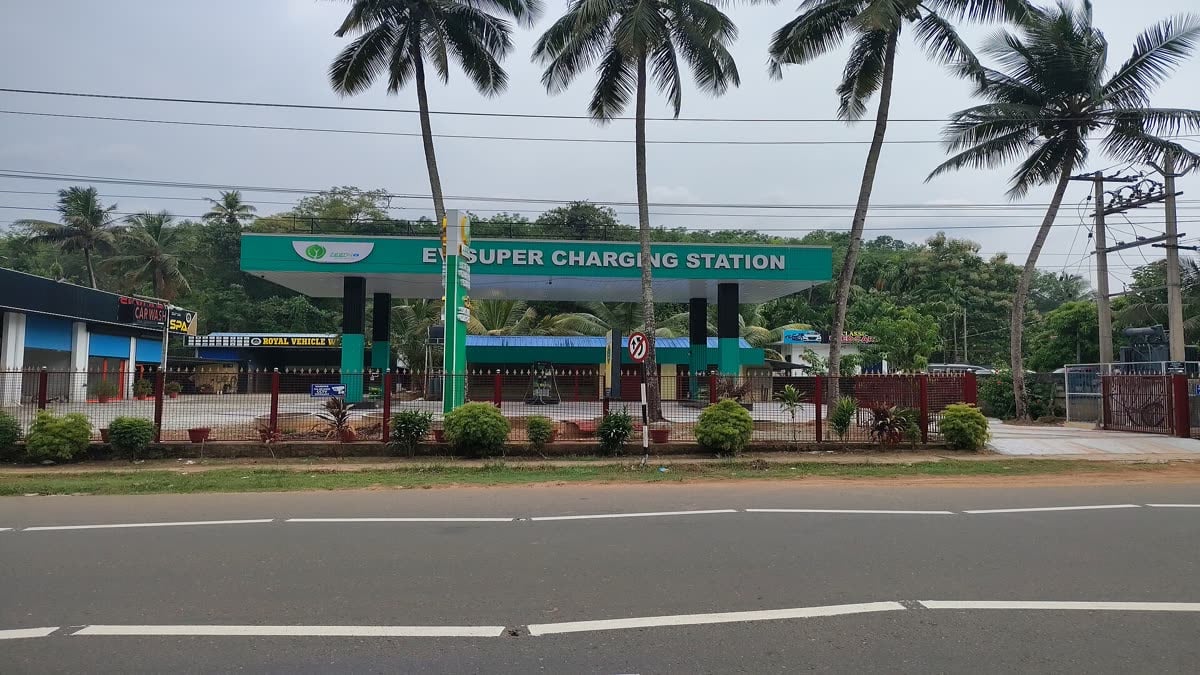
- Wikimedia Commons, EV charging station, Kollam — photograph taken 28 Apr 2026, CC BY-SA 4.0