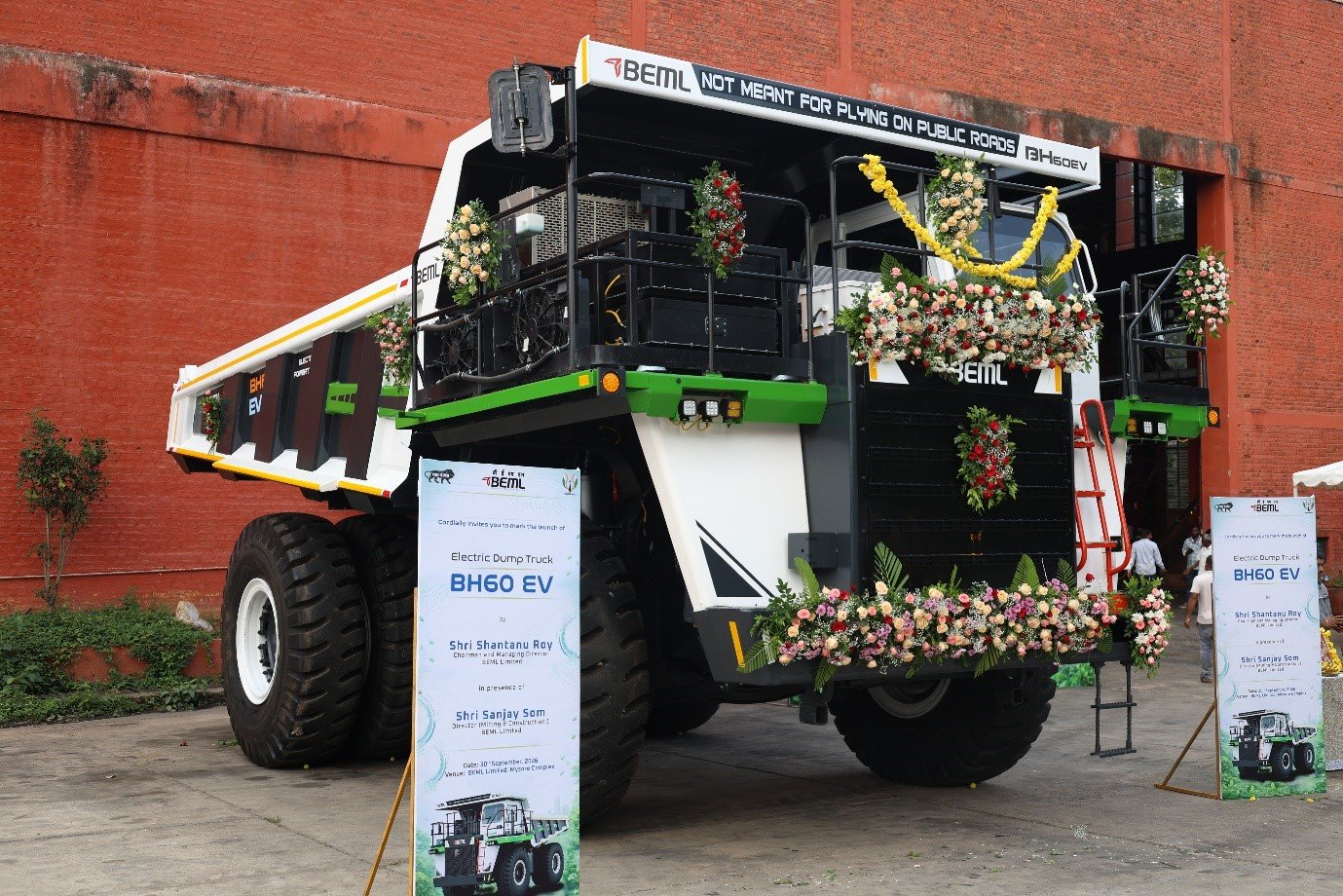
BEML unveiled the BH60-EV, an indigenously developed 60-ton electric dump truck, on 30 Sep 2026, according to a PIB release, for mining and infrastructure work. The development matters beyond one machine: it takes India’s EV transition into a diesel-heavy industrial segment where payload, charging capacity and uptime are as important as tailpipe emissions.
Key takeaways
- The PIB release dated 30 Sep 2026 says BEML unveiled the BH60-EV at its Mysuru Complex.
- The truck has a 1,000 kWh lithium-ion battery and a 54,500 kg payload, according to BEML’s release and Livemint’s 2 Oct 2026 report.
- BEML says operating costs could be 40–60% lower than comparable diesel equipment, but the outcome depends on site conditions.
- The company has not published a purchase price, operating range, production volume or customer-order timeline in the cited reports.
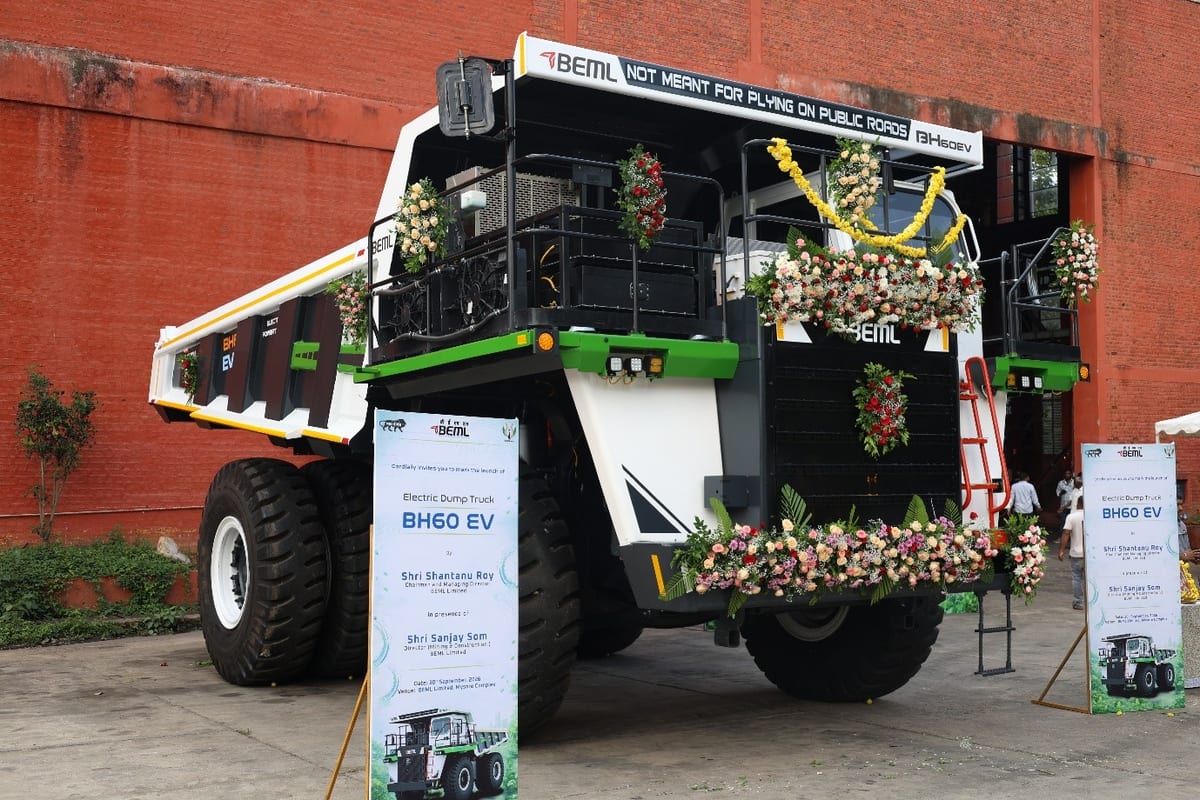 BEML’s BH60-EV electric dump truck at its unveiling. Credit: Press Information Bureau, Government of India / BEML.
What BEML has unveiled
The Ministry of Defence’s Press Information Bureau said on 30 Sep 2026 that BEML had unveiled the BH60-EV, describing it as India’s first indigenously designed and developed 60-ton electric dump truck. The virtual launch took place at BEML’s Mysuru Complex and was led by company chairman and managing director Shantanu Roy.
Livemint’s report published on 2 Oct 2026 independently repeated the core specifications and placed the truck in mining and infrastructure operations traditionally served by diesel-powered equipment. That distinction is important: the BH60-EV is not a road-going haulage truck for ordinary highway use. It is heavy equipment designed for controlled industrial sites, where routes, loading points and charging can be planned around the work cycle.
BH60-EV specifications reported so far
| Reported detail | Figure | What it tells operators |
|---|---|---|
| Truck class | 60 tonnes | Targets high-capacity mining and infrastructure work. |
| Battery | 1,000 kWh | Charging is a site-planning issue, not just a vehicle feature. |
| Payload | 54,500 kg | Designed around heavy material movement. |
| Rock-body volume | 36.4 cubic metres | Capacity has to be matched to the material and duty cycle. |
| Operating-cost claim | 40–60% lower | BEML’s estimate versus conventional diesel equipment. |
| Estimated annual emissions reduction | About 130 tonnes of CO₂ | BEML’s estimate, subject to operating conditions. |
All figures in the table are from BEML’s 30 Sep 2026 PIB release and were also reported by Livemint on 2 Oct 2026. The cost and emissions figures are company estimates, not an independently verified guarantee.
Why the battery size changes the fleet calculation
A 1,000 kWh battery is far larger than a typical passenger EV battery. For a mining operator, the question is not simply whether electricity is cheaper than diesel at a public charger. It is whether the site can supply the required power, install suitable charging equipment, protect uptime during shifts and manage the vehicle’s energy demand alongside other machinery.
BEML said it is offering a complete charging-station solution that can work with site electrical infrastructure and scale for fleet operations. That is a meaningful part of the announcement because an electric dump truck without a dependable charging plan can lose its productivity advantage through waiting time. Operators assessing public or depot charging can use FuelPrice’s EV charging directory as a reference for the wider charging network, although industrial mine-site charging will require a separate technical assessment.
What the 40–60% cost claim does and does not mean
BEML says the BH60-EV is designed to deliver 40–60% lower operating costs than conventional diesel equipment. Livemint reports the same range but also notes that the actual result would depend on electricity prices, utilisation, charging requirements and maintenance. That caveat should stay central: a company operating-cost estimate is not the same as a guaranteed saving for every mine.
The comparison also needs a full cost sheet. Diesel users can start with the current live fuel-price information, but an electric fleet must add charging infrastructure, electrical upgrades, demand charges, battery warranty terms, maintenance arrangements and any downtime during charging. A fair comparison should use the same payload, shift length, grade, haul distance and annual working hours. If the electric truck carries less, runs fewer shifts or faces long charging queues, the headline percentage may not describe the real fleet outcome.
What it means for India’s EV transition
The BH60-EV follows BEML’s 35-ton electric dump truck, launched on 10 Apr 2026, according to both the PIB release and Livemint. Moving from a 35-ton platform to a 60-ton machine suggests the company is testing electric propulsion in progressively heavier applications rather than limiting it to passenger cars, two-wheelers and buses.
That matters for transport and energy planners because mining and construction equipment consumes fuel through repeated, high-load cycles. Electrification in this segment could reduce local tailpipe emissions around worksites and create demand for high-capacity chargers, battery systems, power electronics and service skills. It does not mean diesel disappears from heavy industry now, and the overall climate impact will still depend partly on how the charging electricity is generated.
For everyday motorists, this is an industry signal rather than a new vehicle choice. The truck has no reported road-going range or consumer price, and it is not a substitute for a road-legal commercial vehicle. Its relevance is that the Indian manufacturing and charging ecosystem is being asked to solve a harder EV problem: high payload, steep grades, long shifts and industrial uptime.
Checks before a fleet considers adoption
- Duty cycle: compare the truck’s payload, haul route, gradients and shift pattern with the site’s actual work.
- Charging capacity: confirm grid connection, transformer capacity, charger layout, power quality and backup arrangements.
- Uptime: model charging time, shift handover and recovery plans against the diesel fleet’s current availability.
- Battery terms: ask for warranty coverage, thermal-management requirements, replacement assumptions and end-of-life handling.
- Service support: verify parts availability, technician training, remote diagnostics and the response plan for a site breakdown.
- Cost basis: compare total ownership cost, not only energy cost, over the same working hours and payload.
What to watch next
The next useful developments will be BEML’s commercial production and customer details, the final purchase or lease economics, and evidence from real operating sites. Operators will also want measured data on energy use per tonne-kilometre, charging time, battery durability and productivity against a comparable diesel dumper. Those figures will show whether the claimed cost range can hold outside a controlled launch announcement.
For now, the BH60-EV is a confirmed product unveiling and a clear sign that electric mobility is moving into India’s heavy industrial equipment pipeline. The reader takeaway is practical: the vehicle’s value will be decided by the complete site system—battery, charger, electricity tariff, payload, uptime and support—not by the zero-tailpipe-emissions label alone. For road users comparing the running cost of conventional vehicles, the fuel-cost calculator remains useful for trip-level petrol or diesel estimates, while this machine’s economics will need a fleet-grade operating model.