India has notified its final Corporate Average Fuel Economy (CAFE-III) norms for passenger vehicles, with the new framework taking effect on 1 Apr 2027. For buyers, the immediate point is that the rules apply to new vehicles manufactured or imported for sale in India and work through each carmaker’s fleet average, so they do not change the mileage of an existing car overnight.
Key takeaways
- CAFE-III will apply from 1 Apr 2027 through 31 Mar 2032 to new passenger vehicles made or imported for sale in India.
- The fuel-consumption benchmark moves from 3.9960 litres/100 km in the 2027–28 cycle to 3.3273 litres/100 km in 2031–32.
- The target is a manufacturer-level fleet average, not a promise that every individual car will deliver the benchmark in everyday traffic.
- The framework gives compliance pathways to battery-electric, hybrid, flex-fuel and other cleaner technologies, which may influence future model planning.
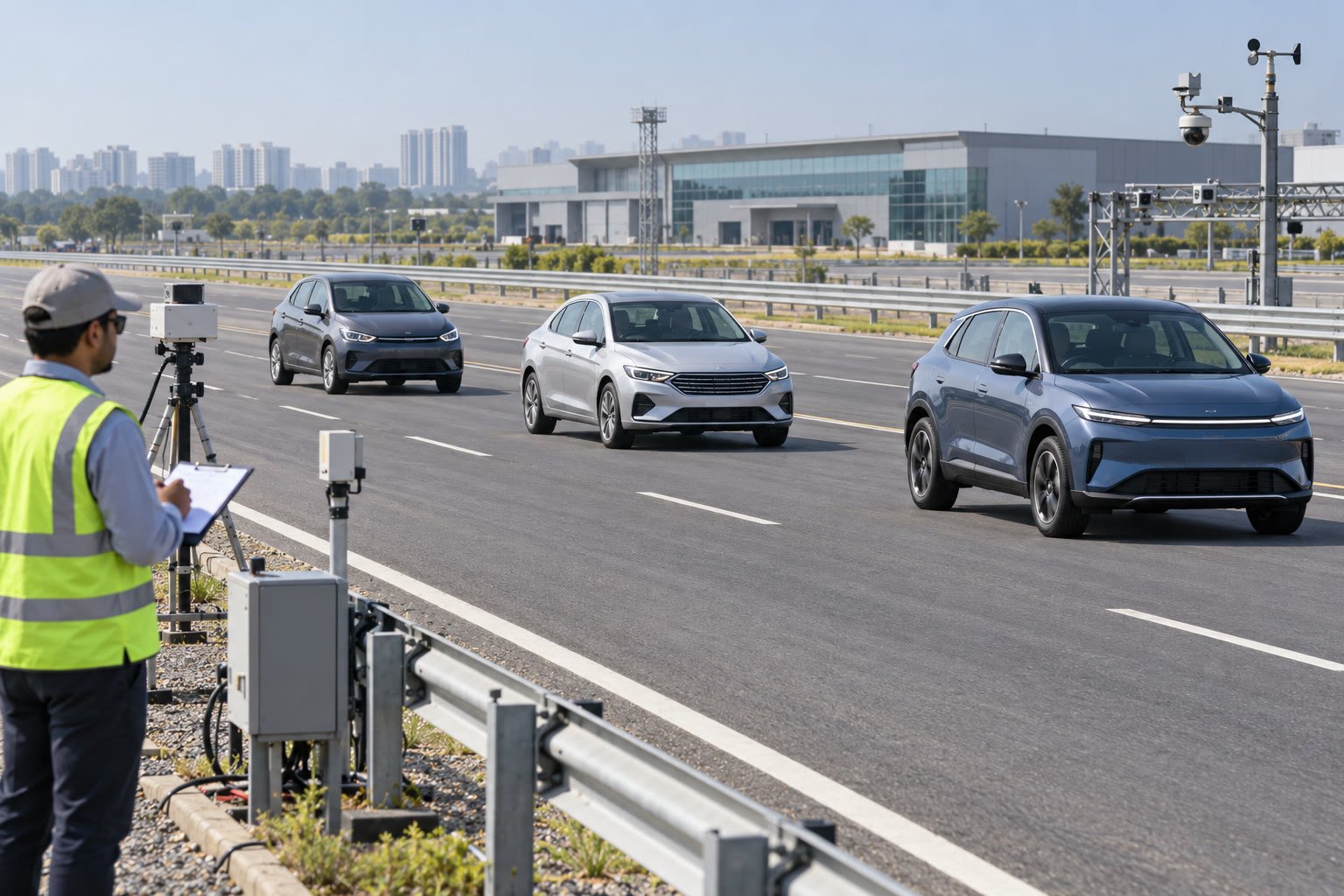
 Illustrative editorial image: passenger vehicles being evaluated on a test track under an efficiency standard. Credit: FuelPrice illustration.
What CAFE-III actually regulates
CAFE rules measure the average fuel efficiency of a carmaker’s eligible passenger-vehicle portfolio. That distinction matters: the government is setting a fleet-level obligation, not assigning the same mileage number to every hatchback, sedan or SUV sold in India.
The final framework covers M1-category passenger vehicles manufactured or imported for sale in India. A company’s result is calculated across the vehicles it sells, with vehicle weight and powertrain treatment built into the compliance system. A manufacturer can therefore manage the obligation through a combination of more efficient petrol or diesel vehicles, hybrids, EVs, alternative fuels and approved efficiency technologies.
For a car buyer, the regulatory benchmark should not be read as a real-world mileage guarantee. The official figures are part of a compliance calculation. Traffic, speed, air-conditioning use, load, tyres and driving conditions will still affect the fuel or electricity consumed by an individual vehicle.
The new efficiency path from 2027 to 2032
The Ministry of Power’s notification sets a progressively tighter fuel-consumption benchmark across the five-year period. The first cycle begins at 3.9960 litres/100 km for 2027–28 and reaches 3.3273 litres/100 km for 2031–32. The Indian Express independently reported the same opening and final benchmark values while explaining the fleet formula.
| Compliance cycle | Fuel-consumption benchmark | What it means |
|---|---|---|
| 2027–28 | 3.9960 litres/100 km | First year of the new framework |
| 2031–32 | 3.3273 litres/100 km | Final year of the five-year path |
The reference weight in the final formula is 1,229 kg. The weight-sensitive design means heavier and lighter fleets do not face an identical target, although the obligation remains a fleet-average exercise. A manufacturer selling mostly larger SUVs will therefore manage a different target line from one selling mostly compact cars.
Small cars lose a proposed special concession
One of the most important changes for the affordable-car market is what the final rules leave out. The Indian Express and Free Press Journal reported that the final framework does not retain a separate concession proposed for petrol cars below the 909-kg threshold.
That does not mean a small car already on sale must suddenly meet a new mileage figure, and it does not automatically set a new showroom price. It means the policy debate over how to treat lightweight cars has been settled through the broader weight-based fleet formula. Carmakers will decide how to balance their portfolios, technologies and compliance credits as the start date approaches.
Why EVs and hybrids get a compliance role
The official release lists battery-electric vehicles, range-extended electric vehicles, plug-in hybrids, strong hybrids and flex-fuel vehicles among the powertrains that receive volume-derogation factors, also called super credits, in fleet-average calculations. The purpose is to give manufacturers more than one route to meet the tightening standard.
For future buyers, that could mean more attention to the mix of powertrains offered by each brand. It does not guarantee that every new model will be electric, hybrid or cheaper to run. It does mean that a carmaker can use cleaner technologies alongside efficiency improvements in conventional vehicles while managing its overall CAFE position.
The framework also recognises alternative fuels, including ethanol-blended petrol, biofuels and compressed biogas, through a Carbon Neutrality Factor. That is a regulatory accounting mechanism; it should not be confused with a claim about the pump price or the real-world operating cost of a particular vehicle.
What changes for current owners and near-term buyers
Existing car owners do not need to change a vehicle because of this notification. The stated scope is new passenger vehicles manufactured or imported for sale in India from the effective date, so the rule is aimed at manufacturer compliance and future product planning.
People comparing vehicles in the transition period should separate three questions: the model’s certified test-cycle efficiency, its likely fuel or charging cost in the intended use, and the availability of the relevant fuel or charging network. A claimed test result is useful for comparison, but it is not a personal cost estimate.
For a petrol or hybrid running-cost estimate, use the vehicle’s realistic efficiency with the fuel cost calculator and check the latest local rate on the live fuel prices page. For an EV, the state-wise EV charging directory helps answer the separate infrastructure question. These tools do not replace the manufacturer’s certified figures; they add the trip and location context that the CAFE calculation does not provide.
What to watch before the start date
The next useful information will be how carmakers disclose certified efficiency, powertrain credits and fleet-level compliance under the new framework. The notification provides the policy direction, but it does not announce the price, mileage or launch timing of any specific model.
For buyers, the practical takeaway is to treat CAFE-III as a rule shaping the vehicles that will be developed and sold over the next product cycle, not as an immediate change to an existing car’s registration, insurance or fuel bill. Model-specific claims still need to be checked when the vehicle is officially listed for sale.
Sources
- Press Information Bureau, Ministry of Power — New Corporate Average Fuel Economy (CAFE) Norms Notified — 30 Sep 2026
- The Indian Express — What India’s new CAFE-III fuel-efficiency norms mean for carmakers, small cars and EVs — 30 Sep 2026
- Free Press Journal — Govt Notifies CAFE-3 Norms: Small Cars Get No Special Relief, EV Incentives Retained — 30 Sep 2026