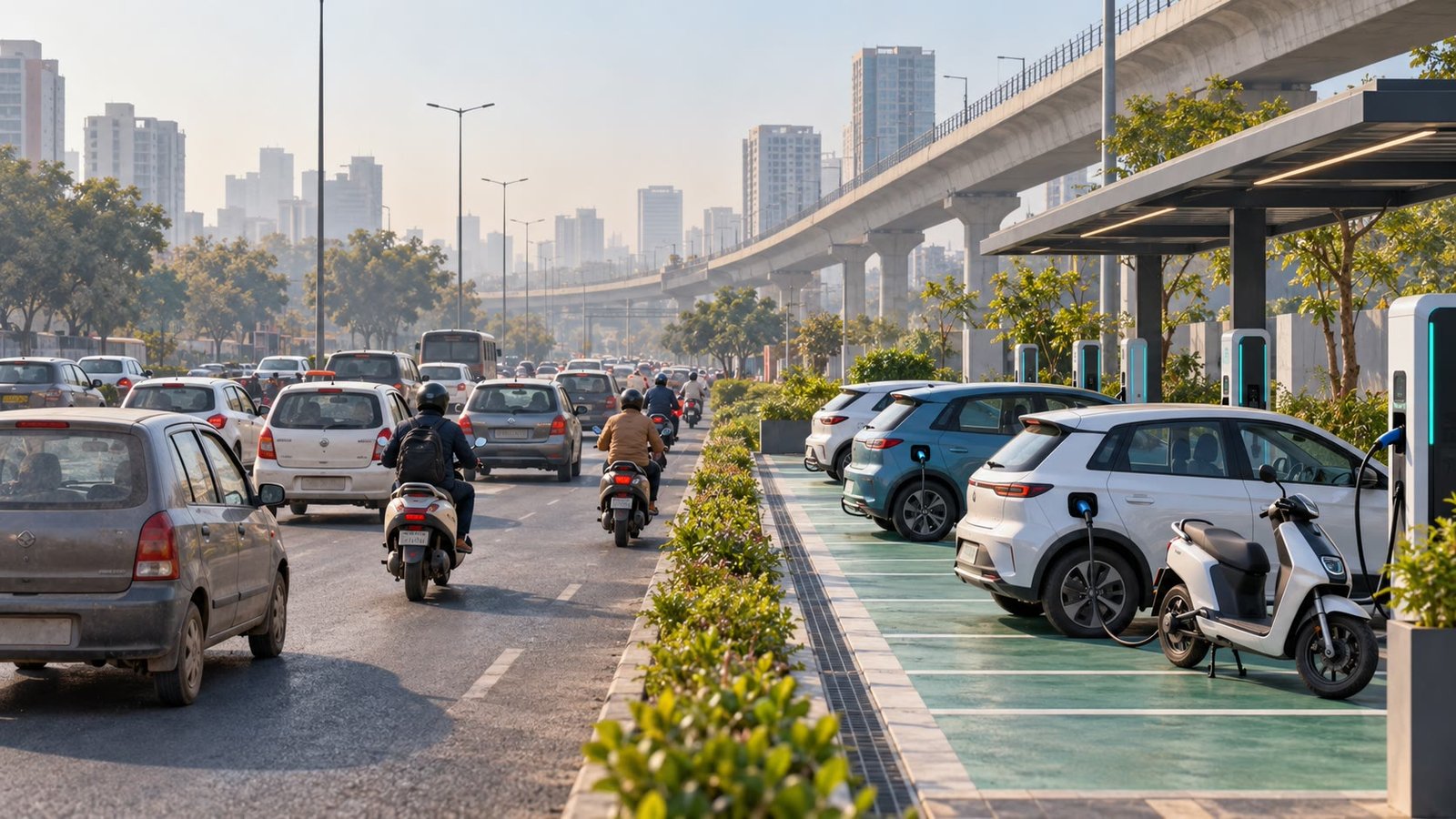
An expert panel constituted by the Commission for Air Quality Management (CAQM) has proposed that automakers reach a 20% zero-tailpipe-emission vehicle share in new private four-wheeler sales in Delhi-NCR in 2027, rising to 100% in 2030. The recommendations were reported on 8 Oct 2026, but they are not a notified ban or registration rule yet, so the panel's roadmap does not change what private vehicle owners can drive today.
Key takeaways
- The reported sales path for new private four-wheelers is 20% zero-tailpipe-emission vehicles in 2027, 45% in 2028, 70% in 2029 and 100% in 2030.
- The panel has also proposed immediate exit of BS-I, BS-II and BS-III vehicles, BS-IV phase-out by 2030, BS-VI two-wheeler phase-out by 2035 and BS-VI car phase-out by 2040.
- These are recommendations from an interim report submitted to CAQM; they are not an enforcement order or an immediate ban on petrol and diesel cars.
- Delhi's separate draft EV policy has its own proposed registration timetable and says it would apply only from the date of notification.
What the CAQM panel has proposed
Reports by The Times of India and Mint describe an interim report from a 15-member expert panel set up by CAQM to reduce vehicle-related pollution in the National Capital Region. The panel's proposal is framed around zero-tailpipe-emission, or ZTE, vehicles. Battery-electric vehicles are currently the practical ZTE option for most road users, but the report is described as technology-neutral and leaves room for other technologies if they become viable.
The main proposal is a progressive target for each original equipment manufacturer selling private four-wheelers in Delhi-NCR. The reported sequence is:
| Year | Reported ZTE share of new private four-wheeler sales |
|---|---|
| 2027 | 20% |
| 2028 | 45% |
| 2029 | 70% |
| 2030 | 100% |
The wording matters. This is a proposed sales mandate for new vehicles, not a statement that existing petrol or diesel cars will stop working on a particular date. It also does not announce a price cut, subsidy or guaranteed charging access. Those details would need to be settled in a government notification and implementation framework.
Older vehicles could face a separate phase-out
The interim report is also reported to recommend that BS-I, BS-II and BS-III vehicles leave the active fleet immediately, followed by BS-IV vehicles by 2030. It places later exit timelines on BS-VI two-wheelers by 2035 and BS-VI cars by 2040. The panel has additionally proposed tougher seasonal restrictions on BS-IV vehicles during the November-to-January pollution period.
For a vehicle owner, the distinction between a recommendation and a rule is critical. A panel's proposed exit timeline does not itself cancel a registration, block fuel or require scrappage. Any enforceable restriction would need a formal order that explains the covered vehicle categories, geography, effective date, exemptions, enforcement process and any transition or scrappage support.
What applies to drivers today
The official CAQM committee mandate says the panel was created to review clean-mobility policies, emission standards, EV readiness, infrastructure, costs and incentives, and to recommend additional measures. That confirms the panel's remit, but it does not turn the interim report into law.
Delhi's Transport Department separately uploaded the Delhi Electric Vehicle Policy 2026–2030 as a draft in April 2026. The document says the policy would apply from the date of notification and proposes only-electric registration for L5 three-wheelers from 1 Jan 2027 and for two-wheelers from 1 Apr 2028. Those dates belong to the draft Delhi policy, not to a newly effective NCR-wide car ban. Readers should check the latest CAQM, Delhi, Haryana, Uttar Pradesh and Rajasthan notifications before treating any proposed date as binding.
Owners of older vehicles can also review the current pollution-control position in FuelPrice's earlier coverage of CAQM's Delhi-NCR goods-vehicle GRAP curbs. That is separate from the new panel roadmap and illustrates why the exact vehicle class, emission standard and pollution-response stage matter.
What the proposal could mean for buyers and fleets
If the sales targets are adopted, new-vehicle choice in Delhi-NCR would gradually shift toward EVs and other ZTE technologies. It could affect model availability, dealer planning, charging demand and resale expectations, but the report alone does not establish which manufacturers would be covered, how compliance would be measured or what penalties would apply.
For a buyer comparing powertrains, the useful calculation remains specific to the vehicle and usage pattern. Petrol or diesel running cost depends on distance, efficiency and the dated pump price; EV running cost depends on energy consumption, charging tariff, charging losses and access to home or public charging. Current fuel rates can be checked through the live fuel-price hub, while EV owners and prospective buyers can review the state-wise EV charging directory. Neither tool assumes that a future policy proposal will deliver a particular saving.
Fleet operators have a wider planning question because charging downtime, depot electrical capacity and vehicle utilisation can matter as much as energy price. A proposed ZTE sales share could make charging access a business constraint before it becomes a registration constraint. For inter-city use, the road-trip planner can help map routes and stops, but the availability and operating status of individual chargers still needs to be checked before a trip.
What to watch next
CAQM and the concerned governments would need to decide whether to accept, modify or reject the interim recommendations. The next meaningful update would be an official notification, consultation paper or implementation order that identifies the affected vehicles and gives an effective date. Until then, reports of a 2030 target should be read as a policy direction under consideration, not as an immediate instruction to replace a vehicle.
For readers, the practical takeaway is to separate three questions: what rules are already in force, what a government has formally proposed, and what a panel has recommended. That distinction protects owners from premature scrappage decisions while giving buyers, fleets and charging providers time to track a potentially significant shift in Delhi-NCR mobility policy.
Sources
- The Times of India — “CAQM panel sets phased exit timelines for old vehicles in Delhi-NCR” — 8 Oct 2026
- Mint — “CAQM panel proposes 100% electric cars in Delhi-NCR by 2030” — 8 Oct 2026
- Press Information Bureau, Ministry of Environment, Forest and Climate Change — “CAQM constitutes Expert Committee for Abatement of Air Pollution caused by Vehicular Emissions in Delhi-NCR” — 12 Dec 2025
- Delhi Transport Department — “Delhi Electric Vehicle Policy, 2026–2030 (Draft)” — 11 Apr 2026