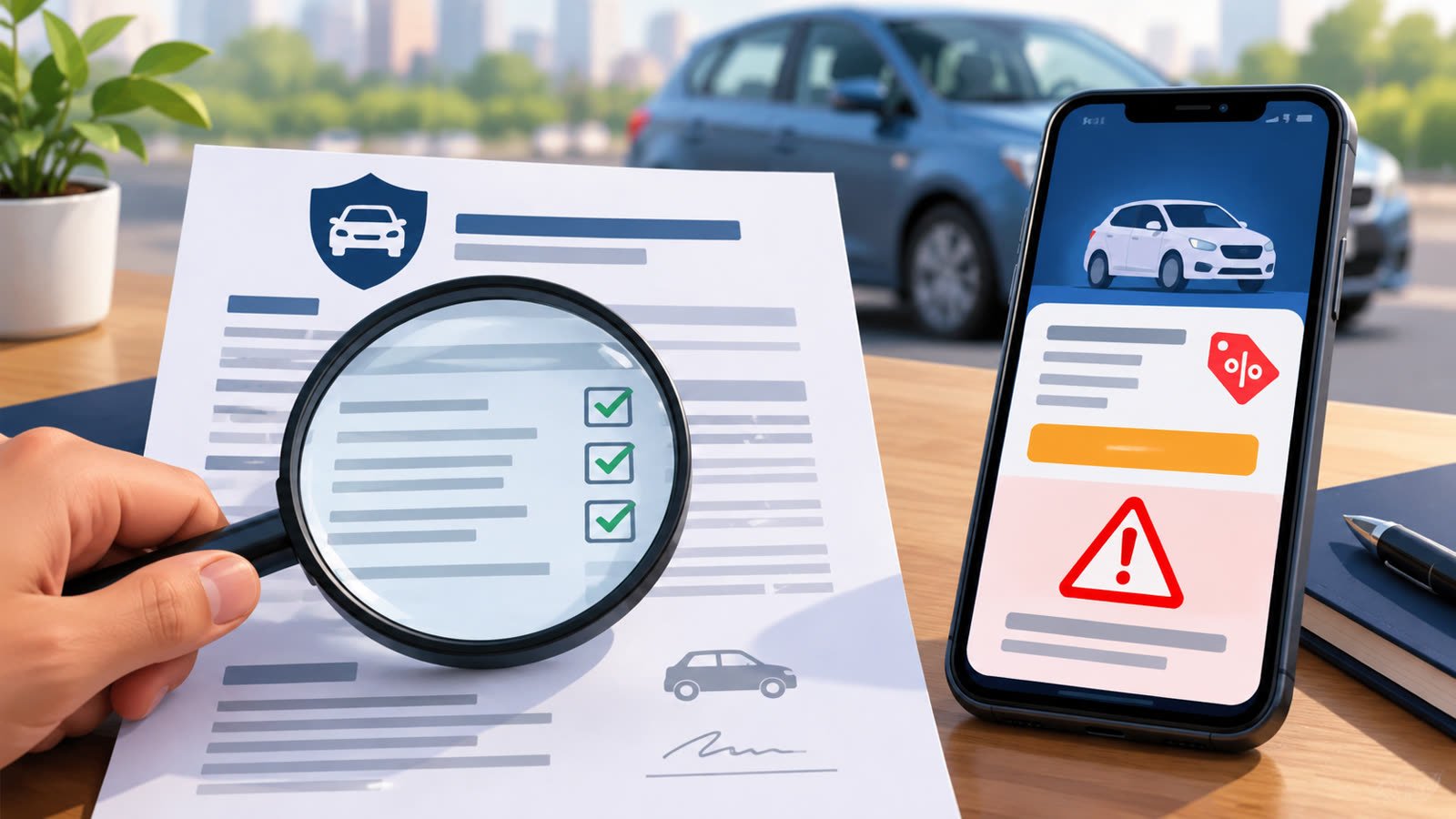
On 9 Oct 2026, Ghaziabad police arrested seven people in an alleged online motor-insurance fraud involving renewal advertisements and forged policy certificates, according to reports citing the police. The case matters to Indian drivers because a convincing PDF or discount offer does not by itself show that a policy is live in the insurer's records.
Key takeaways
- Ghaziabad Crime Branch and Cyber Crime police arrested seven people on Friday, according to reports published on 9–10 Oct 2026.
- Police allege that the group used online advertisements, fake email IDs and phone numbers to attract policy-renewal enquiries, then sent forged certificates after taking payment.
- Reports differ on the alleged loss: two reports put it at more than ₹40 lakh, while an ANI report carried by Asianet Newsable said it was above ₹60 lakh.
- Drivers renewing a policy after seeing a discount advertisement can confirm the policy number, vehicle details and coverage dates through the insurer's official channel before paying.
- Anyone who has transferred money in a suspected online fraud can contact the bank promptly and report financial cyber fraud through 1930 or the National Cyber Crime Reporting Portal.
What police say happened
Reports from The Times of India and Salam Hindustan say the alleged operation used Google Ads and Facebook pages to reach motorists looking for a cheaper premium or help with policy renewal. The advertisements allegedly displayed contact details controlled by the group rather than the insurer's verified customer-service channels.
According to the reports, callers sought payment into bank accounts and then emailed documents made to resemble insurance certificates. The Times of India reported that the group had allegedly been active for about four months. Police said digital evidence, including advertisements, emails and forged certificates, was recovered from devices seized during the arrests.
The reported recovery included four mobile phones, two debit cards, two cheque books, one bank passbook and ₹3,000 in cash. The investigation is continuing, and police are also looking for an alleged ringleader. These are allegations reported from the police investigation; the arrests are not a final court finding.
Why the loss figures do not match
The reports do not give one settled loss figure. The Times of India reported that police estimated nearly ₹40 lakh across about 70 people, while Salam Hindustan reported an estimate above ₹40 lakh. An ANI report published by Asianet Newsable put the alleged loss above ₹60 lakh and said more than 20 formal complaints had been registered on the National Cyber Crime Reporting Portal. The figures can change as investigators reconcile complaints, bank records and the money trail.
Why a forged certificate is a serious problem
A motorist may believe a renewal is complete because a document arrives by email with a familiar insurer name, a policy number and a vehicle registration number. But the practical test is whether the policy exists in the insurer's own records and whether the coverage dates and vehicle details match the vehicle being driven.
IRDAI's motor-insurance guidance says that a separate certificate of insurance is required for a motor vehicle and is issued by the insurer. That makes independent confirmation important when a document comes from an unknown number, a social-media page or an advertisement rather than from a channel the policyholder has verified.
Price alone is also an incomplete check. IRDAI's consumer guidance asks policyholders to compare deductibles, coverage and IDV because a lower premium can be paired with higher out-of-pocket responsibility, lower coverage or a lower insured value. Drivers checking a renewal can use the zero-depreciation and comprehensive insurance guide to understand the difference between common cover options before comparing documents.
What drivers can check before paying
- Start with a trusted route. Open the insurer's official website or app yourself, or use the customer-care details printed on an earlier policy that has already been verified. Do not treat a sponsored search result, forwarded message or incoming call as proof that the contact belongs to the insurer.
- Match the core details. Ask the insurer to confirm the policy or certificate number, registration number, make and model, policyholder name, coverage dates and the type of cover. A mismatch in even one of these fields is a reason to stop and seek clarification before making a payment.
- Check the payment destination. The payee name, payment page and receipt should be consistent with the insurer or its authorised intermediary. A request to send a premium to an unrelated personal bank account, to scan an unfamiliar QR code or to share an OTP should be treated as a warning sign.
- Compare the terms, not just the discount. Read the own-damage and third-party sections, deductibles, exclusions, IDV and add-ons. For owners checking an expired or soon-to-expire policy, the car-insurance renewal and NCB guide explains the checks that can affect a renewal record.
- Keep the evidence. Save the advertisement URL, call number, messages, email headers, payment receipt, bank transaction reference and the document received. Those details can help the insurer, bank and investigating agency trace the transaction.
What to do if money has already been sent
The first step is to contact the bank or payment service through its official fraud-reporting channel and preserve the transaction reference. Financial cyber fraud can be reported through the national helpline 1930 and the National Cyber Crime Reporting Portal. A prompt report does not guarantee recovery, but it gives the bank and investigators the transaction details needed to examine the transfer.
The insurer should also be contacted through an independently verified channel to check whether a policy was actually issued. If there is a policy-service grievance that the insurer does not resolve, IRDAI's Bima Bharosa system provides an online route to register a complaint and track its status. The portal warns that it does not ask policyholders for payments or QR-code scans to process a complaint.
Two-wheeler owners can apply the same checks to bike renewals; the bike-insurance renewal guide covers third-party cover, own-damage cover, NCB and IDV in plain language.
What happens next
Police are expected to examine the bank accounts, digital advertisements, forged certificates and complaints from different states as the investigation progresses. The loss estimate and the list of affected policyholders may therefore change. For drivers, the immediate takeaway is narrower and practical: verify the policy in the insurer's system, check the payment route and keep a record of any suspicious contact instead of relying on a document that only looks official.
Sources
- The Times of India — “7 who cheated 70 with fake insurance offers held in Ghaziabad” (10 Oct 2026)
- Salam Hindustan — “फर्जी बीमा पॉलिसी के नाम पर 40 लाख से अधिक की ठगी, सात आरोपी गिरफ्तार” (9 Oct 2026)
- Asianet Newsable / ANI — “Ghaziabad cyber fraud: 7 held for duping people via fake insurance” (10 Oct 2026)
- IRDAI — “Motor Insurance — Policy Holder” (accessed 10 Oct 2026)
- National Cyber Crime Reporting Portal — “State/UT nodal and grievance officer details” (accessed 10 Oct 2026)
- IRDAI Bima Bharosa — “About Us” (accessed 10 Oct 2026)
This article is for general information only and is not financial, insurance or legal advice.