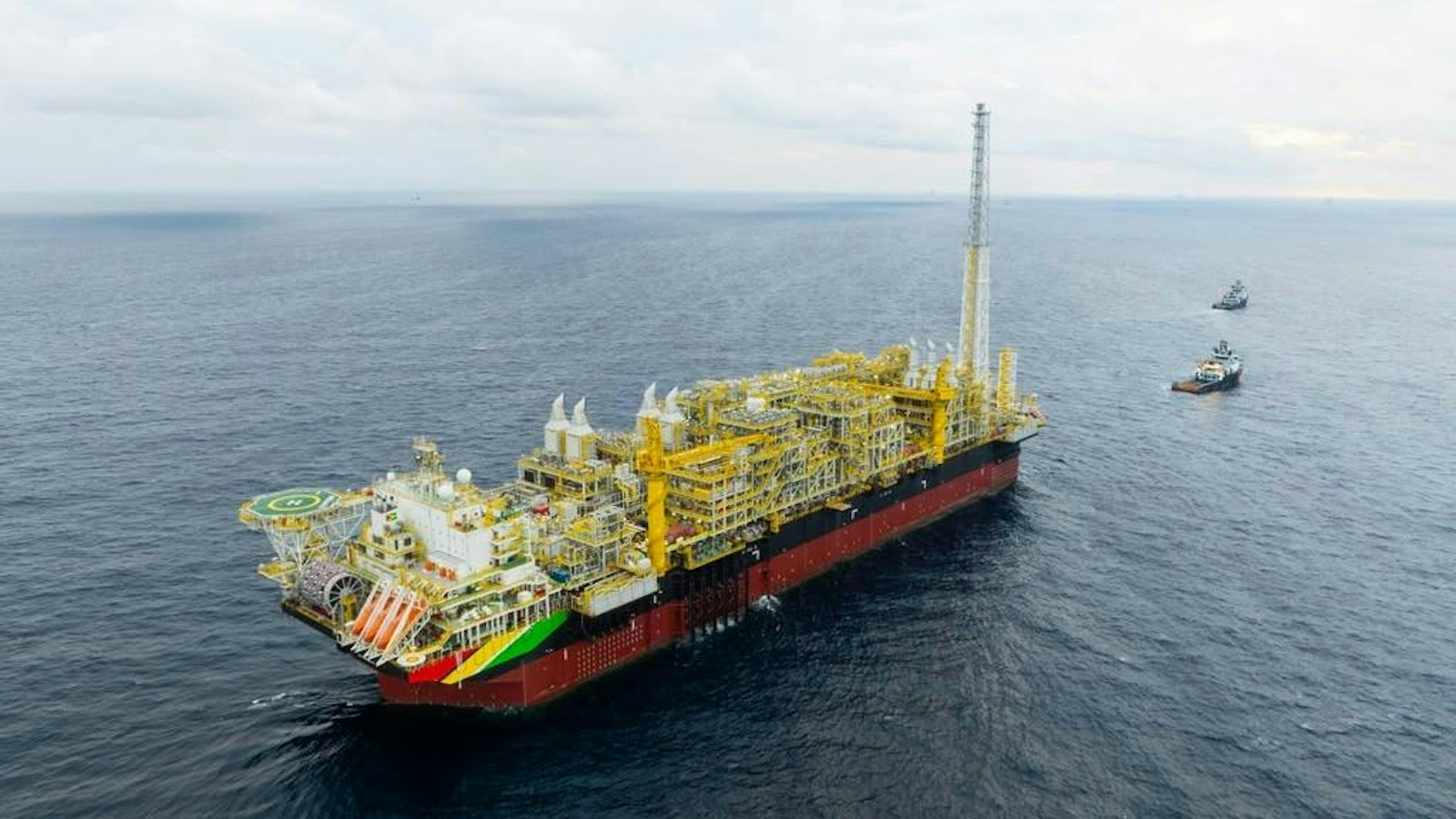
ExxonMobil and the Government of Guyana said on 16 Nov 2026 that the Uaru offshore project has produced first oil, the fifth development in the Stabroek Block. Its Errea Wittu floating production, storage and offloading (FPSO) vessel is expected to reach an initial 250,000 barrels per day in the first quarter of 2027, adding a sizeable new supply stream but not an instant change to global pump prices.
Key takeaways
- First oil from Uaru was announced on 16 Nov 2026 by ExxonMobil and Guyana's Department of Public Information.
- The Errea Wittu FPSO is expected to reach an initial production capacity of 250,000 barrels per day in the first quarter of 2027, according to ExxonMobil and Oil & Gas Journal's independent report.
- ExxonMobil and Oil & Gas Journal put Guyana's installed production capacity at 1.1 million barrels per day after the start-up.
- The vessel has storage capacity of 2 million barrels and is the fifth FPSO operating in the Stabroek Block, according to the company and the trade publication.
- The practical effect for drivers and fleets will depend on the ramp-up, export flows, refining margins, freight and local taxes—not on the start-up announcement alone.
What has changed offshore Guyana
First oil means the Uaru development has moved from construction and commissioning into production. The project is operated by ExxonMobil Guyana in the offshore Stabroek Block, where the new Errea Wittu joins four earlier FPSOs. Guyana's government described Uaru as its fifth offshore development, while ExxonMobil described the start-up as the fifth development in the block.
That wording matters for fuel-market readers. A production start is a confirmed operational milestone, but it does not mean the vessel is already delivering its full planned rate. ExxonMobil's 16 Nov release says Errea Wittu is expected to achieve its initial production capacity of 250,000 barrels per day in the first quarter of 2027. Oil & Gas Journal reported the same ramp-up timetable on 16 Nov. The figure is therefore a stated capacity target for the next stage, not a claim that 250,000 barrels per day was flowing on announcement day.
The numbers behind the new supply
ExxonMobil said the start-up raises Guyana's installed production capacity to 1.1 million barrels per day, a figure also reported by Oil & Gas Journal. Installed capacity describes what the country's operating projects are designed to produce; it is not identical to a daily export total, which can move with maintenance, reservoir performance, loading schedules and operating conditions.
The FPSO has storage capacity of 2 million barrels, according to ExxonMobil, the Government of Guyana and Oil & Gas Journal. That storage is part of the offshore logistics chain: crude can be held on the vessel before being transferred to export tankers. The government also said the vessel will combine several Uaru-area resources and a network of production and injection wells, but the confirmed reader-relevant point is the sequence—first oil now, then a monitored ramp toward the initial 250,000-barrel-per-day capacity.
ExxonMobil holds a 45% interest in the Stabroek Block, with Hess Guyana Exploration at 30% and CNOOC Petroleum Guyana at 25%, according to the company's release and Oil & Gas Journal. These ownership figures explain why the start-up is both a national production milestone for Guyana and a material development for several international energy companies.
Why the start-up matters to global oil markets
Guyana is a small producer compared with the largest oil-exporting countries, but its offshore output has expanded quickly enough to matter at the margin. A new FPSO adds another non-OPEC supply source in the Americas, a region that global market watchers track alongside OPEC+ policy, Middle East shipping and refinery activity.
The timing is important. The International Energy Agency's 13 Nov 2026 Oil Market Report said the oil market was showing tentative signs of rebalancing as Gulf exports recovered, while also warning that refined-product supply—especially diesel—remained tight. In that setting, new Guyanese crude can add to available supply over time, but it does not automatically solve a shortage of diesel or guarantee lower petrol prices. Crude still has to be lifted, transported, refined and distributed into the markets that need it.
The IEA also identified the United States, Canada, Brazil, Argentina and Guyana as a group contributing to wider supply growth. Uaru fits that broader trend, but its effect should be read as cumulative rather than standalone: the market response will depend on how much production actually arrives, what other producers do, and whether demand or shipping risks change at the same time.
What it means for fuel users and fleets
For a motorist, the start-up is not a dated retail-price notice. Pump prices reflect benchmark crude, refinery margins, freight, currency movements, competition and taxes or duties in the local market. A future increase in Guyanese exports may influence supply expectations, but the link to a particular forecourt price is indirect and can take time.
Readers can track dated retail movements in the live fuel prices section and test how a change would affect a regular journey with the fuel cost calculator. For a longer route, the road-trip planner can help separate distance and vehicle-efficiency assumptions from the wider oil-market headline.
Fleet operators should watch diesel and other refined-product markets separately from crude. A new offshore crude stream may improve supply diversity, yet freight rates, refinery outages or regional disruptions can still keep delivered fuel expensive. EV owners are not directly exposed to one oil project, although global energy prices can influence the broader cost and policy environment for transport.
What to watch next
The first checkpoint is the Errea Wittu ramp toward its stated initial capacity in the first quarter of 2027. Production guidance is forward-looking, so actual rates may differ with reservoir performance, equipment reliability, weather and offshore operations. ExxonMobil itself cautioned that future production rates and project outcomes can change.
The second checkpoint is export performance. Market observers will want to see regular loading data, whether the new barrels reach international buyers smoothly and how Guyana's output behaves alongside the rest of the Americas' supply. The third is the refined-product response: even if crude availability improves, diesel margins and refinery capacity will determine how much of that benefit reaches transport users.
The reader takeaway
Uaru's first oil gives Guyana a larger role in the international supply picture and confirms another major offshore project entering operation. The headline capacity is meaningful, but the fuel-price effect will be gradual and conditional. For drivers and transport businesses, the useful signal is to follow the 2027 ramp, actual exports and benchmark refined-product prices together rather than treating first oil as an immediate promise of cheaper fuel.
Sources
- ExxonMobil: “ExxonMobil starts production at Uaru, raising Guyana's installed capacity to 1.1 million barrels per day” (16 Nov 2026)
- Government of Guyana, Department of Public Information: “Guyana's 5th FPSO hits first oil” (16 Nov 2026)
- Oil & Gas Journal: “ExxonMobil Guyana starts production at Uaru” (16 Nov 2026)
- International Energy Agency: “Oil Market Report - November 2026” (13 Nov 2026)
This article is for general information only and is not financial, insurance or legal advice.