India’s electric-vehicle market has reached about 8.3% of vehicle sales in FY2025-26, and the next industry challenge is moving beyond battery-pack assembly to cells, materials and engineering. An ETAuto analysis published on 12 Oct 2026 says deeper battery localisation is becoming important for competitiveness and supply-chain resilience; for Indian EV buyers, that could eventually affect vehicle cost, range, charging performance and service resilience.
The important distinction is that this is an industry direction, not a new buyer mandate or an announced across-the-board price cut. The Ministry of Heavy Industries’ latest published scheme data shows that domestic cell capacity is being built, but the ecosystem is still moving from announced capacity to large-scale production.
Key takeaways
- Official government material puts India’s EV adoption at 8.26% in FY2025-26; NITI Aayog’s 2025 index reports 8.25%, so the practical picture is roughly 8.3%.
- The Production Linked Incentive programme for Advanced Chemistry Cells has an outlay of ₹18,100 crore for 50 GWh of capacity.
- As of 31 May 2026, the Ministry said 40 GWh had been awarded and beneficiary companies had reported ₹5,180 crore of investment and 1,277 direct jobs.
- Local cells may reduce exposure to freight, currency and trade disruptions over time, but they do not automatically make every EV cheaper or extend its range.
Why battery localisation is back in focus
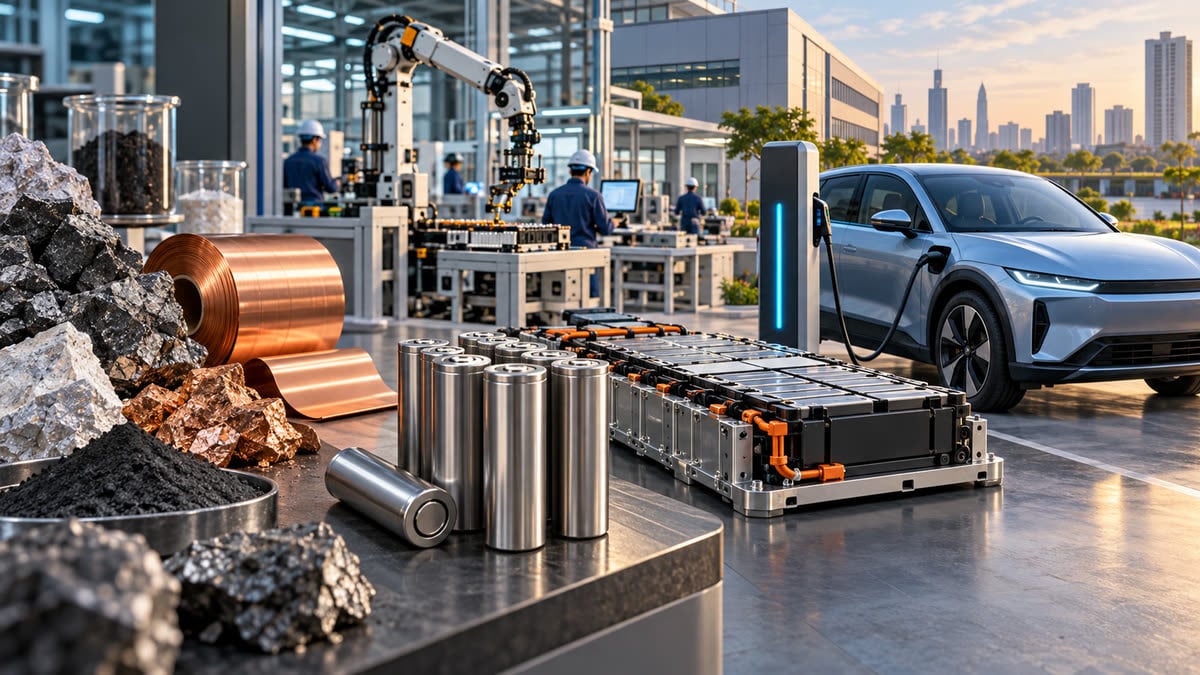
An EV can be assembled in India while still depending on imported cells, active materials, machinery or battery-management technology. ETAuto’s 12 Oct analysis argues that localisation is therefore no longer only an import-substitution exercise. It is also about controlling a larger share of the components that influence cost, charging behaviour, thermal management and product development.
That matters because the battery is one of the most consequential systems in an EV. Cell chemistry, pack architecture and thermal controls affect how much energy the vehicle stores, how quickly it can accept a charge and how consistently it performs in Indian heat and traffic. A stronger domestic supplier base could also reduce exposure to shipping costs, exchange-rate movements and sudden changes in international trade policy. Those are potential benefits, not guaranteed outcomes for a particular model.
What the official capacity numbers show
The Ministry of Heavy Industries said in a 21 Jul 2026 parliamentary reply published through the Press Information Bureau that the ACC battery-storage PLI scheme has a ₹18,100-crore outlay for 50 GWh. It reported that four companies had been awarded a combined 40 GWh of capacity, while no beneficiary had claimed an incentive under the scheme at that point. The same reply said beneficiary firms had reported ₹5,180 crore of investment and 1,277 direct jobs as of 31 May 2026.
| Indicator | Published position | What it tells readers |
|---|---|---|
| EV adoption | About 8.3% in FY2025-26 | Demand is large enough for supply-chain scale to matter. |
| ACC PLI outlay | ₹18,100 crore for 50 GWh | Cell manufacturing is being supported as a strategic capability. |
| Capacity awarded | 40 GWh of the planned 50 GWh | Announced capacity still has to translate into operating output. |
| Reported ACC investment | ₹5,180 crore as of 31 May 2026 | Build-out is under way, but it remains a long-cycle process. |
The government numbers should not be read as proof that every EV sold in India already uses locally made cells. They show a capacity-building pipeline. The next checkpoints are commissioning, production consistency, local supplier depth, recycling and whether domestic output can meet automotive-grade requirements at competitive cost.
What could change for EV buyers
Prices may become less exposed to outside shocks
More local sourcing can reduce the share of freight, currency and import-policy risk in the battery supply chain. That could make pricing more predictable as volumes grow. It does not promise a lower ex-showroom price: minerals, equipment, energy, financing and quality-control costs will still influence the final vehicle.
Range and charging depend on engineering, not only location
Local cell production is useful only when it is paired with strong battery-management, thermal-management and charging engineering. Buyers should continue to compare usable battery capacity, claimed and real-world range, charging time, connector compatibility and warranty terms. For public charging availability by state, the EV charging station directory is the practical follow-up.
Service and replacement planning may improve gradually
A deeper supplier ecosystem could make parts and technical support easier to organise over time, but that benefit will not arrive uniformly. Before taking delivery, check what the battery warranty covers, whether degradation limits are stated, who handles high-voltage repairs and how long replacement components may take. The EV charging-cost guide can also help separate charging spend from the vehicle’s full ownership cost.
What changes now—and what does not
Nothing in the 12 Oct industry analysis changes an existing EV’s approved price, range or warranty. It also does not create a new instruction for private owners to replace a vehicle or use a particular battery technology. The near-term story is about manufacturers, cell companies, materials suppliers and policymakers trying to build capability ahead of demand.
For a buyer comparing an EV with a petrol or CNG vehicle, the useful comparison remains total cost over the intended usage: purchase price, financing, home or public charging, insurance, maintenance and resale assumptions. A fuel-cost calculator can help benchmark a comparable petrol or CNG commute, but it should be paired with the EV’s actual charging tariff and expected charging pattern.
What to watch next
- Whether the awarded ACC capacity moves from construction and commissioning into regular cell output.
- Whether Indian suppliers develop capability in cells, materials, battery-management systems and recycling rather than only pack integration.
- Whether local production changes vehicle pricing, warranty support or charging performance in specific models; those claims should be checked model by model.
Reader takeaway: India’s EV market is now large enough that battery localisation is becoming a strategic ownership issue, but the benefits will arrive in stages. Buyers should treat local-cell announcements as a supply-chain signal and continue to verify the exact battery, warranty, charging and service details of the vehicle they are considering.