NHAI’s latest official Multi-Lane Free Flow (MLFF) report lists 5,04,765 e-notices across six barrier-free toll plazas for 1–30 September 2026. The number matters because a vehicle can pass without stopping, but a failed FASTag payment or a vehicle-number mismatch can still create a notice that needs action within 72 hours.
Key takeaways
- IHMCL’s September 2026 table records 5,04,765 e-notice entries across Choryasi, Mundka, Daulatpura, Gharaunda, Manoharpura and Shahjahanpur.
- Mundka in Delhi recorded the highest plaza total at 1,60,171 notices; Choryasi recorded 93,587 and Gharaunda 86,844.
- Under the notified rules, the original applicable toll can be paid within 72 hours of an e-notice. After that window, twice the user fee is payable.
- Drivers should check the FASTag balance, the vehicle registration number (VRN) linked to the tag, the tag’s windscreen placement and the official e-notice portal.
What the September MLFF data shows
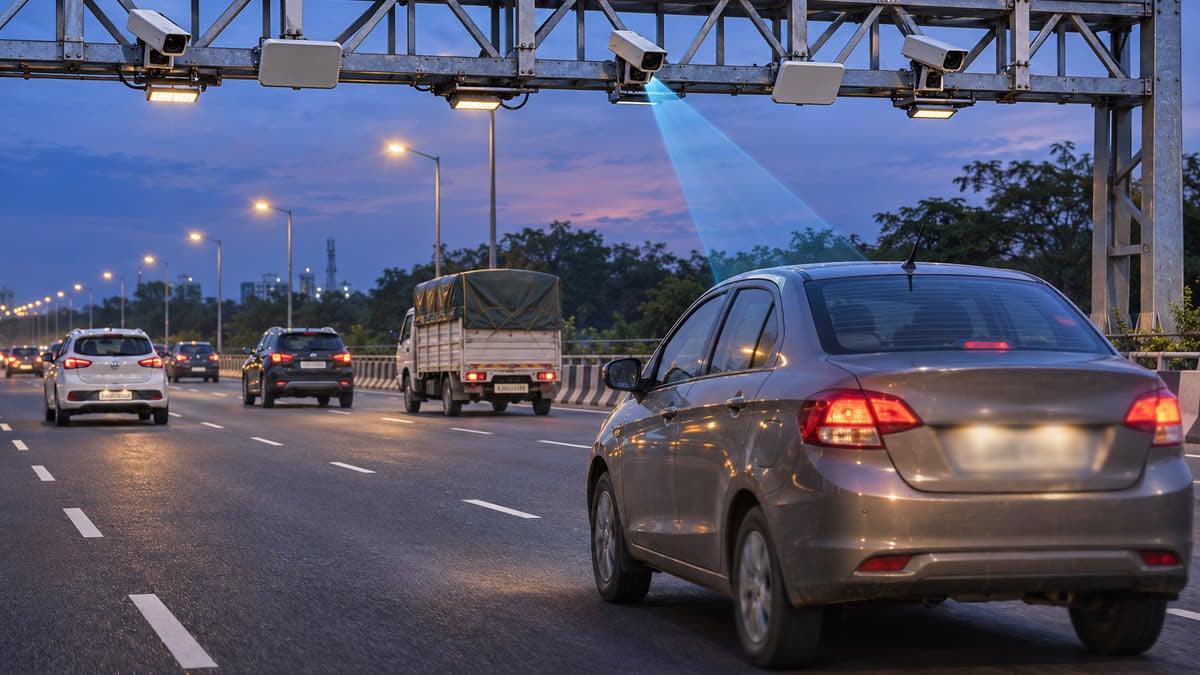
MLFF combines high-performance FASTag readers with automatic number-plate recognition (ANPR). The vehicle keeps moving under the gantry while the system tries to match the tag, the registration number and the applicable user fee. When the user fee is not received, the passage can move into the e-notice process instead of being stopped at a booth.
The 5,04,765 figure is an editorial sum of the six plaza totals in IHMCL’s official vehicle-category report. The same table also lists the amount received against e-notices, but that column should not be read as the total face value of all notices or the amount still outstanding. IHMCL says its transaction data may change after settlement, reconciliation and other operational adjustments.
| Plaza | Location | E-notices | E-notice amount received |
|---|---|---|---|
| Choryasi | Surat, Gujarat | 93,587 | ₹1,27,86,655 |
| Mundka | Dwarka, Delhi | 1,60,171 | ₹2,22,67,695 |
| Daulatpura | Jaipur, Rajasthan | 34,221 | ₹31,22,065 |
| Gharaunda | Ambala–Chandigarh | 86,844 | ₹1,14,13,570 |
| Manoharpura | Jaipur, Rajasthan | 64,406 | ₹67,07,890 |
| Shahjahanpur | Jaipur, Rajasthan | 65,536 | ₹1,38,22,855 |
| Six-plaza total | 5,04,765 | ₹7,01,20,730 | |
The table is useful for drivers because it shows that e-notices are not limited to one corridor. The plazas cover Delhi, Gujarat, Haryana and Rajasthan, and the same basic payment workflow applies wherever MLFF is operational. If you are comparing a route before a long trip, the toll-charge calculator can help estimate the toll component; it does not replace checking the tag’s live status.
Why a barrier-free toll can still create a notice
Barrier-free does not mean toll-free. A valid FASTag must be affixed to the vehicle’s windscreen and mapped to the same registration number that the camera reads. A low balance, an inactive or non-functional tag, an incorrect VRN, or a plate that cannot be read clearly can prevent the normal deduction.
The Ministry of Road Transport and Highways’ March 2026 rules amendment defines an unpaid user fee as a recorded passage for which the applicable fee was not received. It provides for an electronic notice, integration with VAHAN and a structured recovery route. The notified rule is simple for a driver: pay the original user fee within 72 hours, or twice the applicable fee becomes payable. The same 72-hour period is also the window for submitting a representation against a notice.
That is why plate and tag hygiene matters more under MLFF. The Times of India reported in May that NHAI had warned tampered, obscured or non-standard number plates could impair automated tolling and make it difficult to identify the vehicle owner. This is an enforcement and system-integrity concern; it is not a claim that every e-notice reflects deliberate evasion.
What drivers should check now
- Confirm the tag-to-vehicle match. Check that the FASTag is linked to the correct VRN and is fixed on the windscreen, not loose inside the cabin. The one-vehicle, one-tag setup matters because MLFF is matching the digital record to the vehicle on the road.
- Check the balance before a highway trip. A successful deduction depends on the tag being active and funded. Use the FASTag balance and deduction guide for the basic checks before departure.
- Use only the official e-notice portal. The NHAI/Parivahan portal lets a user log in with the VRN and an OTP linked to VAHAN. It also provides a chassis-number option when the mobile number is not updated, and a payment-status check for pending or stuck transactions.
- Watch the 72-hour clock. If the notice is genuine, paying within the window keeps the payable amount at the original applicable user fee. If the deduction already happened, save the bank or FASTag transaction reference before paying again.
- Raise a grievance promptly. An owner or driver can submit a representation through the designated portal within 72 hours. The rules provide for disposal within five days; if a representation is not disposed of within that period, the claim can lapse under the notified mechanism. For technical highway support, the official portal lists the 1033 helpline.
Fleet operators need an additional control: keep a vehicle-wise list of the registration number, issuing bank, driver and recent toll alerts. A notice sent to a company vehicle may be missed if the driver assumes that a moving gantry means the toll was automatically settled. Repeated unpaid dues can also be recorded in VAHAN and may affect vehicle-related services after the conditions in the rules are met.
What changes next
NHAI is expanding MLFF in phases, so the number of drivers encountering a gantry rather than a conventional toll lane is likely to grow. The earlier FuelPrice explainer on NHAI’s barrier-free toll design covers the wider rollout and the new-highway layout. The practical shift for users is more immediate: the driver may not see a booth, but the payment trail still follows the vehicle and its registration record.
The current data should therefore be read as a compliance signal, not as a fresh toll-rate increase. It does not change the user fee shown at a plaza. It shows why a clean plate, a correctly mapped FASTag and a quick response to an official notice are becoming part of normal highway-trip preparation.
Sources
- IHMCL — VC Wise Monthly Data for Toll Plazas on MLFF-based tolling, September 2026 — September 2026
- IHMCL — ETC Transaction Reports — updated 9 Nov 2026
- NHAI — National Highways Fee Rules, 2026 Amended to Strengthen Toll Compliance and Digital Enforcement — 18 Mar 2026
- NHAI/Parivahan — MLFF e-Notice Road User Portal — accessed 10 Nov 2026
- The Indian Express — New barrier-less tolling: 4 months on, how 10% of all vehicles are missing payments — 27 Aug 2026
- The Times of India — NHAI flags use of tampered number plates to evade toll — 18 May 2026