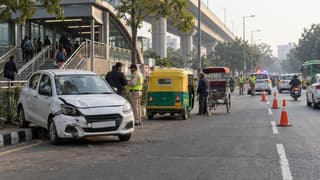
Vehicles seeking fuel in the Delhi-NCR will need a valid Pollution Under Control Certificate (PUCC) under a CAQM direction scheduled to take effect on 1 Oct 2026. District administrations in Noida and Ghaziabad are already testing checks at pumps, so drivers without a current certificate could face a refused refill or a delay at the station.
Key takeaways
- CAQM approved Draft Direction No. 101, which envisages dispensing fuel in the entire NCR only after production of a valid PUCC from 1 Oct 2026.
- Noida and Ghaziabad authorities are conducting trial checks before the planned enforcement date.
- The change affects access to fuel; it is not a petrol or diesel price revision.
- Drivers should check the PUCC expiry date, make sure the registration details match, and keep access to the certificate while travelling through the NCR.
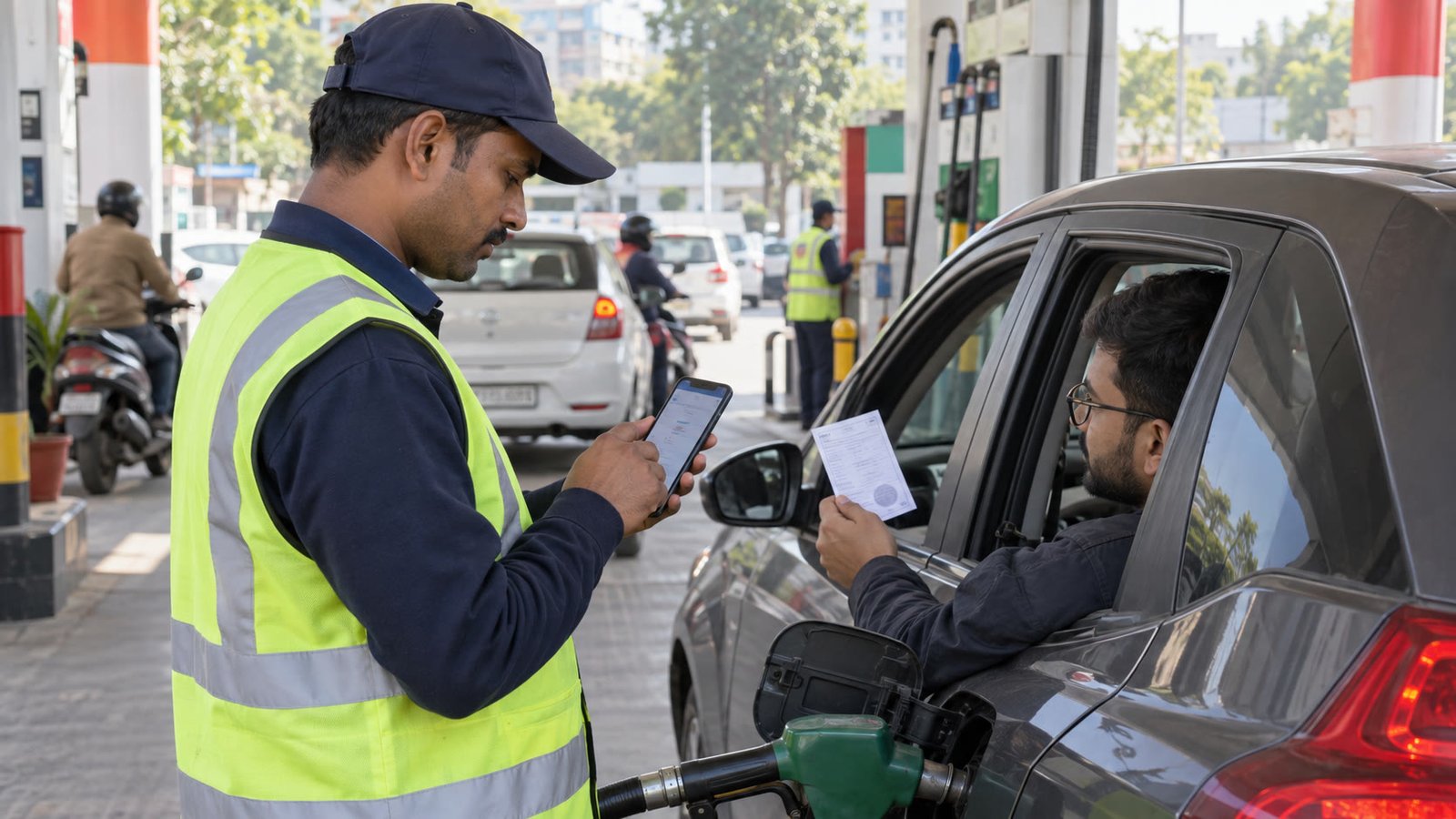
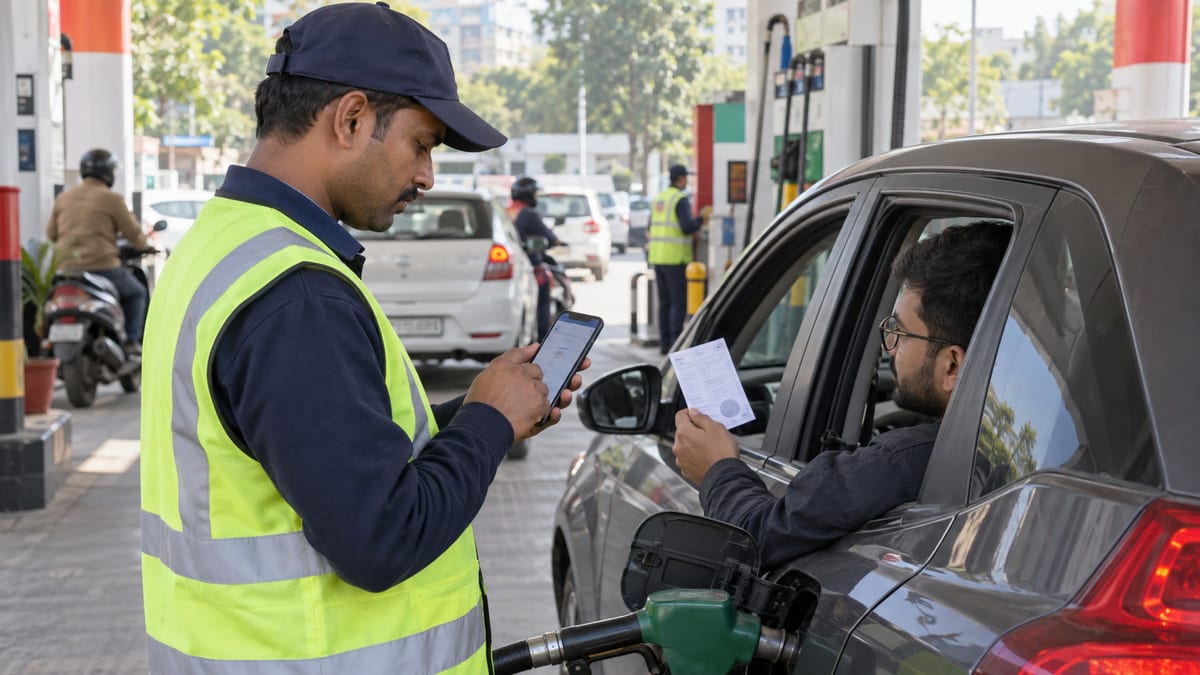 Fuel-station document check shown in an editorial illustration. Credit: FuelPrice editorial image, AI-generated; no official pump or government document is depicted.
What the NCR fuel rule changes
The Commission for Air Quality Management (CAQM) approved Draft Direction No. 101 in May under Section 12 of the CAQM Act, 2021. Its official release says the direction envisages dispensing fuel only after a valid PUCC is produced, with the measure applying across the NCR from 1 Oct 2026. CAQM says the purpose is to address vehicle emissions that contribute to PM2.5, nitrogen oxides and carbon monoxide.
This is a compliance check at the point of refuelling, not a change in the retail price of petrol, diesel or another fuel. A driver may therefore see no change in the displayed rate but still be unable to complete a refill if the vehicle's PUCC is not shown as valid in the checking system.
The official wording refers to fuelling in the NCR rather than only to vehicles registered in the region. As a practical reading of that wording, commuters entering Delhi-NCR from neighbouring states should not assume that an out-of-NCR registration will bypass the check.
Why Noida and Ghaziabad drivers are seeing checks now
The Times of India reported on 26 Sep that the Noida and Ghaziabad district administrations were preparing for the 1 Oct start. The report said fuel-station operators would have to verify certificate validity before dispensing fuel, while local commuters and pump owners had raised concerns about queues, limited pollution-testing hours and disputes during busy periods.
In a Ghaziabad trial reported by The Times of India on 23 Sep, pump staff used an app to check a vehicle registration number against PUCC records. Vehicles whose certificates were not valid were sent to a pollution-testing centre before returning to the pump. The exercise also exposed practical issues such as registration data not matching the system and delays when the server was slow.
Those reports describe local preparation and trial enforcement. They do not replace the final operating instructions that each NCR administration and fuel station may issue. Drivers should therefore treat the certificate requirement as confirmed, while treating the exact scanning, queue-management and grievance process as implementation details that may still be clarified.
Who is affected
The direct impact is on any vehicle seeking fuel at a station in the NCR when its PUCC is expired, unavailable or not recognised as valid. The Ghaziabad trial included private two-wheelers as well as cars, so a rider should not assume that the check is limited to commercial vehicles or larger cars.
Fuel-station operators are also part of the change. They may need to check a vehicle number and retrieve its pollution-certificate status before completing the sale. That creates a time and systems issue at busy pumps, especially where the nearest pollution-testing centre is not on the same premises or has different operating hours.
What drivers should check before 1 Oct
- Check the expiry date. Confirm that the PUCC remains valid for the next journey, rather than relying on a certificate that has already lapsed.
- Check the vehicle details. The registration number on the pollution record should correspond to the vehicle being driven. A mismatch can create a problem even when the owner believes the certificate was renewed.
- Keep the certificate accessible. The CAQM direction is framed around production of a valid PUCC. Keep the current record available in the form accepted by the local checking process and do not assume that an old paper receipt is enough.
- Allow time near the deadline. If a vehicle needs a fresh emissions test, a queue at a testing centre or a pump-side verification delay could affect a commute. Do not assume that every fuel station has a pollution-testing centre.
- Watch local instructions. District administrations may publish details on participating stations, technology checks and help channels. These details matter if an online record is not updated after a valid test.
What it means for fuel and travel costs
The immediate cost question is not a higher price per litre. It is the possibility of an extra stop, a short detour or lost time when a driver reaches a pump without a recognised PUCC. For a regular NCR commute, that friction can matter even when the underlying fuel rate is unchanged.
Drivers can check current rates through FuelPrice's live fuel-price pages, then use the fuel cost calculator to estimate how an additional testing-centre detour could affect a planned trip. Those calculations will not predict a queue, but they can make the time-and-fuel trade-off visible before a long drive.
Anyone planning an inter-city journey through Delhi-NCR can also review the route in the road-trip planner and identify where a fuel stop is likely to fall. The practical aim is simple: complete the document check before the vehicle is low on fuel and before a time-sensitive journey.
What to watch next
The next useful updates will be the final text and enforcement instructions for Draft Direction No. 101, the list of local pump-side systems, and the process for correcting a PUCC record that does not appear in the database. The availability and operating hours of pollution-testing centres will also determine whether the policy feels like a quick verification or an additional queue for commuters.
For now, the reader takeaway is straightforward: 1 Oct is a fuel-access compliance deadline for the NCR, not a fuel-price deadline. Check the vehicle's PUCC validity and registration details before travelling, and allow time for local verification while the administrations complete their rollout.
Sources
- Commission for Air Quality Management, “28th Full Commission Meeting” press release (15 May 2026)
- The Times of India, “A week to ‘no PUCC, no fuel’, vehicle owners in Noida and Ghaziabad fear traffic mess near pumps” (26 Sep 2026)
- The Times of India, “Trial run begins in Ghaziabad for ‘no PUCC, no fuel’ rule” (23 Sep 2026)
- NDTV India, “Noida-Ghaziabad to Gurugram-Faridabad: no PUCC, no fuel in NCR from 1 October” (22 Sep 2026)