A Hassan consumer commission has ordered a private insurer to pay ₹10 lakh on an accidental-death claim after the policyholder’s expired driving licence was cited as a reason for rejection. The reported ruling matters to Indian riders and vehicle owners because it links the licence objection to the cause of the crash, while also showing why the exact policy type and claim documents matter.
The Indian Express reported on 29 Oct 2026 that the Hassan District Consumer Disputes Redressal Commission found the fatal crash was caused by a tipper lorry driver and held the insurer’s rejection to be a deficiency in service. The order does not mean an expired licence is harmless in every insurance dispute; it is a decision on the facts and policy before that commission.
Key takeaways
- The accident happened on 6 May 2024 on the Konanur–Ramanathapura Road in Hassan district, according to the reported case.
- The policy carried an accidental-death cover of ₹10 lakh against an annual premium of ₹300, with the last two premium debits reported on 29 Dec 2022 and 27 Dec 2023.
- The commission ordered ₹10 lakh with 10% annual interest from 6 May 2024, plus ₹5,000 each for deficiency in service, mental agony and litigation costs.
- The insurer must comply within 45 days of receiving the order, as reported on 29 Oct 2026.
- The practical lesson is to check licence validity, policy wording, premium debits, nominee details and the written reason for any claim rejection.
What the Hassan commission decided
The case followed the death of a two-wheeler rider after a tipper lorry hit the vehicle from behind on 6 May 2024. Police registered a case against the lorry driver and later filed a chargesheet attributing the crash to rash and negligent driving. The commission relied on the material before it and concluded that the insured person had not contributed to the accident.
The policy had been arranged through a bank-linked account and promised the nominee ₹10 lakh if the account holder died in an accident. The reported complaint said the policyholder paid an annual premium of ₹300 through automatic deduction. The last two debits were recorded on 29 Dec 2022 and 27 Dec 2023, and the commission found that the cover was in force when the crash occurred.
The insurer argued that the deceased did not hold a valid driving licence on the accident date. It also raised objections about delayed intimation, the commission’s jurisdiction and the timing of the complaint. The commission rejected those objections, including the time-bar argument, and held that the complaint filed on 11 Feb 2026 was within two years of the 6 May 2024 accident.
The reported order directed the insurer to pay the ₹10 lakh insured amount with 10% annual interest calculated from 6 May 2024 until realisation. It also awarded ₹5,000 for deficiency in service, ₹5,000 for mental agony and ₹5,000 towards litigation costs. The compliance period was set at 45 days from receipt of the order.
Why an expired licence still needs careful reading
Driving-licence status can be relevant to a motor policy. An IRDAI-hosted standard policy wording for compulsory personal-accident cover for an owner-driver makes an effective driving licence a condition of that cover. That is a useful reminder to check the wording of the actual policy, rather than assuming that a claim decision is governed by the headline description of a product.
At the same time, the Hassan case was reported as a bank-linked accidental-death policy, and the commission’s reasoning turned on the finding that another driver caused the fatal crash. That is different from a claim for damage to the insured vehicle, a third-party motor claim or an owner-driver personal-accident section in a comprehensive motor policy. The outcome of one case should not be treated as a blanket rule that every claim survives an expired licence.
A separate Karnataka motor-accident tribunal order recorded on 3 Feb 2026 also illustrates the distinction. In Dasanna vs Go Digit General Insurance Limited, the tribunal discussed a licence breach while protecting third-party victims through a pay-and-recover approach. That was a different statutory claim and a different fact pattern, but it shows why a policyholder or family member first needs to identify whether the dispute concerns own damage, third-party liability, compulsory personal accident cover or a separate accident policy.
What riders and vehicle owners should check now
Start with the policy schedule and the certificate of insurance. The car insurance policy document guide explains where to find the insured person, period of cover, exclusions, nominee details and claim conditions. For a two-wheeler or a bank-linked accident product, the same discipline applies: keep the policy or certificate, premium record and nominee information together.
Next, separate the type of cover. The third-party and comprehensive car insurance explainer sets out why liability cover, own-damage cover and personal-accident protection answer different questions. A family may have more than one policy connected to the same accident, but each policy can have its own insured event, conditions and documents.
For a claim or dispute, retain the written rejection, policy schedule, premium-debit evidence, accident report, FIR or chargesheet where available, medical or death records, and nominee documents. The documents should be matched to the exact reason given by the insurer. If the issue is a renewal or a claim after an earlier accident, the car insurance renewal and claim checklist covers the policy details that commonly need to be compared.
How the grievance route works
IRDAI’s Bima Bharosa guidance says a policyholder should first put the grievance in writing to the insurer’s grievance-redressal officer with supporting documents and obtain an acknowledgement dated by the insurer. The regulator’s FAQ says the insurer should resolve the complaint within 15 days. If there is no satisfactory resolution within that period, the complaint can be escalated through the Bima Bharosa portal or the regulator’s grievance channel.
That route does not guarantee a payout and is not a substitute for the terms of the policy or a consumer commission’s order. It does, however, create a dated record of the rejection, documents supplied and response received. For a family dealing with a road-accident claim, that record can help distinguish a missing-document issue from a disagreement about liability or policy interpretation.
What this ruling does—and does not—change
The Hassan decision is a reported consumer-commission order, not a new nationwide motor-insurance rule. It does not automatically rewrite exclusions, licence conditions or claim procedures for every insurer. Its immediate value is narrower: where a policy is active, the accident evidence points to another driver’s negligence and the insurer relies on an expired licence, the commission may examine whether that reason actually fits the policy and the facts of the loss.
For drivers, the safest reading is practical rather than predictive. Keep the driving licence current, confirm that premiums have actually been debited or paid, check who is insured and who is nominated, and ask for a written reason if a claim is rejected. Those checks will not turn an uncovered loss into a covered one, but they can make the policy position and the dispute much clearer.
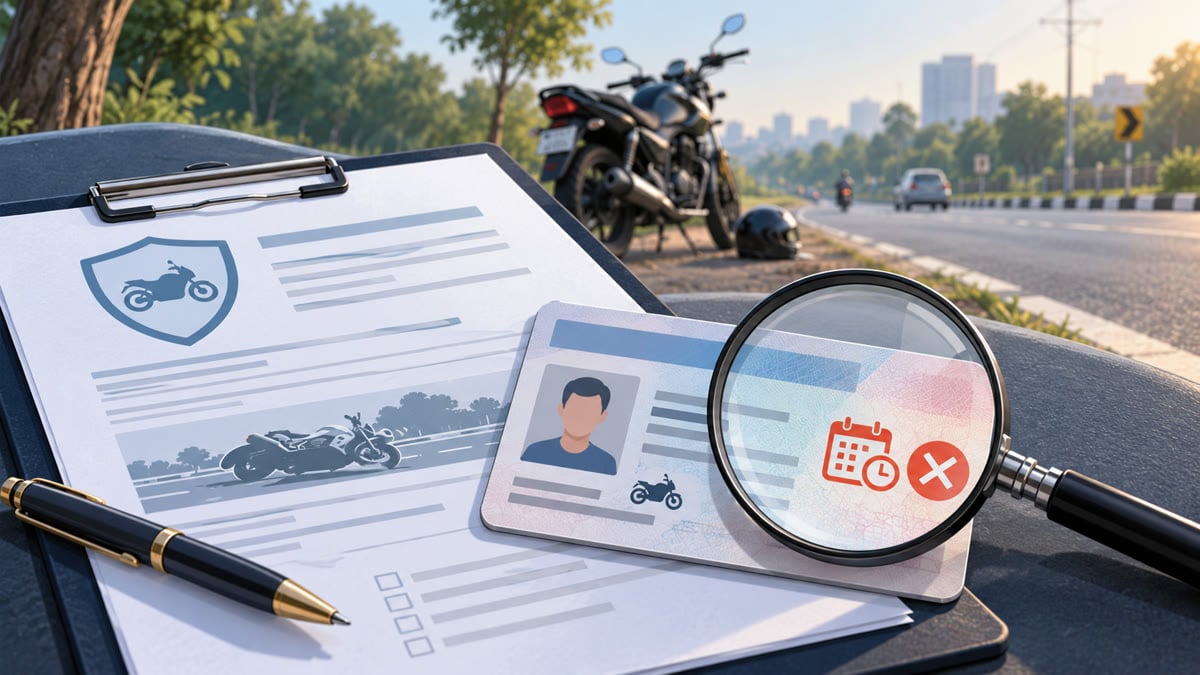
Illustration: insurance and licence checks for a road-accident claim; not a photograph of the reported Hassan case.
Sources
- The Indian Express — “Insurer rejects claim over expired licence after fatal crash, widow wins Rs 10 lakh” — 29 Oct 2026
- IRDAI — “Section III – Personal Accident Cover for Owner-Driver”, standard motor-policy wording — accessed 29 Oct 2026
- Karnataka motor-accident tribunal record — “Dasanna vs Go Digit General Insurance Limited” — 3 Feb 2026
- IRDAI Bima Bharosa — “Frequently Asked Questions: insurance grievance process” — accessed 29 Oct 2026
This article is for general information only and is not financial, insurance or legal advice.