Suzuki Motor Corporation plans to halve the time needed to develop new vehicles by 2030 and strengthen India as a manufacturing and export hub. The strategy announced on 25 Sep 2026 targets annual production capacity of about 40 lakh vehicles in India from financial year 2030 onward, but it does not announce a specific new model, price or launch date for Indian buyers.
Key takeaways
- Suzuki's 2030 target is a 50% reduction in new-vehicle development lead time.
- The company is also targeting a 30% improvement in development efficiency and a 50% improvement in manufacturing efficiency.
- India's annual production capacity is planned to rise to about 40 lakh vehicles from roughly 29 lakh currently, according to reports on the strategy briefing.
- Suzuki will continue a multi-pathway approach covering battery EVs, hybrids, petrol, CNG, flex-fuel and other lower-carbon technologies.
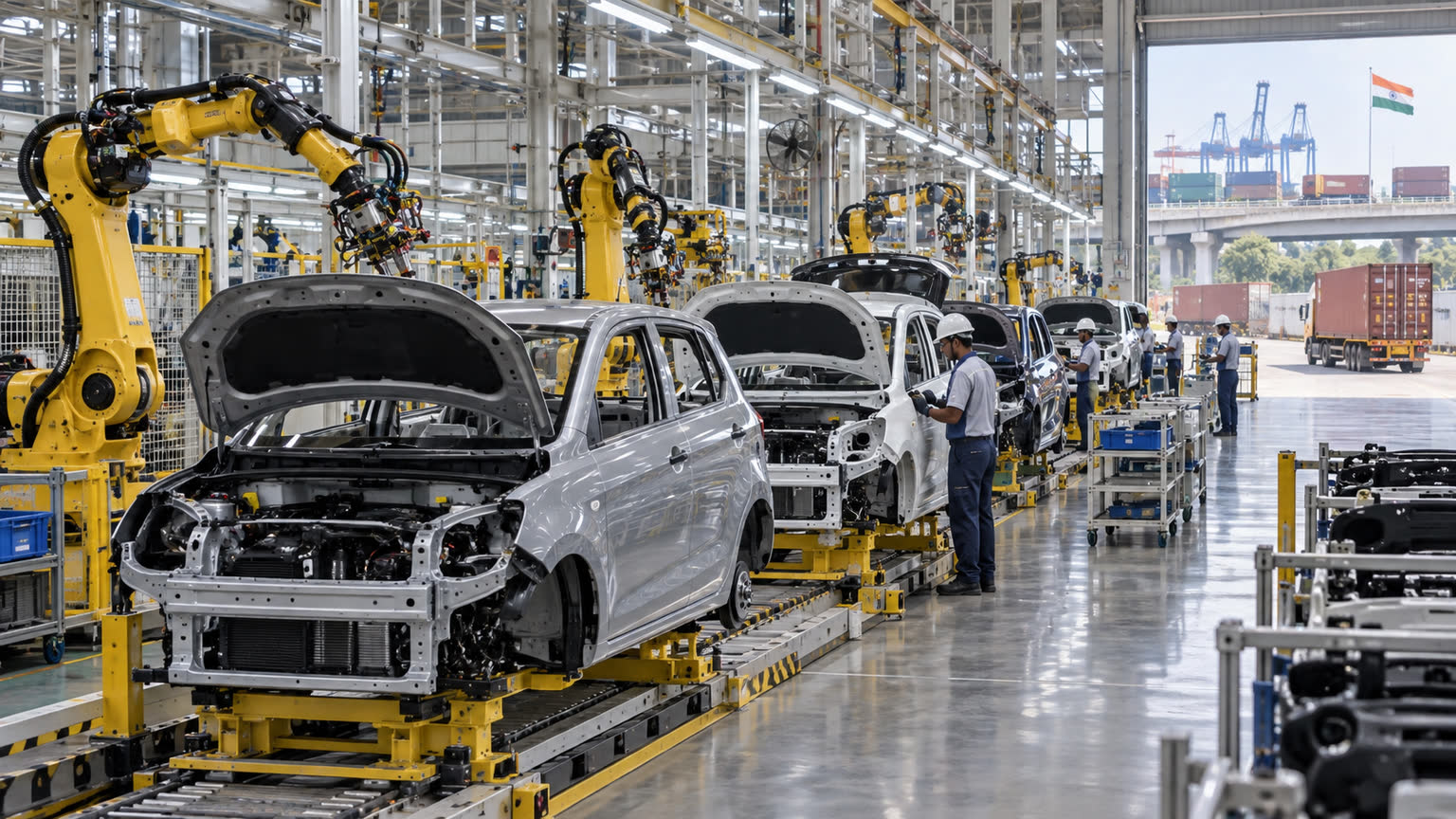
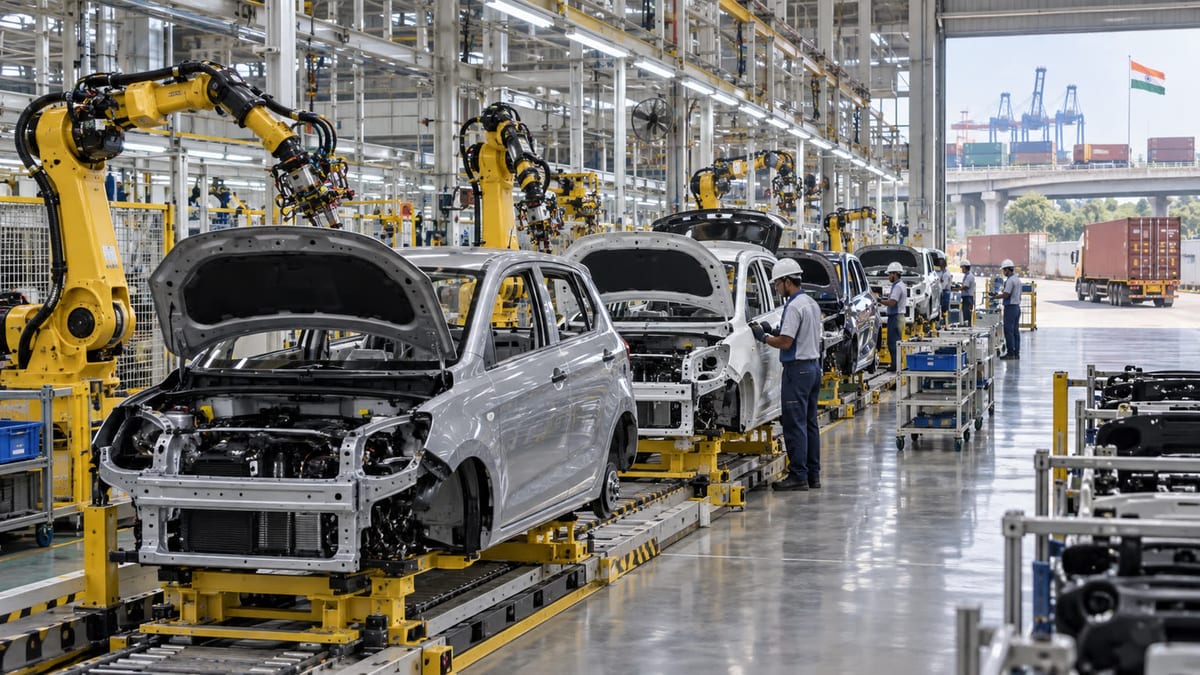 AI-generated editorial illustration by FuelPrice; a representative vehicle manufacturing and export scene, not an official Suzuki product photograph.
What Suzuki announced
In its 25 Sep 2026 Technology Strategy 2026 for 10 Years Ahead release, Suzuki said it would change the way engineering and manufacturing work together. The company is targeting a 50% cut in new-vehicle development lead time by 2030, alongside a 30% improvement in development efficiency and a 50% improvement in manufacturing efficiency.
The approach is based on concurrent development. Instead of moving through planning, design, production engineering, quality and procurement one after another, Suzuki plans to bring those teams into the programme earlier and make them work in parallel. It also plans to use more digital engineering and modularisation so that parts, processes and technologies can be shared where they fit different markets.
That is a company target, not a promise that every future model will arrive in half the current time. Suzuki has not published a model-by-model timeline or said that a particular Maruti Suzuki car will launch by a particular date because of this plan.
Why India matters to the plan
Suzuki said Japan and India will be the two main centres of its global business foundation. The official strategy release puts India's future annual production capacity at approximately 40 lakh units from financial year 2030 and beyond. Economic Times and Moneycontrol, reporting on the same briefing on 25 Sep 2026, put the current Indian installed capacity at about 29 lakh units. Reaching the target would therefore mean adding roughly 11 lakh units of annual capacity, subject to investment, plant execution and demand.
Indian plants would serve domestic buyers as well as export markets. The Indian Express reported that technologies developed in Japan will be adapted for different markets, with India playing a larger role in manufacturing and exports. For suppliers and transport operators, a larger production base can mean more component movement, factory logistics and vehicle dispatches; for buyers, it could support a wider flow of models over time.
What the multi-powertrain plan means for buyers
Suzuki is not presenting the strategy as a move from petrol vehicles to battery EVs alone. Its stated pathway includes battery EVs, hybrids, internal-combustion engines, CNG, flex-fuel and carbon-neutral-fuel technologies. The official release also names series hybrids, a new hybrid system, direct-injection turbo engines, a lightweight vehicle architecture and software-related vehicle technology as areas under development.
For Indian drivers, the practical point is that the choice of powertrain is likely to remain linked to the local mix of fuel availability, charging infrastructure, electricity generation, regulation and use patterns. A city commuter with reliable home charging, a long-distance driver and a CNG fleet operator may not need the same vehicle technology. The strategy leaves room for Suzuki and Maruti Suzuki to develop several options in parallel rather than committing every market to one solution.
The running-cost question remains separate from the technology announcement. Before comparing a future petrol, CNG, hybrid or EV model, readers can estimate a current route through the fuel cost calculator and check current rates on the live fuel prices page. EV owners can also review the state-wise EV charging directory to see how charging access fits a regular route.
Biogas and safety technology
Suzuki's India plan also includes compressed biogas. The company said its third Indian biogas plant started operations in August 2026 and that the fuel can use existing CNG vehicles and infrastructure. That does not change the fuel available to every driver today, but it shows why the company is treating CNG and biogas as part of a broader transition rather than as separate products.
Moneycontrol also reported that Suzuki plans to bring advanced driver-assistance features to affordable vehicles in India, including autonomous emergency braking and lane-departure prevention. The report noted that no specific rollout timeline was announced. Buyers should therefore treat the safety direction as a stated plan and check the equipment list and variant-specific safety features when an actual vehicle is launched.
What changes now?
Nothing changes immediately for an existing Maruti Suzuki owner or for a buyer placing an order today. There is no new Indian price list, subsidy, fuel rule or confirmed launch schedule attached to the 25 Sep announcement. The near-term watch points are plant expansion, supplier investment, the pace of new-model approvals and whether the promised hybrid, CNG, EV and safety technologies appear in products with published specifications.
For a future purchase, the useful comparison will be the complete running picture: purchase price, fuel or charging cost, expected use, service access, safety equipment and resale conditions. Suzuki's strategy may broaden the menu, but the right choice will still depend on the vehicle's confirmed specification and the driver's route.
Sources
- Suzuki Motor Corporation — “Suzuki Announces Technology Strategy 2026 for 10 Years Ahead” — 25 Sep 2026
- The Economic Times — “Suzuki to cut vehicle development time by half by 2030; India capacity target at 4 million” — 25 Sep 2026
- The Indian Express — “Suzuki to Halve Vehicle Development Time by 2030, Targets 4 Million Units Annual Production Capacity in India” — 25 Sep 2026
- Moneycontrol — “Suzuki to halve new model development time by 2030, expand India's global production role” — 25 Sep 2026
- Autocar India — “Suzuki aims to halve new model development time by 2030” — 25 Sep 2026