Uttar Pradesh has approved amendments to its 2022 tourism policy that recognise highway wayside amenities, allow budget-hotel incentives for properties with six to 49 rooms and streamline homestay approvals. For drivers, the change could eventually mean more places to stop, eat and rest on journeys through the state, although it does not announce a list of new facilities or an opening date.
Key takeaways
- Hotels with six to 49 rooms, with attached bathrooms, can qualify under the revised budget-hotel category, subject to commercial and GST registration and building rules.
- The policy recognises permitted sub-leases of government-owned land for developing highway rest stops, subject to registration, landowner consent and other conditions.
- Homestay and bed-and-breakfast provisions are aligned with Uttar Pradesh's 2025 framework, with approvals envisaged within one month through the UP Tourism portal.
- The Cabinet decision creates a policy and investment route; it does not guarantee a rest stop on any particular highway or make a new facility available immediately.
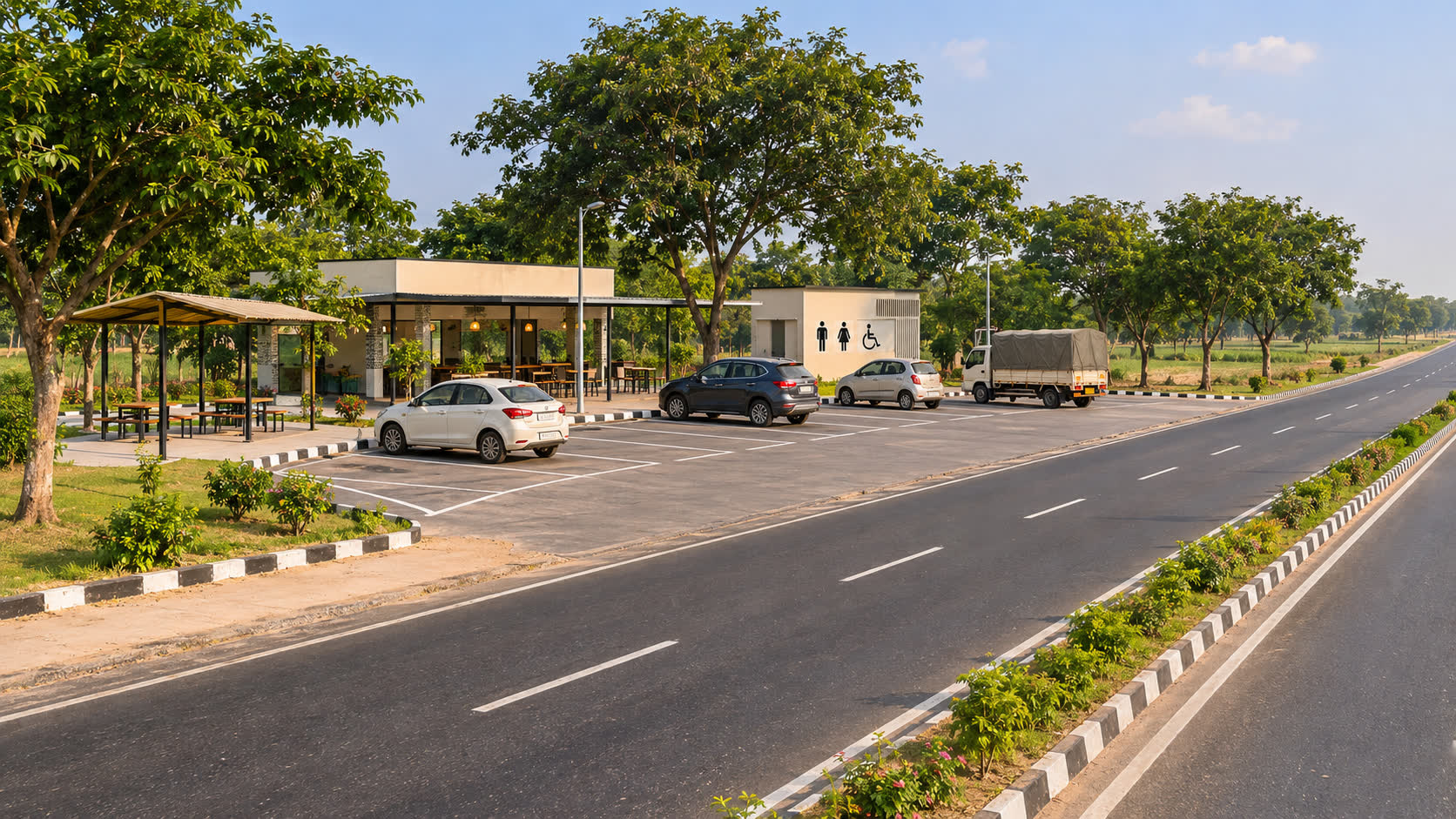
Illustrative image: a possible highway rest area, not an existing Uttar Pradesh facility.
What the Uttar Pradesh Cabinet approved
The Uttar Pradesh Information and Public Relations Department said on 18 Nov 2026 that the state Cabinet approved a proposal to amend the Uttar Pradesh Tourism Policy 2022. The official note says the changes are intended to simplify procedures, widen participation and improve tourism infrastructure, including farm stays, rural tourism, food experiences, cultural centres and wayside amenities.
For road users, the most relevant part is the policy support for facilities along highways and expressways. The amendment recognises the role of wayside amenities in transit tourism and allows permitted sub-leases of land owned by government bodies for rest-stop development. An eligible operator will still need to meet the prescribed conditions, complete registration and obtain the landowner's consent.
Smaller hotels can enter the incentive framework
Business Standard and Hindustan Times reported that the minimum room requirement for the budget-hotel category has been reduced from 10 rooms to six. The revised category covers establishments with six to 49 lettable rooms, with an attached bathroom for each room. Commercial registration, GST registration and compliance with building regulations remain part of the conditions.
This matters to travellers because smaller properties may be able to seek tourism-policy benefits in places where a large hotel project would not be viable. It may also support more accommodation near smaller towns, heritage routes and rural destinations. The policy does not set room prices, promise a particular standard of service or require travellers to use any property. Availability, safety, parking, food and operating hours will still need to be checked at the individual facility.
What the rest-stop provision actually does
The rest-stop change is an enabling measure rather than a construction announcement. It makes certain government-owned land arrangements easier to use for highway amenities, but the official Cabinet note does not name specific highways, locations or opening dates. The media reports also describe eligibility and incentives, not a completed network of new stops.
The stamp-duty benefit has an important limit: it is available only once for an eligible transaction. If an original lessee has already used that benefit, a sub-lessee cannot claim it again. That condition is relevant to operators and landowners, but it does not create a new toll, fee or payment obligation for a passing driver.
What this means for drivers and road-trip planners
In the near term, a driver should treat the amendment as a possible supply change, not as proof that a new rest area is open. Existing fuel stations, eateries and designated stops remain the practical basis for planning. A new facility will help only after it is built, registered and operating with dependable parking, toilets, food and access arrangements.
For a long drive, use the FuelPrice road-trip planner to map the journey and identify where a break is needed. Then use the fuel-cost calculator to account for the planned route and any detours. If the trip crosses tolled corridors, the toll-charge calculator can keep the road budget separate from accommodation and food costs. Drivers carrying vehicle papers can also review the road-trip document checklist before leaving.
Families, fleet operators and local businesses
Families may benefit from more choices for scheduled breaks if the policy attracts small hotels and rest-stop operators to busy routes. For fleet and transport operators, dependable stopping points can make trip planning more predictable, but the policy itself does not promise truck parking capacity, secure overnight parking or commercial-vehicle services. Those details will depend on project approvals and the facility's operating model.
For local businesses, the change connects roadside spending with rural tourism, regional food, handicrafts and farm visits. That could spread travel demand beyond large tourist centres, while the state says its focus-destination and circuit approach is intended to guide investment. These are expected effects of the policy, not measured outcomes already delivered.
What to check before relying on a new stop
- Confirm that the facility is open on the date and time of travel; Cabinet approval alone is not an operating certificate.
- Check whether access is available from the direction of travel and whether a safe re-entry to the highway is provided.
- Look for verified information on toilets, parking, food, lighting and emergency assistance rather than relying only on a promotional listing.
- Keep an existing fuel and break plan as a fallback until the new facility has a reliable operating record.
What to watch next
The next useful update will be implementation detail from the Uttar Pradesh Tourism Department: the registration route, eligible project categories, incentive conditions and the locations that receive approvals. The UP Tourism portal already provides policy and registration information for tourism units, but travellers should wait for a facility-specific listing before treating a planned rest stop as part of a route.
The policy therefore has a clear long-term road-trip angle, but its immediate result is administrative. It widens the route for smaller accommodation providers and wayside-amenity investors; the benefit to drivers will arrive only as approved projects become visible, accessible and consistently operational.
Sources
- Uttar Pradesh Information and Public Relations Department — Cabinet's important decisions, 18 Nov 2026
- Business Standard — UP amends tourism policy to promote budget hotels, homestays and rest stops, 20 Nov 2026
- Hindustan Times — UP cabinet decision: Tourism policy expands incentives to six-room hotels, farm stays, 19 Nov 2026
- Department of Tourism, Government of Uttar Pradesh — tourism policy and registration portal, accessed 20 Nov 2026